You are wrapping up a crucial project proposal, a research paper, or a high stakes email to your department head. You scan your draft and realize you have typed “according to the data,” “according to the report,” and “according to our team” all within three paragraphs. It reads mechanically.
The rhythmic repetition drains the energy right out of your prose, making your writing sound rigid and flat.
When we rely on a single transitional phrase over and over, we fail to capture the subtle nuances of our sources. Are you referencing a strict legal mandate, or are you gently aligning with a colleague’s casual suggestion?
Using the exact same word for both scenarios does a disservice to your communication skills. Expanding your vocabulary enhancement toolkit allows you to match your phrasing to the precise weight, tone, and authority of your information source, instantly injecting life and professional polish into your writing improvement journey.
What is Another Word for “According”?
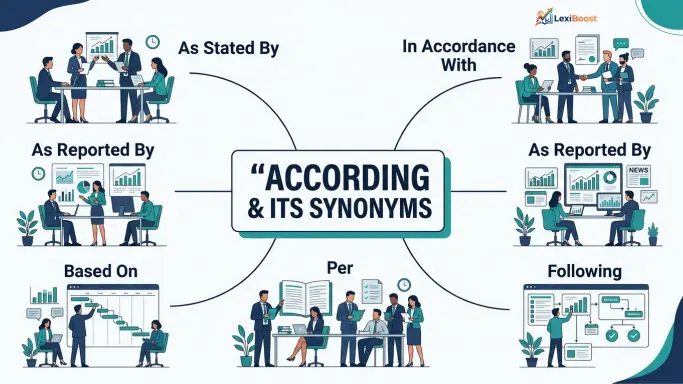
The most common, direct synonym for “according” (specifically when used as “according to“) is as stated by.
Depending on your specific context, here are four strong, versatile alternatives:
- Per: Ideal for concise, professional, or technical references (e.g., per your instructions).
- In line with: Best for showing agreement with a philosophy, rule, or trend.
- Consistent with: Excellent for data analysis and scientific reporting where facts match a hypothesis.
- As reported by: Perfect for media, journalism, or secondary sources.
Quick Reference: 30 Alternatives to “According”
| Synonym | One Line Meaning |
| Per | By means of, or in accordance with a specific source. |
| Consistent with | In agreement or harmony with facts or patterns. |
| In line with | Conforming to a particular direction, rule, or policy. |
| As stated by | Repeating exactly what a specific authority has declared. |
| Pursuant to | Carrying out or following a legal law, rule, or formal request. |
| In accordance with | Obeying or adhering to a rule, wish, or specific law. |
| By | Indicating the author, creator, or source of an idea. |
| Under | Regulated or governed by a specific rule or agreement. |
| As claimed by | Attributing an unverified assertion to a specific source. |
| As reported by | Relaying information initially gathered by a news or research source. |
| In the words of | Directly citing someone’s specific phrased expression. |
| Congruent with | Identical in character, shape, or underlying logic. |
| Commensurate with | Corresponding perfectly in size, degree, or proportion. |
| Akin to | Sharing a similar nature, character, or properties. |
| In compliance with | Meeting the strict requirements of a rule or regulation. |
| By virtue of | On the grounds of or because of a specific authority. |
| In harmony with | Agreeing perfectly in spirit, tone, or overall sentiment. |
| As noted by | Drawing attention to a specific observation made by an expert. |
| As maintained by | Backing a continuous argument held by a specific theorist. |
| Conforming to | Matching established standards, patterns, or behaviors. |
| Based on | Using a specific data set or story as a foundation. |
| In agreement with | Holding the same view or opinion as another party. |
| Judging by | Making an assessment based on visible evidence or sources. |
| Adhering to | Following a guideline or belief system without straying. |
| According as | Depending on if a certain condition is fully met. |
| In the light of | Drawing conclusions by taking new information into account. |
| Matching | Being equal to or corresponding closely with a standard. |
| True to | Remaining loyal or accurate to a specific concept or promise. |
| Governed by | Controlled or directed strictly by a rule or authority. |
| As outlined by | Following a structured plan or summary provided by someone. |
30 Detailed Synonyms for “According”
1. Per
- Meaning: In accordance with; by means of.
- Explanation: Per is an incredibly snappy, efficient preposition. It is heavily favored in corporate, legal, and technical environments because it strips away verbal clutter. While some style guides warn against overusing it in purely literary essays, it is standard practice in business communication skills. Use it when you are directly following orders, referencing a specific line item in a contract, or executing a repeatable process. It sounds objective and leaves no room for creative interpretation.
- Examples:
- The software update was deployed last night per the system administrator’s schedule.
- Per our previous conversation, I am attaching the updated project invoice.
2. Consistent with
- Meaning: In agreement or harmony with.
- Explanation: This phrase carries a heavy analytical weight. It is perfect for research papers, scientific reporting, and data analysis. Instead of just saying “according to the data,” using consistent with implies that multiple pieces of evidence line up beautifully without contradiction. It is highly formal, objective, and suggests systematic verification rather than a simple hearsay report.
- Examples:
- The Q3 revenue growth is entirely consistent with our long term market projections.
- Her testimony was consistent with the physical evidence found at the scene.
3. In line with
- Meaning: Conforming to or in agreement with.
- Explanation: In line with is a versatile, mid to high formality phrase that works well in both corporate and academic settings. It evokes a visual image of items arranged in a straight file. Use this when you want to show that an action, strategy, or idea perfectly respects an established boundary, corporate philosophy, or cultural trend.
- Examples:
- Our team developed a new marketing strategy in line with the company’s rebranding goals.
- The school’s new safety policy is in line with national educational standards.
4. As stated by
- Meaning: Directly declared or expressed by someone.
- Explanation: This is a literal, direct alternative to “according to.” It is neutral, professional, and attributes information cleanly to its source without adding extra emotional baggage. It works beautifully in academic writing, journalistic reporting, and formal presentations where attribution clarity is your top priority.
- Examples:
- As stated by the World Health Organization, clean water access is a fundamental human right.
- The economy is on a steady mend, as stated by the chief financial analyst during the summit.
5. Pursuant to
- Meaning: In accordance with or in execution of a legal rule or request.
- Explanation: This is a hyper formal, legal term. You should avoid it in casual conversations or light emails, but absolutely deploy it when writing contracts, formal legal notices, or highly structured corporate compliance documents. It implies a binding obligation or a formal action taken because a law or regulation explicitly commands it.
- Examples:
- Pursuant to Article 4 of the lease agreement, tenants must provide a 30 day move out notice.
- The regulatory body launched an audit pursuant to the newly passed consumer safety act.
6. In accordance with
- Meaning: In a manner that conforms with a rule, law, or wish.
- Explanation: This phrase is formal, authoritative, and traditional. It is slightly more elegant than a simple “according to.” Use this when you want to emphasize strict adherence to rules, regulations, protocols, or a person’s explicit final wishes. It sounds incredibly deliberate and respectful of authority.
- Examples:
- The funds were distributed in accordance with the late grandfather’s will.
- All chemical waste must be disposed of in accordance with environmental safety protocols.
7. By
- Meaning: Indicating the author or source.
- Explanation: Do not overlook the power of simple monosyllabic words for expressive writing. By is direct and informal to neutral. While “according to the book” focuses on the text, saying “a book by…” shifts focus to the creator. It simplifies sentences, cutting out corporate speak.
- Examples:
- The revolutionary economic theory proposed by John Maynard Keynes reshaped modern fiscal policy.
- The guidelines laid out by our committee must be followed.
8. Under
- Meaning: Subject to the authority, control, or guidance of.
- Explanation: Under works best when you want to show that an action is governed, protected, or restricted by a specific framework, contract, or supervisor. It sets a clear hierarchy, establishing that the source dictates the terms of whatever is happening underneath it.
- Examples:
- Under the current organizational guidelines, freelance writers must submit work weekly.
- The research program was conducted under the strict supervision of the ethics board.
9. As claimed by
- Meaning: Declared as a fact, though potentially unproven.
- Explanation: This phrase introduces a healthy dose of academic skepticism or journalistic objectivity. When you use as claimed by, you are attributing the statement to a source while subtly signaling to the reader that the claim hasn’t been definitively proven yet. It keeps your writing balanced and guarded.
- Examples:
- The smartphone’s battery can last for three full days, as claimed by the manufacturer’s ads.
- As claimed by the local residents, the intersection has always been highly hazardous.
10. As reported by
- Meaning: Information relayed through a formal broadcast, publication, or document.
- Explanation: This is a cornerstone phrase for journalism, research essays, and market analysis. It implies that the information went through an official reporting channel (like a study, a news agency, or an investigation team). It adds an layer of institutional credibility to your source attribution.
- Examples:
- Global temperatures rose slightly last year, as reported by NASA’s climate monitoring satellite network.
- As reported by the morning news, the highway construction project will face a two month delay.
11. In the words of
- Meaning: Citing the exact phrase or philosophical stance of an individual.
- Explanation: This alternative adds a literary, engaging touch to your prose. It is conversational yet deeply respectful. Use this when you are about to introduce a direct quote or a deeply personal insight from an authoritative figure, philosopher, or historic personality.
- Examples:
- In the words of Albert Einstein, “Creativity is intelligence having fun.”
- We must act decisively now, in the words of our founding director.
12. Congruent with
- Meaning: In agreement, harmony, or correspondence with something.
- Explanation: Rooted in geometry and mathematics, congruent with is highly formal and academic. It suggests a perfect, logical, geometric like fit between two ideas, behaviors, or values. It goes beyond simple agreement; it implies that the two concepts map over each other perfectly.
- Examples:
- The CEO’s daily actions are completely congruent with the company’s stated ethical mission statement.
- These fossil discoveries are entirely congruent with established evolutionary timelines.
13. Commensurate with
- Meaning: Corresponding in size, degree, or proportion.
- Explanation: This formal, sophisticated phrase is used almost exclusively when discussing scales, compensation, values, risks, or efforts. It indicates that one element changes, scales, or matches perfectly relative to another standard source.
- Examples:
- Your starting salary will be directly commensurate with your professional experience and education level.
- The legal punishment must be commensurate with the severity of the committed crime.
14. Akin to
- Meaning: Similar in character, spirit, or nature.
- Explanation: Akin to means “related by blood” or “sharing a family resemblance.” In writing, it acts as a descriptive, comparative bridge. Use it when you want to show that a concept, behavior, or rule operates similarly to another, creating an elegant comparison.
- Examples:
- Managing an office full of stressed software developers is akin to herding cats.
- His architectural style is akin to the minimalist movements of northern Europe.
15. In compliance with
- Meaning: Conforming to or obeying a regulation, order, or law.
- Explanation: This is an explicit corporate and regulatory term. It leaves no room for creative freedom. It signals to the reader that a specific action was performed strictly because a regulatory authority required it to avoid penalties or legal trouble.
- Examples:
- Our manufacturing plant operates in compliance with all federal environmental emissions regulations.
- The bank updated its software in compliance with international data security guidelines.
16. By virtue of
- Meaning: Because of or based on the authority of.
- Explanation: A powerful, formal rhetorical tool. It explains that something is true, permitted, or executed specifically because of a unique power, position, or inherent quality possessed by the source. It answers “why” and “according to what authority” simultaneously.
- Examples:
- By virtue of her position as Chief Executive Officer, she holds the final veto power over acquisitions.
- The court held that the contract was invalid by virtue of the original fraud.
17. In harmony with
- Meaning: In smooth, peaceful agreement or consistency.
- Explanation: This phrase brings a pleasant, artistic, or collaborative tone to your sentence. It suggests that two elements do not clash or fight; instead, they blend beautifully. It is wonderful for design, philosophy, environmental writing, or teamwork discussions.
- Examples:
- The new waterfront building was designed to sit in harmony with the surrounding natural cliffs.
- Our department’s goals are in harmony with the broader cooperative community spirit.
18. As noted by
- Meaning: Pointed out or observed by a source.
- Explanation: This is a polite, intellectual way to draw an expert’s observation into your text. It doesn’t sound as heavy as “as argued by”; instead, it suggests that an intelligent observer made a sharp note of a fact, and you are simply bringing it to light for your readers.
- Examples:
- As noted by the lead researcher, the study sample was limited to urban households.
- The project is falling behind schedule, as noted by the scrum master in today’s standup.
19. As maintained by
- Meaning: Strongly asserted, argued, or defended over time by a source.
- Explanation: Use this when your source is actively defending an intellectual stance, theory, or controversial opinion against critics. It implies that the source hasn’t just stated a fact once; they have consistently stood by this viewpoint over time.
- Examples:
- As maintained by early classical economists, free markets naturally tend toward long term equilibrium.
- The defendant is completely innocent of all charges, as maintained by his defense attorneys.
20. Conforming to
- Meaning: Adapting to or matching established standards or behaviors.
- Explanation: This phrase focuses heavily on adherence to a mold, shape, or rigid expectation. It is neutral to formal and works excellently when discussing manufacturing specifications, social expectations, or code architectures.
- Examples:
- All incoming steel shipments must be processed conforming to strict ISO safety metrics.
- Children often face intense peer pressure conforming to popular societal trends at school.
21. Based on
- Meaning: Founded upon or derived from a specific source.
- Explanation: An absolute workhorse of the English vocabulary. It is simple, clear, and universally understood. It shifts the focus from simple attribution to deep foundation. It shows that your entire line of reasoning, data, or creative choice was built directly upon a specific core text or finding.
- Examples:
- The screenplay for the award winning movie was based on a series of obscure historical journals.
- Based on our customer surveys, we need to redesign our mobile application’s checkout pipeline.
22. In agreement with
- Meaning: Sharing the same view, opinion, or factual alignment.
- Explanation: This alternative emphasizes a unified front. It shows that your conclusion or source matches another authority smoothly. It is highly collaborative and serves as an excellent transitional phrase in comparative essays or debate roundups.
- Examples:
- Our legal council is in agreement with the external auditors regarding the tax restructuring.
- In agreement with current scientific consensus, the report urges immediate carbon reduction strategies.
23. Judging by
- Meaning: Making a logical inference based on apparent evidence.
- Explanation: This phrase feels conversational, intuitive, and human. It works brilliantly when you are deducing a reality from visible signs, clues, or a casual observation rather than reading from a formal rulebook.
- Examples:
- Judging by the dark storm clouds gathering on the horizon, our afternoon baseball game will be canceled.
- Judging by his recent LinkedIn posts, he is looking to make a major career pivot very soon.
24. Adhering to
- Meaning: Sticking firmly to a rule, contract, or moral philosophy.
- Explanation: Adhering to brings an emotional undertone of discipline, loyalty, or unyielding obedience. It implies that straying from the source would compromise your integrity or safety. It is stronger than simple conformity; it implies an active, conscious effort to stay glued to a standard.
- Examples:
- By strictly adhering to a rigorous, low glycemic diet, he managed to reverse his pre diabetic indicators.
- Adhering to our core company values means putting customer privacy above short term advertising profits.
25. According as
- Meaning: Depending on if; in proportion as.
- Explanation: This is a distinct, slightly archaic grammatical construction. It doesn’t mean “according to a person.” Instead, it means that an outcome will change dynamically depending on how a specific condition unfolds. Use it sparingly to add variety to conditional logic strings.
- Examples:
- The final price of the customized software suite will vary according as you select basic or premium modules.
- Men succeed or fail in life according as they develop self discipline early on.
26. In the light of
- Meaning: Drawing a fresh conclusion by taking new evidence into consideration.
- Explanation: A beautiful, intellectually dynamic phrase. It visually suggests illuminating an old problem with a new lamp. Use this when a fresh piece of data, a recent event, or a new source forces you to re evaluate your current actions or beliefs.
- Examples:
- In the light of the recent data breach, our corporate leadership has authorized an immediate security budget double.
- The board decided to rewrite the employee handbook in the light of shifting modern remote work trends.
27. Matching
- Meaning: Corresponding with or being equal to a source standard.
- Explanation: This is a clean, visually descriptive word choice. It works wonderfully when you are verifying that real world results or physical specifications match up seamlessly with an expected blueprint, description, or reference model.
- Examples:
- The color of the newly printed brochures is perfectly matching the digital brand kit guidelines.
- We need to find a candidate with language skills matching our international client demographic.
28. True to
- Meaning: Remaining faithful, accurate, or loyal to an original concept.
- Explanation: This phrase carries an admirable emotional tone of loyalty and authenticity. It is highly effective in biographical writing, artistic critiques, brand management, or when discussing personal honor and staying aligned with a promise.
- Examples:
- True to his campaign promises, the newly elected mayor slashed local property taxes during his first week in office.
- The film adaptation remained remarkably true to the dense, dark atmosphere of the original fantasy novel.
29. Governed by
- Meaning: Controlled, directed, or strictly limited by a source authority.
- Explanation: This phrase strips away all casual freedom. It indicates that the source has absolute structural power over the situation. It is an excellent choice for legal writing, physical science documentation, and deeply institutional corporate governance texts.
- Examples:
- The physical behavior of subatomic particles is strictly governed by the complex laws of quantum mechanics.
- Our international shipping operations are tightly governed by maritime laws and trade tariffs.
30. As outlined by
- Meaning: Following a structured summary, plan, or sketch provided by a source.
- Explanation: This alternative suggests order, planning, and structure. When you say as outlined by, you give your reader the impression that the source didn’t just throw out a random idea they provided a methodical blueprint, checklist, or clear map that you are now faithfully following.
- Examples:
- We will execute the software migration phases exactly as outlined by the technical architect in the master plan.
- As outlined by the syllabus, final projects must be uploaded to the student portal before midnight on Friday.
Formal vs. Informal Synonyms
Choosing the wrong word tone can alienate your audience. To sharpen your communication skills, divide your alternatives into clear linguistic boxes based on your venue:
Formal/Academic Venues
- Pursuant to (Contracts, legal actions)
- In accordance with (Protocols, corporate compliance)
- Congruent with (Scientific data, academic theories)
- As maintained by (Scholarly arguments, historic perspectives)
Informal/Conversational Venues
- Judging by (Casual deductions)
- By (Quick text attributions)
- In the words of (Relatable storytelling, quoting a friend)
- True to (Describing personal actions or traits)
Frequently Asked Questions
Can I use “per” and “according to” interchangeably in academic writing?
While they share meanings, “according to” is preferred in academic prose. “Per” can sound overly transactional or corporate, making it better suited for business memos, invoices, and technical documentation rather than scholarly essays.
Is “pursuant to” too formal for regular business emails?
Yes. “Pursuant to” is a legalistic phrase. Unless you are attaching a formal contract or addressing a serious compliance dispute, stick to warmer, professional alternatives like “in line with” or “per our agreement.“
How do “as claimed by” and “according to” differ in tone?
“According to” is entirely neutral. “As claimed by” introduces a subtle layer of skepticism, suggesting that the source’s statement is an unverified assertion or an opinion rather than an established, undeniable objective fact.
What is the shortest professional alternative to “according to”?
The shortest alternative is “per” (three letters) or “by” (two letters). Both effectively trim sentence clutter in corporate updates, project management boards, and brief daily communication channels.
Can “in line with” replace “according to” in data analysis?
Absolutely. “In line with” is excellent for data analysis because it beautifully illustrates alignment between real world findings and an initial hypothesis, corporate expectation, or historical trend.
Conclusion
Mastering vocabulary variety is one of the fastest, most effective ways to supercharge your expressive writing and overall communication skills. When you consciously eliminate repetitive linguistic crutches like “according to,” you force yourself to analyze the true relationship between your writing and your sources.
Every single synonym explored in this guide carries its own unique weight, texture, and professional authority. By swapping out lazy repetitions for precise alternatives like consistent with, pursuant to, or as noted by, you immediately clarify your arguments and keep your readers actively engaged from your opening sentence down to your final bullet point.
Do not let your hard earned insights get buried under predictable, monotonous phrasing. Treat your vocabulary as an evolving, dynamic toolkit.
The next time you sit down to draft an important email, a research article, or a business proposal, challenge yourself to audit your text for repetitiveness.
Step out of your linguistic comfort zone, choose your synonyms intentionally, and watch your writing transformation take flight.

I’m Elaris Vane, a vocabulary enthusiast and English language writer at LexiBoost, where I help readers discover smarter and more natural ways to use English words. I enjoy simplifying complex vocabulary, explaining synonyms and antonyms, and breaking down confusing word differences into easy explanations.