Have you ever found yourself using the word “concept” repeatedly while writing an essay, blog post, or presentation? Repeating the same word can make your writing sound dull and less engaging.
Whether you’re explaining a new idea, discussing a theory, or sharing a creative plan, choosing the right alternative can make your message clearer and more interesting. Learning different synonyms for “concept” helps improve your vocabulary, strengthens your writing, and allows you to communicate with confidence.
In this guide, you’ll discover 50 useful alternatives, along with their meanings and examples, to help you use the perfect word in every situation.
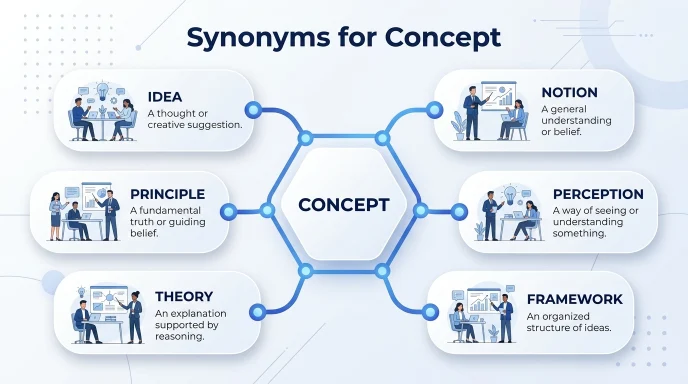
50 Synonyms for Concept At A Glance
| Synonym | Simple Meaning |
| 1. Idea | A thought, plan, or picture formed in the mind. |
| 2. Notion | A vague belief or understanding about something. |
| 3. Thought | An opinion, idea, or plan produced by thinking. |
| 4. Theory | A formal idea that explains how something works. |
| 5. Principle | A basic truth, rule, or law that guides behavior. |
| 6. View | A personal opinion or way of looking at a situation. |
| 7. Impression | A general feeling or idea left in your mind. |
| 8. Hypothesis | A smart guess that you test to see if it is true. |
| 9. Belief | A strong feeling that something is real and true. |
| 10. Conception | The specific way you imagine or understand an idea. |
| 11. Plan | A set of steps made to achieve a future goal. |
| 12. Suggestion | An idea put forward for other people to consider. |
| 13. Understanding | The ability to look at something and know its meaning. |
| 14. Abstraction | A general idea that does not belong to a physical object. |
| 15. Opinion | A personal belief that is not based on proven facts. |
| 16. Picture | A clear mental image of a situation or event. |
| 17. Design | A drawing or plan that shows how to make something. |
| 18. Scheme | A large, organized plan for doing or getting something. |
| 19. Perception | The way you notice and understand things using your senses. |
| 20. Angle | A specific way of approaching or thinking about a problem. |
| 21. Sentiment | A general feeling or attitude toward a specific topic. |
| 22. Brainstorm | A sudden, bright idea that solves a tricky problem. |
| 23. Framework | A basic structure that supports a larger system or idea. |
| 24. Outlook | Your general attitude or way of looking at life. |
| 25. Strategy | A detailed plan of action to achieve success. |
| 26. Vision | A clear, exciting picture of what the future could look like. |
| 27. Doctrine | A set of beliefs taught by a church or political group. |
| 28. Proposal | A formal plan presented to a group for approval. |
| 29. Supposition | An idea that you think is true without any proof. |
| 30. Theme | The main topic or core message in a book or talk. |
| 31. Blueprint | A detailed photographic print or plan used for building. |
| 32. Guess | An answer or opinion you make without sure facts. |
| 33. Interpretation | An explanation of the specific meaning of something. |
| 34. Conviction | A very strong, deep belief that you hold tightly. |
| 35. Assumption | A thing that you accept as true without checking it. |
| 36. Intent | A clear purpose, goal, or aim in your mind. |
| 37. Core | The most central and basic part of any idea. |
| 38. Philosophy | A set of basic theories about real life and knowledge. |
| 39. Paradigm | A standard model, pattern, or example of something. |
| 40. Definition | The exact meaning of a word, phrase, or thought. |
| 41. Outline | A short summary that shows the main parts of an idea. |
| 42. Sketch | A quick, rough drawing or brief outline of a plan. |
| 43. Model | A simple example or small copy that explains a system. |
| 44. Clue | A piece of information that helps you understand an idea. |
| 45. Premise | A statement that you use to support a final conclusion. |
| 46. Sentiment | A feeling, emotion, or opinion about a certain event. |
| 47. Insight | A sudden, deep understanding of a complicated issue. |
| 48. Judgment | An opinion or conclusion formed after thinking carefully. |
| 49. Ideology | A system of strong ideas and ideals that guide people. |
| 50. Project | A big piece of planned work that finishes a specific goal. |
50 Synonyms for Concept Explained
Idea
Meaning:
This word refers to a fresh thought, a new plan, or a picture that you form in your head. It is the most common way to talk about a spark of creativity.
Examples:
- I have a great idea for a new family game we can play tonight.
- She wrote down her best idea in a small notebook.
Notion
Meaning:
This means a quick, vague belief or a slight understanding about how something works. It is an idea that is not fully figured out yet.
Examples:
- He had a silly notion that cats could fly if they tried hard.
- I only have a small notion of how the machine operates.
Thought
Meaning:
This is an opinion, an intention, or an idea that comes directly from your active brain. It is the result of sitting down and thinking carefully.
Examples:
- A sudden thought made him stop walking and look back.
- Thank you for sharing your kind thought about my school work.
Theory
Meaning:
This is a formal, smart idea that tries to explain exactly how or why something happens. It is usually backed by study or science.
Examples:
- The teacher explained the basic theory of gravity to the children.
- I have a funny theory about why our dog hates rain.
Principle
Meaning:
This means a core truth, a steady rule, or a law that guides how people choose to act. It forms the base of a system.
Examples:
- Honesty is the most important principle in our classroom.
- He refuses to steal because it goes against his values.
View
Meaning:
This is a personal opinion or a specific way of looking at a tricky situation. It depends entirely on your own eyes.
Examples:
- In my view, winter is much better than hot summer.
- The two friends hold a very different view on sports.
Impression
Meaning:
This is a general feeling or a quick idea left in your mind after meeting someone. It happens fast and might change later.
Examples:
- The new student made a very polite impression on the teacher.
- I got the impression that she was happy with her gift.
Hypothesis
Meaning:
This is a smart guess or an idea that you want to test out in a science lab. It needs proof to become real.
Examples:
- The scientists wrote down a hypothesis before starting the test.
- Your hypothesis makes a lot of sense, so let us check it.
Belief
Meaning:
This is a strong, deep feeling that something is completely real, good, and true. You hold it close to your heart.
Examples:
- She has a firm belief that hard work brings real success.
- It is important to respect the personal belief of every individual.
Conception
Meaning:
This refers to the exact way you imagine, build, or understand a brand new idea in your brain. It is your unique view.
Examples:
- My conception of a perfect vacation is sitting by a quiet lake.
- The artist had a strange conception for his new stone statue.
Plan
Meaning:
This is a list of organized steps made ahead of time to reach a goal. It tells you what to do next.
Examples:
- We made a solid plan to clean the school yard on Saturday.
- Do you have a backup plan if the train arrives late?
Suggestion
Meaning:
This is an idea or a helpful hint put forward for other people to consider. It is not a strict command.
Examples:
- The doctor gave me a good suggestion to drink more fresh water.
- I am always open to a smart suggestion from my team.
Understanding
Meaning:
This is the clear ability to look at something and know its true meaning without confusion. It means you get it.
Examples:
- The children now have a better understanding of the math rule.
- We came to an understanding after talking for an hour.
Abstraction
Meaning:
This is a general, deep idea that does not belong to a real, physical object you can touch. It lives in thoughts.
Examples:
- Truth is an abstraction that can be hard to define clearly.
- He likes discussing an abstraction rather than everyday facts.
Opinion
Meaning:
This is a personal thought or a choice that is not based on hard, proven facts. It varies from person to person.
Examples:
- It is my honest opinion that chocolate is the best flavor.
- Everyone has a right to share their own opinion during class.
Picture
Meaning:
This is a clear, detailed mental image that you paint inside your mind about an upcoming event. It helps you see it.
Examples:
- I can easily picture how beautiful the garden will look in spring.
- The manager painted a bright picture of our company future.
Design
Meaning:
This is a drawing, a pattern, or a thoughtful plan that shows exactly how to build an item. It guides the maker.
Examples:
- The architect drew a modern design for the new library building.
- I really like the simple design of this mobile phone app.
Scheme
Meaning:
This is a large, highly organized plan or system for doing a specific task. Sometimes it can be tricky or clever.
Examples:
- The town started a new scheme to recycle old plastic bottles.
- He came up with a funny scheme to surprise his sister.
Perception
Meaning:
This is the specific way you notice, judge, and understand things around you using your five senses. It is your awareness.
Examples:
- Age can change your overall perception of time and speed.
- The public perception of the company is improving every single day.
Angle
Meaning:
This means a specific direction, viewpoint, or way of approaching a tough problem. It helps you see it differently.
Examples:
- Let us look at this business issue from a different angle.
- The reporter found an interesting angle for her news story.
Sentiment
Meaning:
This is a general feeling, an emotional thought, or an attitude that a crowd holds toward a topic. It is about feelings.
Examples:
- Public sentiment is moving away from buying big gasoline cars.
- There is a lot of sweet sentiment in this old song.
Brainstorm
Meaning:
This is a sudden, brilliant flash of an idea that pops up to solve an annoying problem. It hits you quickly.
Examples:
- We had a quick brainstorm session to find a name for the cat.
- I just had a wonderful brainstorm that will save us hours.
Framework
Meaning:
This is a basic structure or a set of loose ideas that supports a much larger system. It holds things together.
Examples:
- The lawyer built a legal framework for the new business deal.
- This textbook provides a helpful framework for learning history fast.
Outlook
Meaning:
This is your general attitude, mood, or specific way of looking at life and the future. It can be bright or dark.
Examples:
- She always keeps a very positive outlook even during tough days.
- The economic outlook for the small shop looks great this year.
Strategy
Meaning:
This is a detailed, smart plan of action that you follow over a long time to achieve success. It wins games.
Examples:
- Our coach came up with a winning strategy for the match.
- The marketing strategy helped us sell a lot of books online.
Vision
Meaning:
This is a clear, exciting, and beautiful picture of what the future could look like if you work hard. It inspires people.
Examples:
- The leader shared a bold vision of peace for the nation.
- He has a clear vision for his online blogging career.
Doctrine
Meaning:
This is a strict set of beliefs or ideas taught as true by a church, a school, or a political party.
Examples:
- The soldiers promised to follow the military doctrine of defense.
- We studied the economic doctrine of the old government.
Proposal
Meaning:
This is a formal plan or a written suggestion presented to a group so they can vote on it. It waits for a yes.
Examples:
- The city council rejected the proposal to build a new mall.
- He submitted a neat proposal for the upcoming school website project.
Supposition
Meaning:
This is an idea or a theory that you guess is true, even though you have no real proof yet. It is an assumption.
Examples:
- His argument is based on a weak supposition that could be wrong.
- We must check the facts instead of relying on pure supposition.
Theme
Meaning:
This is the main topic, the core message, or the central idea that runs all through a book, movie, or party.
Examples:
- The main theme of the movie was the power of true friendship.
- We chose a colorful jungle theme for my daughter’s birthday.
Blueprint
Meaning:
This is a detailed photographic print or a highly specific plan used by builders to make a house. It shows every room.
Examples:
- The builders carefully looked at the blueprint before laying bricks.
- This document is a perfect blueprint for starting a website.
Guess
Meaning:
This is an answer or a quick opinion that you make when you do not know the exact facts. It might be right or wrong.
Examples:
- Take a wild guess at how many sweets are in the jar.
- My guess is that the package will arrive around noon today.
Interpretation
Meaning:
This is an explanation or a specific way of understanding the meaning of code, art, or a book. It is how you translate it.
Examples:
- The actor gave a beautiful interpretation of the old play character.
- That law is open to many kinds of legal interpretation.
Conviction
Meaning:
This is a very strong, fixed belief that you hold tightly in your mind. You are completely certain about it.
Examples:
- She spoke with deep conviction about the need to save wildlife.
- It is my firm conviction that kindness always wins in life.
Assumption
Meaning:
This is an idea that you accept as a true fact without checking to see if it is actually correct. It can trip you up.
Examples:
- Do not make an assumption about a person before meeting them.
- His entire plan failed because it was built on a false assumption.
Intent
Meaning:
This means a clear purpose, a deliberate goal, or an aim that you have fixed in your mind before acting.
Examples:
- It was my full intent to clean my room, but I ran out of time.
- She looked at him with an intent to hear the whole story.
Core
Meaning:
This is the most central, basic, and vital part of any idea or system. It is the heart of the matter.
Examples:
- The core of the problem is that we do not have enough paper.
- We must protect the core values of our family business.
Philosophy
Meaning:
This is a set of basic theories or systems of thought about real life, knowledge, right and wrong. It guides lifestyle.
Examples:
- My life philosophy is simple: stay calm and keep learning new skills.
- He enjoys reading books about ancient Greek philosophy at night.
Paradigm
Meaning:
This is a standard model, a clear pattern, or a perfect example of how something is done. It sets the style.
Examples:
- The invention of the internet created a new paradigm for business.
- This school is a perfect paradigm of modern learning methods.
Definition
Meaning:
This is the exact, clear statement that explains the meaning of a word, a phrase, or a thought. It ends confusion.
Examples:
- The dictionary gives a clear definition for every hard word.
- What is your personal definition of a successful life?
Outline
Meaning:
This is a short, neat summary that shows the main parts or lines of a big idea without small details.
Examples:
- The teacher drew a quick outline of the history essay on the board.
- I need a brief outline of your plan before we begin.
Sketch
Meaning:
This is a quick, rough drawing or a very brief, basic outline of a plan. It shows the shape but no tiny pieces.
Examples:
- He made a fast sketch of the website layout on a paper napkin.
- She gave us a rough sketch of how the event will run.
Model
Meaning:
This is a simple example, a tiny copy, or a drawing that helps explain how a larger system functions.
Examples:
- The students built a small clay model of the solar system.
- This shop uses an excellent model for helping customers fast.
Clue
Meaning:
This is a piece of helpful information or a hint that guides you to find an answer or understand a thought.
Examples:
- The detective found a tiny clue that solved the mystery.
- I do not have a single clue how to fix this broken computer.
Premise
Meaning:
This is a basic statement or an idea that you assume is true, and you use it to build a final argument.
Examples:
- The whole story starts on the premise that aliens are real.
- If your premise is wrong, your final answer will be wrong too.
Sentiment
Meaning:
This is a feeling, an emotion, or an opinion about a certain event or a memory. It comes from the heart.
Examples:
- There is no room for soft sentiment in a tough business meeting.
- She kept the old watch because of pure family sentiment.
Insight
Meaning:
This is a sudden, deep, and wonderfully clear understanding of a very complicated issue. It makes you say “aha!”
Examples:
- The presentation gave us a fresh insight into modern web design.
- He has a lot of sharp insight into how search engines work.
Judgment
Meaning:
This is an opinion or a final conclusion that you form after thinking about all the facts very carefully.
Examples:
- You must use your own good judgment when crossing busy roads.
- The head teacher passed a final judgment on the school issue.
Ideology
Meaning:
This is a structured system of strong ideas, beliefs, and ideals that guide a whole group or government.
Examples:
- They are studying the political ideology of different world leaders.
- The company ideology focuses heavily on protecting the planet.
Project
Meaning:
This is a big piece of planned, organized work that a person or team does over time to reach a final goal.
Examples:
- Our team finished the new website project two days early.
- My daughters are working on a fun art project for school.
Frequently Asked Questions
1. What is another word for concept?
Common synonyms for concept include idea, notion, thought, theory, and principle.
2. Is “idea” the same as “concept”?
They are similar, but a concept is usually broader and more developed than a simple idea.
3. Which synonym for concept is best for academic writing?
Words like theory, framework, principle, and paradigm are commonly used in academic writing.
4. Why should I use synonyms for concept?
Using synonyms improves readability, avoids repetition, and makes your writing more engaging.
5. Can I use concept synonyms in everyday conversations?
Yes. Words such as idea, thought, and plan are widely used in everyday speech and writing.
Conclusion
Expanding your vocabulary makes writing, blogging, and daily speaking much more exciting and natural. When you stop repeating the same words, your text flows beautifully, captures attention, and keeps your audience engaged.
Try using these diverse synonyms for concept in your next school essay, work email, or blog post. Practice makes perfect, and switching up your words is the absolute fastest way to become a communication expert!

My name is Emily Johnson, and I am an English content writer with a strong passion for language and communication. I enjoy exploring the beauty of words and turning complex vocabulary into simple, easy-to-understand explanations. My work mainly focuses on synonyms, antonyms, word meanings, and practical writing tips that help people improve their English skills step by step.