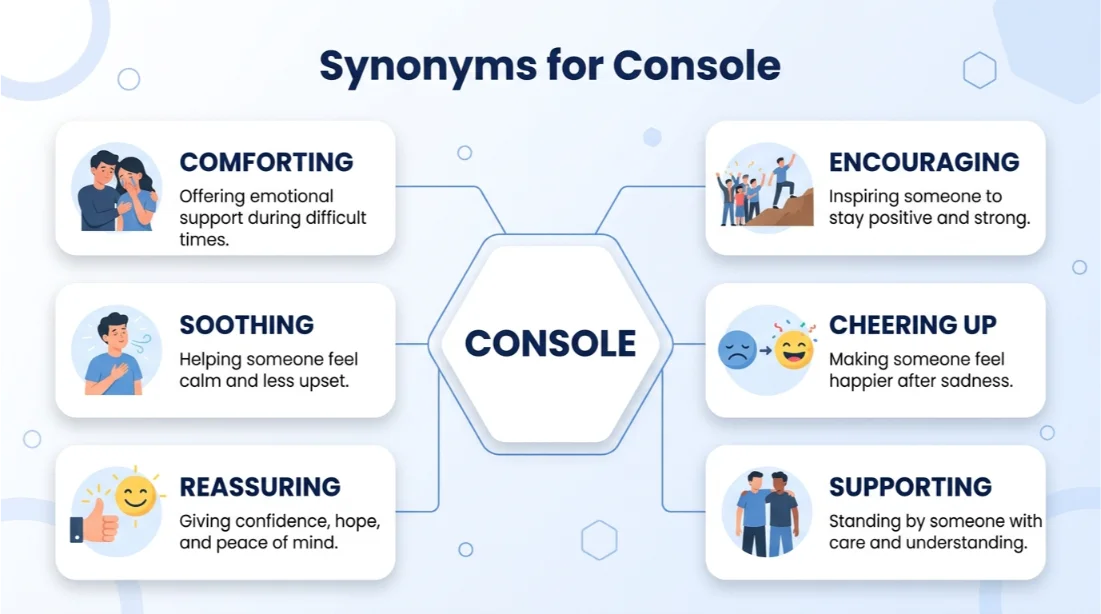
In the quiet, heavy moments of life, we often find ourselves reaching for the right words. Imagine sitting across from a close friend who has just suffered a heartbreaking loss, or standing beside a colleague whose multi-month project was suddenly canceled. Your natural instinct is to offer comfort.
But as you open your mouth, or as your fingers hover over the keyboard, you find yourself repeating the same word: “I want to console you,” or “We tried to console him.”
While “console” is a beautiful, classic word, relying on it too heavily can make your expressive writing feel repetitive, clinical, or even slightly detached. In daily life, we encounter situations requiring comfort in vastly different intensities ranging from a child weeping over a scraped knee to a spouse processing deep grief. Using the exact same verb for both scenarios weakens our communication skills.
If you are looking for professional vocabulary enhancement, drafting a piece of creative writing, or simply trying to sharpen your daily communication skills, this guide will provide you with the ultimate toolkit of dynamic alternatives to “console.”
What is another word for “console”?
The most common and direct synonym for “console” is “comfort.”
- Comfort: To soothe someone’s grief or distress. Use this in almost any everyday situation, if formal or informal, when you want to make someone feel physically or emotionally more at ease.
- Soothe: Best used when the distress has a sharp, agitated, or painful edge. It implies calming down heightened anxiety or physical discomfort.
- Solace: A literary, highly elegant alternative used when someone finds deep, quiet peace or comfort in a specific thing, place, or thought during a time of sadness.
- Reassure: Ideal when the sadness is rooted in fear, doubt, or insecurity. It focuses on restoring someone’s confidence.
Quick Reference: 30 Alternatives to “Console”
| Synonym | One-Line Meaning |
| 1. Comfort | To ease someone’s emotional pain or physical distress. |
| 2. Soothe | To calm, quiet, or ease agitation and sharp pain. |
| 3. Solace | To bring quiet peace or comfort in times of grief (often literary). |
| 4. Reassure | To restore confidence and relieve someone’s doubts or fears. |
| 5. Cheer | To lift someone’s spirits and bring a spark of joy. |
| 6. Succor | To give vital assistance and comfort in times of extreme hardship. |
| 7. Commiserate | To express joint sadness or pity with someone. |
| 8. Condole | To formally express sympathy, especially after a death. |
| 9. Alleviate | To make physical or emotional suffering easier to bear. |
| 10. Hearten | To give someone hope, courage, or renewed spirits. |
| 11. Relieve | To take away or lessen a heavy burden of distress. |
| 12. Assuage | To make an unpleasant or painful feeling less intense. |
| 13. Mitigate | To moderate the severity or harshness of a painful situation. |
| 14. Allay | To quiet down or diminish fears, doubts, or anger. |
| 15. Quiet | To bring a state of peaceful stillness to a troubled mind. |
| 16. Pacify | To bring peace to anger, agitation, or excitement. |
| 17. Uplift | To elevate someone’s spiritual or emotional state. |
| 18. Buoy | To keep someone’s spirits afloat during a difficult trial. |
| 19. Sympathize | To feel or express compassion and understanding. |
| 20. Empathize | To deeply understand and share the feelings of another. |
| 21. Calm | To make someone quiet, tranquil, and free from agitation. |
| 22. Encourage | To inspire someone with hope, courage, or confidence. |
| 23. Soften | To make a harsh emotional blow feel gentler and less severe. |
| 24. Ease | To free someone from worry, pain, or trouble. |
| 25. Support | To provide emotional strength or physical backup to another. |
| 26. Sustain | To keep someone from falling or giving up under pressure. |
| 27. Moderate | To bring down the intense peak of grief or anger. |
| 28. Mollify | To soften an angry or hostile temper. |
| 29. Salve | To act as a healing balm or soothing influence. |
| 30. Foster | To nurture, cherish, and gently care for someone’s well-being. |
30 Detailed Synonyms for “Console”
1. Comfort
- Meaning: To bring physical ease or emotional freedom from pain and worry.
- Explanation: This is the most versatile substitute for “console.” It carries a warm, nurturing, and universal tone. It is equally appropriate in formal letters of condolence and intimate family settings. While “console” specifically targets active grief, “comfort” can refer to alleviating physical pain or simply making a room feel warm and safe.
- Examples:
- The nurse stayed by his bedside to comfort him through the long, painful night.
- She wrapped her arms around her weeping daughter, trying to comfort her after the bad dream.
2. Soothe
- Meaning: To gently calm a person’s feelings, nerves, or physical pain.
- Explanation: “Soothe” has a gentle, rhythmic, and tactile quality. It is highly effective when dealing with high levels of anxiety, anger, or sensory overload. Unlike “console,” which is purely emotional, “soothe” bridges the gap between physical and mental healing—like a balm on a burn or soft music to a crying baby.
- Examples:
- Her soft, melodic voice worked quickly to soothe the panic-stricken child.
- The warm tea and quiet fireplace helped soothe his frayed nerves after a grueling day at work.
3. Solace
- Meaning: To give comfort or peace of mind to someone in a time of intense grief.
- Explanation: “Solace” is a deeply poetic, literary, and evocative word. It carries a heavy, respectful emotional tone, usually reserved for tragic or profound losses. We often “seek solace” or “find solace” in quiet reflection, nature, or art, making it a wonderful noun-to-verb shift for expressive writing.
- Examples:
- He sought to solace his broken heart by taking long, solitary walks through the redwood forest.
- Although she was deeply grieving, she solaced herself with the beautiful memories of their time together.
4. Reassure
- Meaning: To say or do something to remove the doubts and fears of someone.
- Explanation: Use “reassure” when the distress you are addressing is caused by insecurity, uncertainty, or fear. While you console someone who has already lost something, you reassure someone who is afraid they might fail or lose something. It is highly practical and carries a confident, stabilizing tone.
- Examples:
- The mentor took a moment to reassure the anxious intern that mistakes are a natural part of learning.
- He squeezed her hand to reassure her that they would make it through the financial crisis together.
5. Cheer
- Meaning: To raise the spirits of someone; to make them happy or hopeful.
- Explanation: “Cheer” (or its phrasal form “cheer up”) is much lighter, brighter, and more energetic than “console.” It should be used for mild disappointments, sadness, or bad days rather than profound grief. It feels highly informal and action-oriented.
- Examples:
- We ordered her favorite takeout to cheer her up after she missed out on the job promotion.
- A surprise visit from his grandchildren did much to cheer the older man during his hospital stay.
6. Succor
- Meaning: To give assistance, aid, and comfort in times of hardship or distress.
- Explanation: “Succor” is an elevated, formal, and somewhat archaic word. It carries an intense, heroic weight. It is typically used in historical contexts, humanitarian discussions, or grand narratives where people are suffering from severe crises like war, famine, or natural disasters.
- Examples:
- Volunteers worked tirelessly through the night to succor the survivors of the devastating earthquake.
- The spiritual leader dedicated his entire life to succoring the poorest and most vulnerable in the city.
7. Commiserate
- Meaning: To express or feel sympathy, pity, or shared misery with another.
- Explanation: “Commiserate” has a distinct “we are in this together” vibe. It is highly social and conversational. Unlike “console,” which positions you as the strong comforter and the other person as the victim, “commiserating” means joining them in their frustration or disappointment.
- Examples:
- After the exam results were posted, the students gathered at the coffee shop to commiserate over their grades.
- We spent the evening commiserating about the endless corporate bureaucracy we have to deal with.
8. Condole
- Meaning: To express sympathy with a person who is grieving.
- Explanation: Extremely formal and serious, “condole” is almost exclusively used in the context of mourning and death (hence the noun “condolences”). It is rarely used in spoken, casual English but is highly appropriate for formal written letters of sympathy to professional contacts.
- Examples:
- The foreign embassy sent a formal letter to condole with the citizens who lost loved ones in the tragedy.
- I went to the parlor to condole with the widow, offering whatever quiet support I could manage.
9. Alleviate
- Meaning: To make physical or mental suffering less severe.
- Explanation: “Alleviate” is analytical, objective, and professional. It is frequently used in medical, technical, or systemic writing. Instead of focusing on the emotional connection of consoling, it focuses on the practical reduction of pain, distress, or systemic problems.
- Examples:
- The new healthcare policy aims to alleviate the financial burden on low-income families.
- Taking a brisk walk in the fresh air can help alleviate the mental fatigue of staring at a screen all day.
10. Hearten
- Meaning: To make someone feel more cheerful, hopeful, or courageous.
- Explanation: “Hearten” is a beautiful, warm, and deeply encouraging word. It focuses on filling someone’s “heart” with hope and determination. Use it when someone is on the verge of giving up, and you want to inspire them to keep pushing forward.
- Examples:
- The coach’s passionate half-time speech served to hearten the tired players for the final quarter.
- I was deeply heartened by the overwhelming community support we received for our local charity drive.
11. Relieve
- Meaning: To release someone from a heavy burden, anxiety, or physical pain.
- Explanation: “Relieve” has an active, physical quality. It implies the sudden lifting of a heavy weight. It is perfect for situations where a problem is actively resolved, instantly taking away the emotional distress of the sufferer.
- Examples:
- The doctor administered medication to relieve the patient’s sharp abdominal pain.
- Hearing that her cat had been found safe instantly relieved the crushing anxiety she had felt all morning.
12. Assuage
- Meaning: To make an intense, unpleasant feeling less severe or lighter.
- Explanation: “Assuage” is a sophisticated, formal academic word. It is most commonly paired with feelings of guilt, anger, grief, or hunger. It differs from “console” because it represents the gradual tempering or pacifying of a burning emotion rather than offering direct emotional sympathy.
- Examples:
- He volunteered at the animal shelter to assuage his guilt over not spending enough time with his own pet.
- The diplomat’s carefully worded apology did little to assuage the fury of the opposing nation.
13. Mitigate
- Meaning: To make a painful or difficult situation less severe, serious, or painful.
- Explanation: “Mitigate” is a highly clinical, professional, and corporate term. You don’t “mitigate” a crying friend; you mitigate risks, damages, or consequences. Use this in business writing, legal contexts, or strategic planning to describe reducing the blow of a negative event.
- Examples:
- The emergency plan was put in place to mitigate the economic impact of the sudden factory closure.
- We added extra safety features to the playground to mitigate the risk of children falling and getting hurt.
14. Allay
- Meaning: To diminish or put to rest fear, suspicion, or worry.
- Explanation: “Allay” is a formal, elegant verb that deals almost exclusively with internal mental turmoil.
- Examples:
- The CEO held an all-hands meeting to allay the employees’ growing fears of upcoming layoffs.
- Her smooth explanation of the flight safety protocols helped allay my intense fear of flying.
15. Quiet
- Meaning: To soothe, calm, or make someone peaceful and silent.
- Explanation: “Quiet” as a transitive verb is highly evocative, intimate, and gentle. It suggests a physical calming down, a lowering of volume, and a reduction of mental noise. It is perfect for storytelling, narrative prose, or describing a parent caring for a child.
- Examples:
- The mother rocked the baby back and forth, humming a soft lullaby to quiet his whimpers.
- He took several deep, slow breaths in an effort to quiet his racing, anxious thoughts.
16. Pacify
- Meaning: To quell the anger, agitation, or excitement of someone.
- Explanation: “Pacify” carries a slightly authoritative or transactional tone. It is often used when one party is angry or hostile, and you do something to soothe them or “make peace.” Be careful—in casual settings, it can sometimes imply satisfying someone just to make them stop complaining.
- Examples:
- The customer service manager offered a full refund to pacify the outraged client.
- The government introduced minor reforms in an attempt to pacify the protesting citizens.
17. Uplift
- Meaning: To elevate someone spiritually, socially, or emotionally.
- Explanation: “Uplift” has a positive, inspiring, and often spiritual tone. While consoling meets someone in their low point, uplifting seeks to pull them high above it. It is widely used in community work, inspirational speaking, and religious settings.
- Examples:
- Her beautiful poetry has a unique power to uplift the spirits of those going through dark times.
- The organization was founded with a primary mission to uplift underprivileged youth through education.
18. Buoy
- Meaning: To keep someone’s spirits afloat and prevent them from sinking into despair.
- Explanation: “Buoy” (often used as “buoy up”) is a wonderful nautical metaphor. It is used when someone is navigating a sea of troubles, and a piece of good news, a kind word, or a sudden realization keeps them from drowning in sadness. It is energetic and highly visual.
- Examples:
- The flood of warm cards and letters from her neighbors served to buoy her spirits during her recovery.
- He was buoyed up by the sudden hope that his missing dog might still be found.
19. Sympathize
- Meaning: To feel or express compassion, sorrow, or pity for another’s hardships.
- Explanation: “Sympathize” is a standard, polite, and respectful word. It is more about acknowledging someone else’s pain from a slight, respectful distance. It is highly appropriate for professional emails, casual acquaintances, and formal social interactions.
- Examples:
- I deeply sympathize with your current situation, and I am here to help in any way I can.
- While she had never lost a business herself, she could easily sympathize with her friend’s frustration.
20. Empathize
- Meaning: To fully understand and mentally share the feelings and experiences of another.
- Explanation: “Empathize” goes a step deeper than sympathize. While sympathy says, “I feel bad for you,” empathy says, “I feel this with you.” It implies a deep psychological connection and shared human experience. It is modern, warm, and highly valued in emotional intelligence.
- Examples:
- Having lost his own father at a young age, he could deeply empathize with what his friend was going through.
- Great novelists have a rare ability to empathize with characters of completely different backgrounds.
21. Calm
- Meaning: To make someone quiet, relaxed, and free from agitation or excitement.
- Explanation: “Calm” (often “calm down”) is direct, functional, and highly common. It is used in daily life when someone is intense, overly angry, or excessively nervous. It focuses on physiological and mental restoration of balance.
- Examples:
- The teacher used a quiet, structured game to calm the excited children after recess.
- It took him several minutes to calm down after the terrifying near-miss on the highway.
22. Encourage
- Meaning: To give support, confidence, or hope to someone to help them succeed.
- Explanation: “Encourage” is proactive and future-focused. While you console someone about a past failure, you encourage them to try again. It is positive, supportive, and highly motivating, making it a staple of coaching, mentoring, and parenting.
- Examples:
- My parents always did their best to encourage my creative talents, buying me art supplies whenever they could.
- She wrote a sweet note to encourage her brother before he walked into his first major job interview.
23. Soften
- Meaning: To make a harsh truth, blow, or emotion gentler and easier to take.
- Explanation: “Soften” is a highly strategic, subtle word. It is used when you cannot change a bad outcome, but you do or say something to make the delivery of the news less brutal. It is excellent for communication, PR, and diplomacy.
- Examples:
- He tried to soften the blow of the rejection letter by highlighting the candidate’s impressive strengths.
- She used gentle, carefully chosen words to soften the impact of the sad news on her young son.
24. Ease
- Meaning: To make someone free from pain, trouble, or worry.
- Explanation: “Ease” is simple, clean, and highly reassuring. It can refer to making a physical transition easier or gently lifting emotional stress. It feels very natural and lacks the stuffiness of larger academic words.
- Examples:
- Sharing your heavy secrets with a trusted friend can go a long way toward easing your mind.
- The modern, ergonomic chairs were brought in to help ease the physical strain of long office hours.
25. Support
- Meaning: To give strength, comfort, or assistance to someone in a trial.
- Explanation: “Support” is a strong, foundational word. It is less about emotional soothing and more about standing as a solid rock for someone. It implies reliability, physical presence, and steady, unwavering commitment.
- Examples:
- The entire community rallied together to support the family after their home was lost to the fire.
- Thank you for always being there to support me through the ups and downs of my career.
26. Sustain
- Meaning: To strengthen or support physically or mentally over a long period.
- Explanation: “Sustain” has an endurance-focused, resilient tone. It is used when comfort is needed not just for a moment but over a long, grueling journey. It is deeply respectful and carries a sense of quiet power.
- Examples:
- Her deep, unwavering faith served to sustain her through the darkest years of her long illness.
- The hope of seeing his family again was the only thing that sustained him during his military deployment.
27. Moderate
- Meaning: To make a violent, intense, or extreme emotion less intense.
- Explanation: “Moderate” is a controlled, objective, and somewhat formal word. It implies bringing a runaway emotion (like wild grief or intense rage) back within safe, manageable boundaries using logic or gentle intervention.
- Examples:
- She took a slow walk around the block to moderate the intense anger she felt after the argument.
- The mediator worked carefully to moderate the heated emotions of both parties during the legal dispute.
28. Mollify
- Meaning: To appease the anger or anxiety of someone.
- Explanation: “Mollify” is a classic, highly specific literary word. It is used almost exclusively when dealing with someone who is angry, hostile, or defensive. It implies softening their rough edges, making them more reasonable or pliable.
- Examples:
- He brought a bouquet of fresh flowers to mollify his partner after completely forgetting their anniversary.
- The company offered a generous discount in an attempt to mollify the frustrated subscribers.
29. Salve
- Meaning: To soothe, heal, or ease a troubled mind, conscience, or pride.
- Explanation: “Salve” (derived from healing ointments) is a deeply visual and metaphorical word. It is usually applied to abstract concepts like bruised egos, wounded pride, or guilty consciences. It suggests applying a gentle, restorative treatment to a hidden wound.
- Examples:
- Winning the minor consolation prize did little to salve his deeply bruised ego.
- She tried to salve her conscience by donating a portion of her unexpected profits to a local shelter.
30. Foster
- Meaning: To encourage, cultivate, and nurture a feeling of safety and comfort.
- Explanation: “Foster” is a warm, developmental word. Rather than confronting a single moment of pain, fostering focuses on building a long-term environment of emotional security, trust, and growth. It is highly valued in leadership, therapy, and family life.
- Examples:
- The teacher worked hard to foster a highly collaborative, safe, and welcoming environment in her classroom.
- Good communication is the key to fostering deep trust and emotional safety in a romantic relationship.
Formal vs. Informal Synonyms
Choosing the right alternative for “console” often depends entirely on the setting. Using a highly formal word with a close friend can sound cold, while using casual slang in a professional condolence letter can seem disrespectful. Use this breakdown to match your tone to your audience.
Formal Synonyms (Best for Business, Professional Correspondence, and Literature)
- Condole: “We wish to condole with the families affected by this sudden transition.”
- Succor: “The agency was established to succor those displaced by the crisis.”
- Assuage: “The board took immediate measures to assuage the shareholders’ concerns.”
- Mitigate: “Our primary goal is to mitigate the negative impact on the local community.”
Informal/Conversational Synonyms (Best for Friends, Family, and Casual Writing)
- Cheer up: “I brought you some ice cream to cheer you up after that rough day.”
- Buck up: “Buck up, buddy! You’ll get them next time.”
- Be there for: “I just want you to know that I’m here for you, no matter what.”
- Soothe: “Let’s listen to some quiet music to soothe your mind.”
How to Choose the Right Synonym
To elevate your language skills and ensure your expressive writing hits the mark, consider these three quick questions before choosing your word:
- What is the source of their distress?
- If it is grief or loss, lean toward comfort, solace, or sympathy.
- If it is fear, doubt, or worry, choose “reassure,” “allay,” or “ease.”
- If it is anger, hostility, or frustration, go with mollify, pacify, or assuage.
- What is the intensity of the situation?
- For extreme, life-altering events, use deep words like “succor,” “sustain,” “condole,” or “solace.”
- For everyday disappointments, stick to lighter words like “cheer,” “hearten,” “uplift,” or “calm.”
- What is my relationship with the person?
- To build deep emotional connection, show empathy or commiserate.
- To offer professional, stable support, offer to reassure, alleviate, or support.
Frequently Asked Questions
What is the difference between “console” and “comfort”?
While highly similar, “console” specifically focuses on easing severe grief, sadness, or disappointment after a loss. “Comfort” is broader, encompassing physical ease, safety, and the general lifting of any physical or emotional distress.
Can “console” be used as a noun?
Yes! As a noun (pronounced CON-sole), it refers to a cabinet, control panel, or an electronic system for playing video games. As a verb (pronounced con-SOLE), it means to comfort someone in distress.
When should I use “solace” instead of “console”?
Use “solace” (as a verb or noun) when writing in a literary, poetic, or highly formal style. It carries a quiet, reflective tone of finding peace in a specific place, memory, or thought during deep mourning.
Is “commiserate” a good synonym for “console”?
Yes, but only when you share the same frustration or disappointment. “Commiserate” means to feel or express pity together, whereas “console” is a one-way act of comforting someone else.
What is a good professional synonym for “console”?
In professional settings, “reassure,” “alleviate,” or “mitigate” work beautifully. They sound objective, proactive, and constructive, avoiding overly emotional language while maintaining empathy.
Conclusion
Mastering vocabulary enhancement is not about finding the most complex, multi-syllabic words to show off; it is about finding the exact word that captures the human experience with precision. When we limit ourselves to repeating “console,” we flatten the rich landscape of human emotion.
By actively choosing between words like “soothe,” “hearten,” “commiserate,” or “assuage,” you transform your communication skills from a basic functional tool into an art form. Your expressive writing gains depth, your professional emails project confidence, and your personal relationships benefit from a more authentic, tailored expression of empathy.
The next time you sit down to write a card, draft a story, or speak to a friend in need, pause for a moment. Reflect on the exact nature of their feelings, refer to this guide, and choose the alternative that speaks directly to their heart. Your words have power—use them with intention.

I’m Elaris Vane, a vocabulary enthusiast and English language writer at LexiBoost, where I help readers discover smarter and more natural ways to use English words. I enjoy simplifying complex vocabulary, explaining synonyms and antonyms, and breaking down confusing word differences into easy explanations.