Picture yourself standing at the edge of a massive canyon, looking down into a chasm that seems to plunge straight into the center of the earth. Or perhaps you are listening to a piece of music that moves you so profoundly it leaves you completely speechless. In both moments, your mind reaches for the exact same descriptor: deep.
It’s an incredibly reliable, hard-working word in the English language. We use it to describe physical oceans, intense emotions, complex philosophical theories, and even the low pitch of a bass guitar. However, relying too heavily on this single four-letter word can inadvertently flatten your writing. When every ocean, thought, conversation, and sleep is labeled as just “deep,” your prose loses its texture and vividness.
Overusing a single descriptor reduces the emotional impact of your message. By expanding your English vocabulary and mastering the subtle nuances of alternative expressions, you can transform your communication skills. Choosing the precise word allows you to paint vivid pictures in the minds of your readers, shifting your work from basic reporting to expressive writing. Let’s look at how replacing this common adjective can immediately elevate your writing improvement journey.
What is Another Word for “Deep”?
The most direct and common synonym for “deep” when describing physical distance downward is profound. However, because “deep” is used in so many different contexts, the best alternative depends entirely on what you are describing.
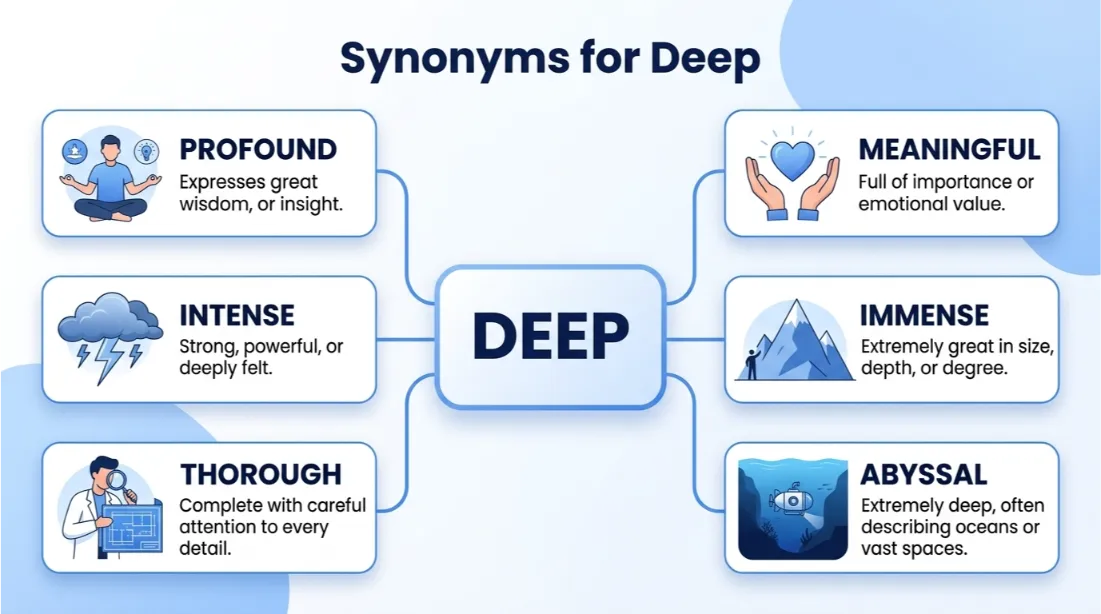
- Profound: Best used for abstract concepts, thoughts, feelings, or insights that show great knowledge or emotional intensity.
- Abyssal: Ideal for physical geography and marine contexts, specifically referring to the dark, immense depths of the ocean.
- Fathomless: Perfect for describing something so incredibly deep or complex that it feels impossible to measure or completely understand.
- Astruse: Excellent for intellectual, academic, or philosophical subjects that are difficult to grasp and require intense study.
Quick Reference: 30 Alternatives to Deep
| Synonym | One-Line Meaning |
| Profound | Showing deep insight, knowledge, or intense emotional depth. |
| Abyssal | Relating to the deepest, darkest depths of the ocean. |
| Fathomless | Impossible to measure or completely comprehend. |
| Abysmal | Limitless and deep (often used modernly for something terribly bad). |
| Bottomless | Appearing to have no floor or physical limit. |
| Yawning | Open wide and gaping, creating a deep, intimidating space. |
| Cavernous | Vast, hollow, and deep, resembling a large cave. |
| Chasm-like | Resembling a deep, structural fissure or split in the earth. |
| Plunging | Dropping down steeply or precipitously. |
| Sunken | Situated at a lower level than the surrounding area. |
| Inmost | Located deepest within the physical body or human psyche. |
| Subterranean | Existing, occurring, or operating entirely underground. |
| Abstruse | Extremely difficult to penetrate intellectually or understand. |
| Esoteric | Intended for or likely to be understood by only a chosen few. |
| Recondite | Dealing with obscure, deep, or hidden subject matter. |
| Cryptic | Having a hidden, mysterious, or ambiguous meaning. |
| Unfathomable | Totally incapable of being fully explored or understood. |
| Inscrutable | Impossible to interpret, understand, or read clearly. |
| Intense | Existing in a very high degree or extreme force. |
| Heartfelt | Deeply felt, sincere, and emotionally genuine. |
| Acute | Sharply felt, intense, or critical in nature. |
| Resonant | Deep, clear, and continuing to sound for a long time. |
| Sonorous | Capable of producing a deep, rich, or imposing sound. |
| Sepulchral | Hollow, deep, and gloomy, like a tomb. |
| Low-pitched | Sounding at the lower end of the auditory frequency spectrum. |
| Low | Not high in pitch or musical frequency. |
| Erudite | Having or showing great knowledge or learning. |
| Sagacious | Having or showing keen mental discernment and good judgment. |
| Wise | Having experience, knowledge, and good judgment. |
| Discerning | Showing good judgment and deep understanding of complex things. |
30 Detailed Synonyms for Deep
1. Profound
- Meaning: Showing great knowledge, insight, or intense emotional depth.
- Explanation: Profound is the ultimate upgrade for “deep” when dealing with intellectual matters or human emotions. It carries a formal, highly respectful tone. While “deep” can feel casual, profound implies that a thought or feeling has a permanent, life-altering impact. Use it when describing grief, wisdom, structural changes, or realizations that completely alter someone’s worldview.
- Example 1: The philosopher’s lecture had a profound impact on how the students viewed ethical responsibility.
- Example 2: She felt a profound sense of relief when the medical test results finally came back negative.
2. Abyssal
- Meaning: Relating to the deepest, dark zones of the ocean floor.
- Explanation: This is a highly specialized, scientific term. It possesses a cold, mysterious, and grand tone. You should save abyssal for physical, geographic, or marine environments. It sets itself apart from standard words by specifically evoking imagery of the sunless, high-pressure environments miles beneath the ocean’s surface where unique creatures live.
- Example 1: Marine biologists discovered several bizarre, glowing species thriving in the abyssal zone of the Pacific.
- Example 2: The submarine slowly descended into the abyssal darkness where sunlight never penetrates.
3. Fathomless
- Meaning: Impossible to measure, bound, or completely comprehend.
- Explanation: Derived from the nautical measurement “fathom,” this word blends physical depth with poetic mystery. It feels elegant and literary. It describes things that feel completely infinite like space, time, or the human capacity for love and sorrow. It carries a much stronger sense of awe and wonder than the basic word “deep.”
- Example 1: She stared up into the fathomless night sky, completely overwhelmed by the sheer scale of the universe.
- Example 2: The detective looked into the suspect’s cold, fathomless eyes but found absolutely no clues.
4. Abysmal
- Meaning: Immeasurably deep, though modernly used to describe something incredibly bad.
- Explanation: Historically, abysmal meant “resembling an abyss.” While it still retains that literal definition in classic literature, modern English uses it almost exclusively as an intense negative modifier. It carries an emotional weight of complete failure or utter hopelessness. Use it informally or professionally to critique terrible quality, performance, or conditions.
- Example 1: The living conditions in the war-torn border town were absolutely abysmal.
- Example 2: Despite weeks of practice, the team’s performance on opening night was an abysmal failure.
5. Bottomless
- Meaning: Appearing to have no base, floor, or physical limit.
- Explanation: Bottomless is a highly descriptive, visceral word. It can be used literally for physical structures, but it is also widely used in casual hyperbole. It implies an insatiable or endless supply of something, whether that is an appetite, greed, or resources. It sounds less formal than profound or fathomless, making it highly versatile.
- Example 1: The old mountain lore warned travelers to stay far away from the bottomless pit in the woods.
- Example 2: The toddlers seemed to possess a bottomless pit of physical energy that exhausted their parents.
6. Yawning
- Meaning: Wide open, gaping, and intimidatingly deep.
- Explanation: This word acts like a physical description. It describes an opening that feels active, dangerous, and large enough to swallow something whole. It is perfect for describing canyons, chasms, doors, or divides. The tone is often slightly ominous or dramatic, making it excellent for creative writing and descriptive essays.
- Example 1: The hikers carefully navigated around a yawning crevasse in the melting glacier ice.
- Example 2: A yawning chasm opened up between the two political parties, preventing any hope of a compromise.
7. Cavernous
- Meaning: Vast, hollow, and deep, resembling a large cave system.
- Explanation: Cavernous is an excellent spatial adjective. It immediately gives the reader a sense of physical scale, echoing sounds, and shadows. Use it to describe indoor spaces, buildings, rooms, or physical features that feel empty and overly large. It differs from “deep” by explicitly focusing on the hollow, echo-prone volume of a space.
- Example 1: The old train station was a cavernous building that felt incredibly cold during the winter months.
- Example 2: He packed his belongings into the cavernous trunk of the vintage sedan.
8. Chasm-like
- Meaning: Resembling a deep, structural fissure or split in the earth.
- Explanation: This is a highly visual, comparative compound word. It emphasizes a sharp, definitive split or separation. While it can describe literal geology, it is incredibly effective when used metaphorically to describe massive disagreements, cultural divides, or structural separations between groups of people where bridging the gap feels nearly impossible.
- Example 1: The earthquake left a chasm-like crack running straight down the middle of the highway.
- Example 2: A chasm-like cultural divide separated the older generation from the tech-savvy youths.
9. Plunging
- Meaning: Dropping down incredibly steeply or precipitously.
- Explanation: Plunging brings dynamic action and movement to your writing. Unlike “deep,” which describes a static state, plunging tells the reader that the drop-off is sudden, dramatic, and fast. Use it to describe cliffs, necklines in fashion, valleys, or sharp economic drops. The tone is dramatic and high-energy.
- Example 1: The scenic highway wound dangerously along the edge of plunging ocean cliffs.
- Example 2: The company’s stock experienced a plunging decline following the unexpected retirement of the CEO.
10. Sunken
- Meaning: Situated at a lower level than the surrounding surface area.
- Explanation: “Sunken” implies that something has dropped down, settled, or been submerged over time. It carries a quiet, slightly eerie, or historical tone. Use it for physical items like ships, architectural features like living rooms, or physical features like hollow cheeks caused by exhaustion or illness.
- Example 1: Divers spent weeks exploring the sunken pirate ship looking for historical artifacts.
- Example 2: After working three consecutive night shifts, he had dark, sunken circles under his eyes.
11. Inmost
- Meaning: Located deepest within a physical structure or the human psyche.
- Explanation: This is an intimate, serious word. It bypasses superficial layers to target the absolute core of something. It is almost always used to describe private human emotions, secrets, desires, or thoughts that a person hides from the rest of the world. It carries far more emotional weight and privacy than simply saying “deep thoughts.”
- Example 1: In her private journal, she felt safe enough to express her inmost fears about the future.
- Example 2: The temple’s inmost chamber was completely off-limits to ordinary visitors.
12. Subterranean
- Meaning: Existing, occurring, or operating entirely underground.
- Explanation: This is a literal, formal adjective with a clinical or mysterious tone. It describes things that exist beneath the soil. It can be used scientifically for rivers and rocks or culturally to describe hidden, secret, or illegal movements that operate away from public view (the “underground”).
- Example 1: The city built a massive subterranean network of pipes to handle the heavy monsoon rains.
- Example 2: The resistance group published a subterranean newspaper to avoid government censorship.
13. Abstruse
- Meaning: Extremely difficult to penetrate intellectually or understand.
- Explanation: “Abstruse” is an academic term used for ideas, theories, or texts that require serious mental effort to unpack. It differs from “deep” by implying that the subject matter is so complex, dense, or poorly explained that it is actively hard for the average person to comprehend. The tone is highly formal and intellectual.
- Example 1: The professor’s research paper was filled with abstruse mathematical formulas that confused the students.
- Example 2: I found the philosophical treatise on metaphysics far too abstruse for casual weekend reading.
14. Esoteric
- Meaning: Intended for or likely to be understood by only a small, specialized group.
- Explanation: This word describes specialized depth. When a topic is esoteric, it isn’t just deep; it requires highly specific, insider knowledge to comprehend. Use it to describe niche hobbies, specialized academic fields, complex legal jargon, or ancient spiritual rituals that the general public is completely unfamiliar with.
- Example 1: The software developers engaged in an esoteric debate about obsolete coding languages.
- Example 2: He possesses an incredible amount of esoteric knowledge regarding ancient Mesopotamian pottery styles.
15. Recondite
- Meaning: Dealing with obscure, deep, or hidden subject matter.
- Explanation: Recondite is a sophisticated synonym that sits comfortably in formal writing. It describes knowledge or information that is hidden away from standard awareness, often because it is old, rare, or highly specialized. It implies a deeper level of obscurity than abstruse.
- Example 1: The historian spent decades researching recondite legal documents from the medieval era.
- Example 2: Her book focuses on the recondite aspects of early twentieth-century economic policy.
16. Cryptic
- Meaning: Having a hidden, mysterious, or deliberately ambiguous meaning.
- Explanation: When something is cryptic, its depth comes from a puzzle or secret code. It implies that the true meaning is intentionally masked. Use it to describe short messages, puzzling riddles, confusing facial expressions, or mysterious clues left behind in a mystery story. It carries a suspicious, intriguing tone.
- Example 1: He left a cryptic note on the kitchen counter before leaving the house early in the morning.
- Example 2: The archaeologist spent months trying to decode the cryptic symbols carved into the stone wall.
17. Unfathomable
- Meaning: Totally incapable of being fully explored, measured, or understood.
- Explanation: This is a powerful adjective that blends frustration with absolute awe. While abstruse means hard to understand, unfathomable means completely impossible to understand because it defies human logic. Use it to describe massive tragedies, incredible cosmic scales, or unpredictable human behaviors.
- Example 1: The scale of destruction caused by the earthquake was completely unfathomable to the public.
- Example 2: For some unfathomable reason, he decided to quit his dream job without having a backup plan.
18. Inscrutable
- Meaning: Impossible to interpret, read, or understand clearly.
- Explanation: This word is almost always applied to human expressions, faces, behaviors, and motives. An inscrutable person is a complete mystery; they show absolutely no outward clues about what they are thinking or feeling inside. It acts as an excellent, precise replacement for “deep and mysterious” in creative writing.
- Example 1: The poker player maintained an entirely inscrutable expression throughout the high-stakes tournament.
- Example 2: The diplomat smiled inscrutably, leaving the reporters guessing about the true outcome of the meeting.
19. Intense
- Meaning: Existing in an extremely high degree or with extreme force.
- Explanation: Intense describes emotional, physical, or sensory depth through sheer power and concentration. Use it when something hits the senses or the mind with concentrated force, like heat, pressure, focus, or rivalry. It is a highly versatile, common word that works well in both casual conversations and professional reporting.
- Example 1: The athletes trained under intense heat to prepare themselves for the upcoming summer games.
- Example 2: After hours of intense concentration, the programmer finally managed to fix the critical bug.
20. Heartfelt
- Meaning: Deeply felt, completely sincere, and emotionally genuine.
- Explanation: This is an emotionally warm, authentic word. It replaces “deep” when describing positive, empathetic human interactions, expressions of gratitude, apologies, or congratulations. It signals to the reader that the emotion is completely real and comes straight from the heart, free of any sarcasm or pretense.
- Example 1: The retiring teacher offered a heartfelt thank-you to all of her students and colleagues.
- Example 2: Please accept our most heartfelt condolences for the loss of your beloved family member.
21. Acute
- Meaning: Sharply felt, intense, or critical in nature.
- Explanation: Acute denotes a sharp, immediate, and highly focused depth. In medical terms, it describes sudden, severe conditions (as opposed to chronic ones). In psychological or situational terms, it describes highly focused awareness, pain, shortages, or intelligence. It carries an urgent, high-stakes tone.
- Example 1: The country is currently suffering from an acute shortage of skilled healthcare professionals.
- Example 2: She experienced an acute pain in her left ankle after tripping over the curb.
22. Resonant
- Meaning: Deep, clear, and continuing to sound or echo for a long time.
- Explanation: This is an auditory and emotional descriptor. Physically, a resonant sound is rich, deep, and beautifully fills a space without being harsh. Metaphorically, an idea, story, or speech is resonant if it stays in people’s minds and continues to move them emotionally long after it is over.
- Example 1: The actor’s resonant voice carried effortlessly to the very back rows of the theater.
- Example 2: The novel’s themes of family sacrifice remain deeply resonant with readers today.
23. Sonorous
- Meaning: Capable of producing a deep, rich, or imposing sound.
- Explanation: Highly formal and literary, “sonorous” describes sounds, speeches, or voices that are grand, impressive, and deep. It carries a heavy sense of authority, dignity, and beauty. Use it to describe church bells, classical instruments, or formal speeches delivered by powerful speakers.
- Example 1: The cathedral’s sonorous bells rang out across the quiet valley every morning at dawn.
- Example 2: He delivered the eulogy in slow, sonorous tones that captivated everyone in attendance.
24. Sepulchral
- Meaning: Hollow, deep, and gloomy, like a tomb.
- Explanation: This is a highly specialized, moody word with a dark, gothic tone. It describes sounds or atmospheres that are not just deep but uncomfortably hollow, cold, and dark. It is perfect for horror writing, ghost stories, or describing incredibly grim, silent, or dark environments.
- Example 1: A sepulchral silence filled the abandoned mansion as the investigators stepped inside.
- Example 2: The villain spoke in a deep, sepulchral whisper that sent chills down my spine.
25. Low-pitched
- Meaning: Sounding at the lower end of the auditory frequency spectrum.
- Explanation: This is a clear, technical, and objective descriptor for audio frequencies. It is entirely free of emotional bias, making it perfect for scientific contexts, technical audio work, or matter-of-fact descriptions where you simply need to state that a sound is low without adding any extra drama.
- Example 1: The heavy machinery emitted a constant, low-pitched hum that irritated the factory workers.
- Example 2: Large dogs typically communicate with a low-pitched growl to warn off potential intruders.
26. Low
- Meaning: Not high in pitch, musical frequency, or volume.
- Explanation: Simple, direct, and completely conversational, low is the standard daily substitute for a “deep” voice or sound. It is highly accessible and keeps your text feeling natural and clean when you want to avoid sounding overly dramatic or academic.
- Example 1: They spoke in low voices at the coffee shop so they wouldn’t disturb the people nearby.
- Example 2: The singer smoothly transitioned into the low notes of the melancholic ballad.
27. Erudite
- Meaning: Having or showing great academic knowledge or learning.
- Explanation: Erudite changes “deep thinker” into a specific, polished descriptor for someone who is highly educated. It implies structural knowledge gained through years of deep reading, research, and academic study. It carries a respectful, highly formal tone.
- Example 1: The book club enjoyed an erudite discussion regarding the historical context of the classic novel.
- Example 2: The university library is a perfect haven for erudite scholars looking to conduct original research.
28. Sagacious
- Meaning: Having or showing keen mental discernment, wisdom, and good judgment.
- Explanation: This is a formal, classic word for deep wisdom. A sagacious person doesn’t just possess facts; they have practical wisdom, foresight, and an uncanny ability to make smart decisions in complicated situations. It carries a tone of deep respect for experience and age.
- Example 1: The business startup succeeded largely thanks to the sagacious advice of its veteran mentors.
- Example 2: The ruler was known across the land for making sagacious decisions that kept the peace.
29. Wise
- Meaning: Having experience, deep knowledge, and good real-world judgment.
- Explanation: Wise is a timeless, universally understood English word. While “erudite” focuses on books and schooling, “wise” focuses on life experience, emotional maturity, and deep truth. It is simple, accessible, and holds immense authority without ever sounding pretentious.
- Example 1: My grandmother gave me some very wise advice about handling difficult relationships.
- Example 2: It is always a wise decision to save a portion of your monthly income for emergencies.
30. Discerning
- Meaning: Showing good judgment and a deep understanding of complex things.
- Explanation: Discerning describes deep taste, observation, or selective judgment. A discerning person can tell the difference between high quality and poor quality, or truth and lies, even when the differences are incredibly small. Use it to describe audiences, critics, art collectors, or readers.
- Example 1: The luxury fashion brand designs its clothing line specifically to appeal to discerning customers.
- Example 2: A discerning critic can easily spot the minor flaws in an otherwise excellent film.
Formal vs. Informal Synonyms
To ensure your word choice always matches your setting, it helps to categorize your vocabulary by formatting tone. Using an academic word in a casual text sounds awkward, while using a casual slang term in a research paper weakens your credibility.
Formal & Academic Settings
Use these when writing research papers, business reports, legal documents, or formal speeches. They demonstrate advanced language skills and precise thinking:
- Profound (e.g., profound economic implications)
- Abstruse (e.g., abstruse theoretical physics)
- Erudite (e.g., an erudite critique of the text)
- Subterranean (e.g., subterranean geological formations)
Informal & Conversational Settings
Use these when writing personal blogs, casual emails, creative stories, or chatting with friends. They keep your writing moving quickly and feeling relatable:
- Bottomless (e.g., a bottomless appetite for snacks)
- Low (e.g., keep your voice low)
- Intense (e.g., that movie was really intense)
- Plunging (e.g., a plunging roller coaster drop)
How to Choose the Right Synonym
Selecting the perfect alternative to “deep” comes down to identifying the exact category of what you are describing. Use this simple mapping guide to make the right choice instantly:
- If it is Physical/Spatial (Canyons, Caves, Water): Focus on scale and shape. Use cavernous, yawning, abyssal, or plunging.
- If it is Intellectual (Ideas, Theories, Books): Focus on mental effort. Use abstruse, profound, esoteric, or recondite.
- If it is emotional (feelings, Responses, beliefs): Focus on human sincerity and impact. Use “heartfelt,” “intense,” “profound,” or “acute.”
- If it is Auditory (Voices, Music, Sound Effects): Focus on pitch and tone quality. Use resonant, sonorous, low-pitched, or sepulchral.
Frequently Asked Questions
Can I use “profound” to describe a deep swimming pool?
No, profound is used for abstract concepts like thoughts, insights, and emotions. For physical depth like a swimming pool, sticking with “deep” or using “plunging” is much more natural.
What is the difference between “abstruse” and “esoteric”?
“Abstruse” means something is complex and genuinely hard to understand intellectually. “Esoteric” means the information is specialized and known by only a tiny, exclusive group of insiders, regardless of how hard it is.
Is “abysmal” always a negative word in modern English?
Yes, in modern daily English, abysmal is used almost exclusively to describe something of incredibly poor quality, such as an abysmal performance or abysmal weather.
What is a good poetic word for a deep ocean?
Fathomless and abyssal are beautiful, literary choices. They evoke images of vast, mysterious, and untamed waters that stir a sense of awe.
How does “resonant” differ from a simple “low” voice?
A low voice refers purely to a low musical pitch. A resonant voice is deep, rich, clear, and carries a full sound that beautifully echoes and fills a room.
Conclusion
Mastering word choice is one of the most powerful steps you can take on your writing improvement journey. As we have explored, a simple phrase like “deep thoughts” can be transformed into an erudite discussion, an abstruse theory, or a profound realization. Each alternative option targets a highly specific shade of meaning that breathes life, accuracy, and professional color into your sentences.
Relying less on repetitive adjectives prevents your prose from sounding flat or automated. Instead, varied word choice engages your readers, sharpens your communication skills, and ensures your true message is delivered with maximum impact.
Try incorporating two or three of these newly learned terms into your next writing project, email, or essay. Notice how changing a single descriptor can completely shift the energy and clarity of a sentence. Challenge yourself to move beyond basic vocabulary, embrace expressive writing, and watch your language skills flourish!

I’m Elaris Vane, a vocabulary enthusiast and English language writer at LexiBoost, where I help readers discover smarter and more natural ways to use English words. I enjoy simplifying complex vocabulary, explaining synonyms and antonyms, and breaking down confusing word differences into easy explanations.