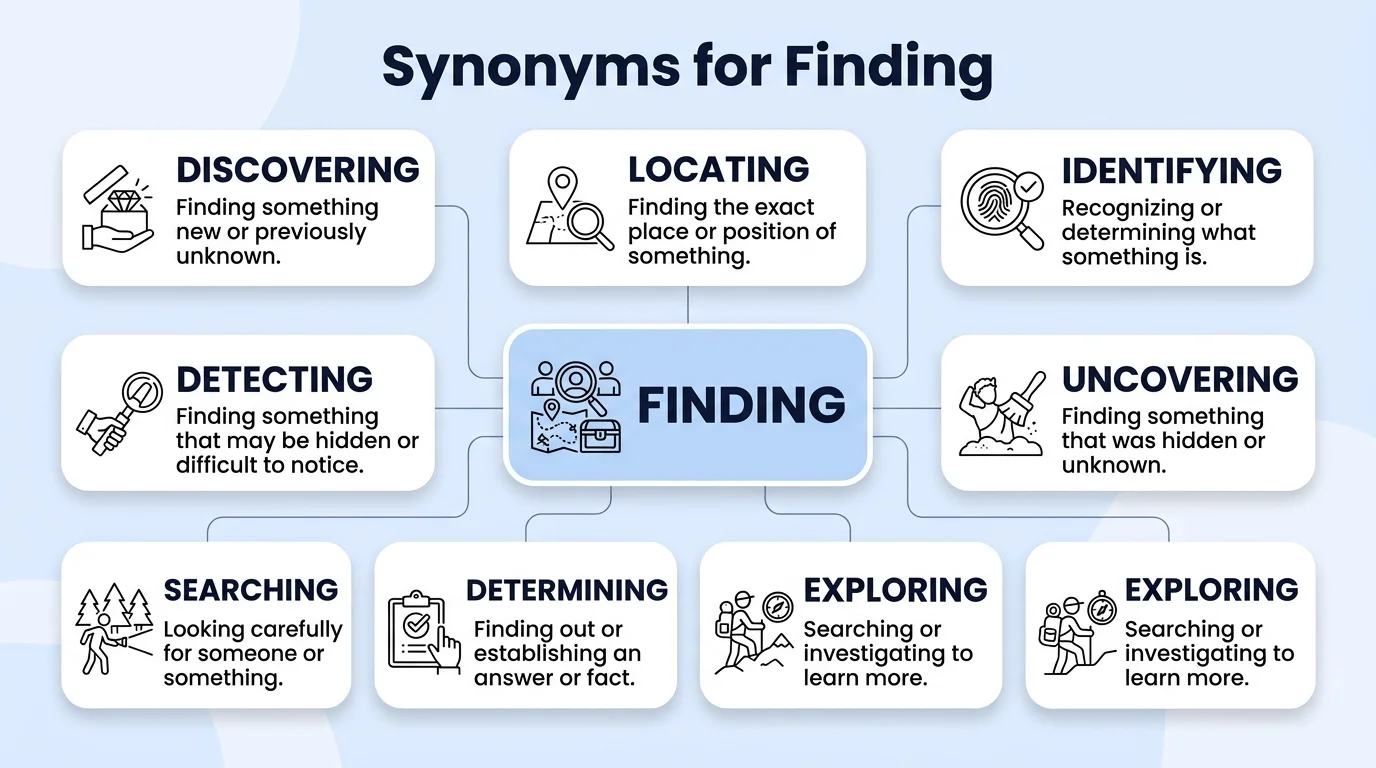
Do you ever search for something lost or work hard to discover a new answer? Think about the relief of locating your car keys right before leaving home. That moment is all about finding. In plain words, finding means discovering, getting, or noticing something you looked for or ran into by chance. Learning varied synonyms for finding is helpful for students, bloggers, content writers, and everyday English speakers. Using fresh words keeps your sentences lively and prevents boring repetition. Whether you are writing a research paper, publishing a blog, or sending an email, knowing the best synonyms for “finding” will make your message clear, engaging, and powerful.
1. Discovery
Meaning: The act of seeing or learning something for the very first time.
Examples:
- The scientist shared her new discovery with the team.
- Finding that hidden coffee shop was a wonderful discovery.
2. Detection
Meaning: The act of noticing or uncovering something that was hidden.
Examples:
- Early detection of the leak saved the house from water damage.
- Smoke alarms are built for quick fire detection.
3. Locating
Meaning: Tracking down the exact place where something is.
Examples:
- I need help locating my missing notebook.
- Locating the right house on this street took ten minutes.
4. Uncovering
Meaning: Removing a cover or bringing a secret fact into the open.
Examples:
- The reporter spent months uncovering the true story.
- We had fun uncovering old toys in the attic.
5. Spotting
Meaning: Seeing or catching sight of something specific in a crowd or area.
Examples:
- She is very good at spotting typos in long articles.
- Spotting a deer in the backyard made our morning.
6. Sighting
Meaning: An instance of seeing something rare or unusual.
Examples:
- The park ranger recorded a rare bird sighting.
- Our neighbors reported a bear sighting near the woods.
7. Recovery
Meaning: Getting back something that was lost, stolen, or misplaced.
Examples:
- The recovery of my stolen bicycle was a big relief.
- Police managed the quick recovery of the lost wallet.
8. Acquisition
Meaning: Gaining or buying something new for yourself or a group.
Examples:
- The museum announced the acquisition of a famous painting.
- His newest book acquisition sits right on the top shelf.
9. Outcome
Meaning: The final result of a search, test, or process.
Examples:
- We were all very pleased with the outcome of the test.
- The outcome of the investigation surprised everyone.
10. Breakthrough
Meaning: An important discovery that solves a major problem.
Examples:
- Doctors made a huge breakthrough with the new medicine.
- Finding that missing file was the major breakthrough we needed.
11. Revelation
Meaning: A surprising fact that is made known to people.
Examples:
- The ending of the mystery book was a total revelation.
- Learning about his secret hobby came as quite a revelation.
12. Retrieval
Meaning: The process of getting something back from a storage place.
Examples:
- Fast data retrieval makes this new computer very useful.
- Retrieval of the fallen ball from the tree took a long stick.
13. Observation
Meaning: The act of watching something closely to learn facts.
Examples:
- His sharp observation helped solve the math puzzle quickly.
- Careful observation of the birds taught the kids a lot.
14. Identification
Meaning: The act of naming or recognizing what something is.
Examples:
- Clear photo identification helped confirm the driver’s name.
- The quick identification of the plant showed it was safe to touch.
15. Realization
Meaning: Becoming aware of a fact or understanding something clearly.
Examples:
- The sudden realization hit him that he forgot his lunch.
- Her realization of the error helped fix the essay immediately.
16. Detection
Meaning: Finding out that something is present or happening.
Examples:
- Fast radar detection warned the pilot about the storm.
- The test allows quick detection of food allergies.
17. Unearthing
Meaning: Digging something up or finding facts after a deep search.
Examples:
- The gardener enjoyed unearthing old coins in the dirt.
- Unearthing old family photos made my grandmother smile.
18. Hit
Meaning: A successful result returned during a search.
Examples:
- My online search produced a direct hit on the first try.
- The database scored a hit for the missing record.
19. Catch
Meaning: Something valuable or useful that you manage to get.
Examples:
- Buying that cheap laptop was an amazing catch.
- That vintage leather jacket was quite a lucky catch at the market.
20. Gain
Meaning: Something good or useful that you obtain.
Examples:
- Reading every day leads to a big gain in vocabulary.
- Her hard work brought a great gain in confidence.
21. Result
Meaning: The information or answer found at the end of an action.
Examples:
- The test result came back positive and clear.
- Hard training gave him the winning result he wanted.
22. Conclusion
Meaning: A final decision or truth reached after looking at the facts.
Examples:
- The team came to a clear conclusion after testing the sample.
- The essay ended with a strong conclusion about healthy habits.
23. Diagnosis
Meaning: Finding out what illness or problem exists by checking the signs.
Examples:
- The mechanic gave an accurate diagnosis of the car trouble.
- A fast medical diagnosis helped her recover quickly.
24. Exposure
Meaning: Making something hidden visible to everyone.
Examples:
- The exposure of the true facts cleared his name.
- Sun exposure helps your body create vitamin D naturally.
25. Tracking
Meaning: Following marks or signs to find where something went.
Examples:
- GPS tracking made following the delivery route very simple.
- Tracking the lost dog led us straight to the park.
26. Tracing
Meaning: Finding the origin or path of something step by step.
Examples:
- Tracing the family tree took my uncle two whole years.
- Police succeeded in tracing the lost phone call.
27. Encounter
Meaning: Meeting or running into something by chance.
Examples:
- Our brief encounter with the friendly puppy made my day.
- A lucky encounter at the library gave me the book I needed.
28. Scoop
Meaning: Finding and publishing an important piece of news first.
Examples:
- The young journalist landed a huge scoop this morning.
- Getting that exclusive scoop made the front page of the paper.
29. Disclosure
Meaning: Giving out new or secret information to the public.
Examples:
- The company made a full disclosure of its annual spending.
- His honest disclosure about the mistake earned him respect.
30. Unveiling
Meaning: Showing something brand new to the public for the first time.
Examples:
- The unveiling of the new town statue attracted a big crowd.
- Fans cheered during the unveiling of the new sports car.
31. Catching
Meaning: Seeing, seizing, or intercepting something at the right time.
Examples:
- Catching the early train gave me extra time to study.
- She was great at catching little errors in the text.
32. Pinpointing
Meaning: Finding or naming the exact detail or location.
Examples:
- The mechanic had no trouble pinpointing the engine noise.
- Pinpointing the exact date helped settle the argument.
33. Sifting
Meaning: Searching through many items to find what you want.
Examples:
- Sifting through old emails helped me find the receipt.
- She spent hours sifting through job listings online.
34. Ferreting
Meaning: Searching tenaciously until you bring hidden things to light.
Examples:
- He is talented at ferreting out bargains at yard sales.
- Ferreting out the truth took a lot of patience.
35. Gathering
Meaning: Collecting items or pieces of information from different places.
Examples:
- Gathering good facts made her school report very strong.
- We spent the afternoon gathering fresh apples in the orchard.
36. Mining
Meaning: Digging deeply into data or materials to find valuable pieces.
Examples:
- Data mining helps businesses learn what customers enjoy.
- Mining old newspapers provided great details for his article.
37. Rooting
Meaning: Digging around in search of something misplaced.
Examples:
- I spent ten minutes rooting through my backpack for a pen.
- The puppy was busy rooting around the blanket for his bone.
38. Scooping
Meaning: Picking up or gathering information quickly.
Examples:
- Scooping up tickets during the flash sale saved us money.
- The writer was busy scooping details for her next chapter.
39. Securing
Meaning: Successfully getting hold of something you worked to obtain.
Examples:
- Securing a seat on the crowded bus was lucky.
- She succeeded in securing a great internship for the summer.
40. Digging
Meaning: Searching hard through items or facts to uncover something.
Examples:
- A little extra digging online helped me find the right guide.
- Digging through the storage box brought back fun memories.
41. Scouring
Meaning: Searching a place thoroughly from top to bottom.
Examples:
- Scouring the internet helped me locate the rare comic book.
- We spent the whole afternoon scouring the beach for sea glass.
42. Sniffing
Meaning: Investigating or looking around to detect clues.
Examples:
- The detective was sniffing around for any useful evidence.
- Our cat went sniffing around the new cardboard box.
43. Recognition
Meaning: Knowing and identifying something when you see it.
Examples:
- His instant recognition of the old song surprised us.
- The app uses facial recognition to unlock the screen.
44. Perusal
Meaning: Reading or examining something carefully to find details.
Examples:
- A quick perusal of the menu helped me pick lunch.
- After careful perusal of the contract, she signed her name.
45. Inspection
Meaning: Looking at something very closely to check its condition.
Examples:
- The house passed the safety inspection with flying colors.
- A close inspection of the tires showed they were still good.
46. Survey
Meaning: Looking over a wide area or collecting answers to study them.
Examples:
- A quick survey of the room showed everyone was smiling.
- The school survey helped teachers learn what students like.
47. Inquiry
Meaning: Asking questions to find out facts about a topic.
Examples:
- Making an inquiry at the front desk solved our room problem.
- An official inquiry was started to check the account balances.
48. Search
Meaning: The act of looking carefully to find a person, place, or thing.
Examples:
- Our search for the lost kitten ended happily in the garden.
- A quick web search gave me three great dinner ideas.
49. Exploration
Meaning: Traveling or looking around an unfamiliar area to discover things.
Examples:
- Their exploration of the forest trail revealed a clear stream.
- Deep sea exploration helps scientists find new ocean creatures.
50. Harvest
Meaning: The collection or yield of useful items gathered together.
Examples:
- His research produced a rich harvest of useful facts.
- We enjoyed a great harvest of sweet tomatoes this summer.
FAQs
1. What is the most common synonym for finding?
The most common synonym for finding is discovery, especially when referring to new facts, places, or results.
2. Can “finding” be used as a noun and a verb?
Yes, “finding” works as a noun meaning a discovered result and as the present participle of the verb “to find.”
3. Which synonym for finding is best for research papers?
Words like discovery, outcome, conclusion, or result fit academic and research writing best.
4. What is an informal synonym for finding?
Informal options include catch, scoop, or hit, which are great for casual speech and blogging.
5. How does using synonyms for finding improve SEO?
Using synonyms prevents keyword stuffing, matches diverse search queries, and makes content much more engaging to read.
6. What is the difference between “discovery” and “recovery”?
A discovery is finding something new, while a recovery is getting back something that was lost or taken.
Conclusion:
Learning and using these synonyms makes your writing, blogging, and daily speaking far more engaging. Swapping repeated words for precise alternatives helps your ideas shine with clarity. Practice using these terms in your emails, essays, and conversations to communicate with confidence and style.

I’m Ethan Cole, a passionate vocabulary writer at LexiBoost, where I help readers understand English words in a simpler and smarter way. I enjoy exploring synonyms, antonyms, and word meanings while creating easy-to-follow content that improves everyday communication