Picture yourself sitting down to start a brand-new project. If you are drafting the blueprint for a modern building, sketching a sleek new logo, or outlining a step-by-step strategy for a business launch, your main objective is the same: you are trying to design something remarkable.
It is a hardworking, incredibly common word in the English language. We rely on it constantly to describe architecture, fashion, graphics, software, and even personal life plans. However, repeating “design” over and over in an essay, professional report, or creative draft quickly drains the energy from your writing. When every layout, plan, structure, and concept is referred to using the exact same term, your prose starts to feel predictable and dry.
Relying on a single generic verb or noun flattens your message. Expanding your English vocabulary with precise, context-specific alternatives transforms your communication skills, helping you convey exact intent if you mean physical crafting, abstract thinking, or tactical planning. Let’s explore how refining your word choice can immediately elevate your writing improvement journey and make your work truly stand out.
What is another word for “design”?
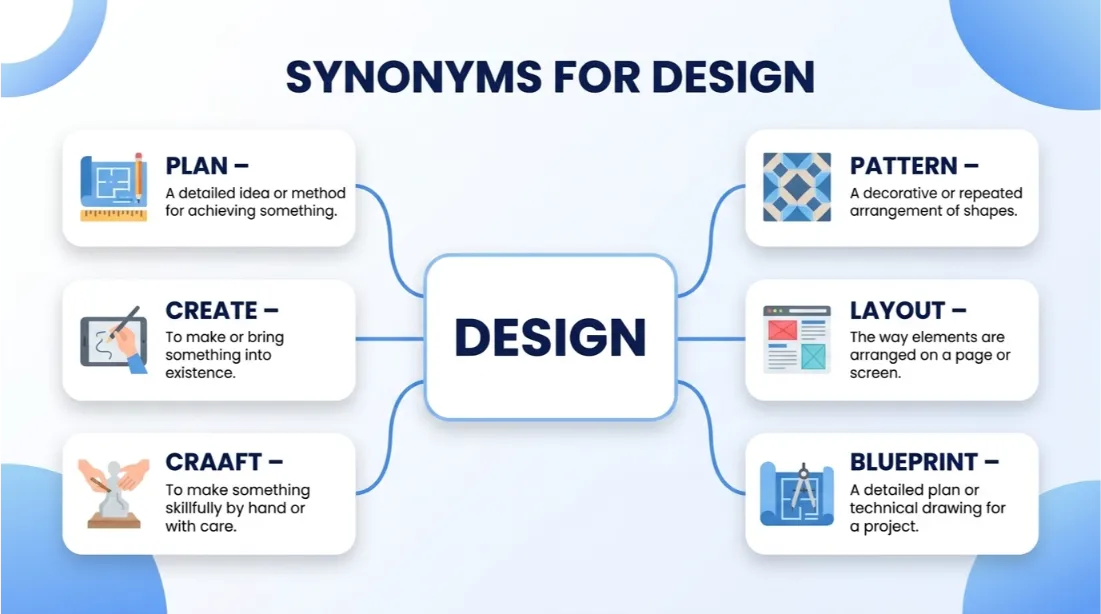
The most versatile and direct synonym for “design” when referring to creating a plan or structure is blueprint. When referring to the act of creating or planning itself, the strongest general alternative is create.
However, because “design” functions as both a noun and a verb across physical, visual, and intellectual fields, the ideal choice depends on your exact context:
- Plan: Best used when referring to organized, step-by-step intentions or forward-thinking strategy rather than physical aesthetics.
- Draft: Ideal for preliminary sketches, early structural outlines, or initial iterations of a technical project.
- Craft: Perfect for highlighting skillful handiwork, deliberate artistic attention, or meticulous personal effort.
- Conceive: Excellent for the purely mental phase of generating a unique idea, concept, or original vision from scratch.
Quick Reference: 30 Alternatives to Design
| Synonym | One-Line Meaning |
| Blueprint | A detailed technical plan, outline, or structural guide. |
| Plan | A thought-out scheme or arranged method for doing something. |
| Draft | A preliminary sketch, outline, or version of a work. |
| Layout | The spatial arrangement or visual setup of elements. |
| Pattern | A decorative motif or a repeated structural guide. |
| Schema | A systematic framework or structured diagram. |
| Model | A three-dimensional representation or structural baseline. |
| Prototype | An initial working model built for testing and refinement. |
| Framework | A basic underlying structure or conceptual system. |
| Outline | A foundational summary or exterior boundary sketch. |
| Structure | The arrangement and organization of interconnected parts. |
| Diagram | A simplified visual representation of information or machinery. |
| Format | The overall shape, size, or presentation style of content. |
| Composition | The deliberate arrangement of artistic or visual elements. |
| Sketch | A quick, unpolished drawing capturing core features. |
| Craft | To fashion or make something with great skill and care. |
| Construct | To build or assemble a physical or intellectual system. |
| Devise | To plan or invent something clever through careful thought. |
| Formulate | To prepare or express an idea in a precise, systematic way. |
| Conceive | To form an idea, plan, or concept in the mind. |
| Engineer | To design, build, or manage something with technical precision. |
| Fabricate | To manufacture, construct, or assemble components. |
| Architect | To carefully plan, structure, and direct a complex system. |
| Contrive | To pull off or plan something through clever, sneaky ingenuity. |
| Fashion | To shape, mold, or give form to a material or idea. |
| Originate | To initiate, invent, or bring something new into existence. |
| Mastermind | To plan and direct a complex project or secret scheme. |
| Map | To plot, plan, or outline a detailed path or structure. |
| Shape | To influence, guide, or physically form the outline of something. |
| Frame | To construct the basic boundary, logic, or support system. |
30 Detailed Synonyms for Design
1. Blueprint
- Meaning: A detailed technical plan, structural guide, or comprehensive outline.
- Explanation: Blueprint brings an authoritative, highly professional tone to your text. While “design” can mean a rough aesthetic idea, a blueprint carries the weight of technical precision, actionable steps, and structural integrity. Use it in architectural, engineering, or corporate contexts when describing a thorough roadmap for execution. It tells the reader that every single detail has been calculated and planned for success.
- Example 1: The engineering team presented a clear blueprint for the new urban transit system.
- Example 2: Her strategic roadmap served as the operational blueprint for the company’s expansion.
2. Plan
- Meaning: A thought-out scheme or arranged method for achieving an objective.
- Explanation: “Plan” is an accessible, highly practical term that works seamlessly across everyday conversations and formal business environments. Unlike “design,” which often highlights visual appearance or artistic form, “plan” focuses on sequence, foresight, and logistics. It shifts the attention away from aesthetics and places it directly onto strategy, practical steps, and future execution.
- Example 1: We need to assemble a solid plan before presenting the budget to investors.
- Example 2: The city’s disaster response plan was updated after the recent storms.
3. Draft
- Meaning: A preliminary sketch, initial version, or working outline.
- Explanation: Draft emphasizes process over final perfection. It carries an informal to neutral tone, signaling that the work is still in progress, open to feedback, and subject to modification. It fits naturally in creative writing, software engineering, architecture, and policy drafting. Use it when you want to make it clear that the current version is an exploratory starting point rather than a polished product.
- Example 1: He submitted a rough draft of the building’s floorplan for client approval.
- Example 2: The legal team reviewed the first draft of the agreement before signing.
4. Layout
- Meaning: The spatial arrangement or visual setup of physical and digital elements.
- Explanation: Layout is a specialized visual term heavily used in print publishing, web development, interior architecture, and user experience work. It differs from “design” by strictly focusing on spatial relationships—where text, images, furniture, or buttons sit relative to one another. Use it when discussing usability, spatial flow, or visual hierarchy.
- Example 1: The magazine editor changed the article’s layout to feature larger images.
- Example 2: Customers found the new website layout much easier to navigate on mobile devices.
5. Pattern
- Meaning: A decorative motif or a repeated structural guide used for reproduction.
- Explanation: Pattern denotes repetition, consistency, and template-like reliability. It works well in textile work, industrial design, behavior analysis, and software development. Unlike the broad term “design,” a pattern explicitly implies that a specific arrangement can be copied or observed repeatedly over time. It carries a ground-level, practical tone.
- Example 1: The tailor cut the fabric according to a traditional sewing pattern.
- Example 2: Researchers noticed a clear behavioral pattern emerging across the test subjects.
6. Schema
- Meaning: A systematic framework, organized database structure, or mental diagram.
- Explanation: “Schema” is a formal, highly academic, and technical synonym. You will encounter it primarily in data science, software architecture, cognitive psychology, and philosophy. It carries an intellectual tone, referring to the hidden logical structure or underlying database relationships that hold a system together, rather than its outward visual appearance.
- Example 1: The database administrator updated the system schema to handle larger datasets.
- Example 2: According to cognitive psychology, people organize information into mental schemas.
7. Model
- Meaning: A physical three-dimensional representation or conceptual baseline.
- Explanation: Model acts as a tangible or conceptual prototype that represents a larger system. It carries a neutral, informative tone suitable for science, finance, fashion, and construction. While a design can exist purely as a thought or sketch, a model implies a functional or visual-scale version built to test real-world application.
- Example 1: Architects built a miniature scale model of the museum to show the city council.
- Example 2: The financial analyst created a forecasting model to predict quarterly revenue.
8. Prototype
- Meaning: An early, functional working sample built for testing and validation.
- Explanation: Prototype carries an energetic, innovative tone strongly tied to tech startups, product engineering, and industrial manufacturing. It goes a step beyond a simple design sketch by delivering a working, testable product. Use it when emphasizing experimentation, practical testing, user feedback, and iterative improvement.
- Example 1: Engineers tested the battery performance on the latest drone prototype.
- Example 2: The software startup launched a working prototype to gather early user feedback.
9. Framework
- Meaning: A basic underlying support system, structure, or conceptual boundary.
- Explanation: “Framework” is a powerful, formal substitute when discussing abstract systems, legal policies, software foundations, or corporate governance. It emphasizes the foundational bones that hold an entire endeavor together. Use it when you want to sound strategic and authoritative, focusing on the rules, logic, or support system rather than decorative surface details.
- Example 1: The policy provides a legal framework for managing regional water resources.
- Example 2: Web developers chose a popular JavaScript framework to speed up construction.
10. Outline
- Meaning: A concise summary, foundational plan, or exterior boundary drawing.
- Explanation: The outline focuses on simplicity and high-level structure. It carries a conversational, pragmatic tone ideal for writing, project kickoffs, and initial briefings. It tells the reader that you are looking at the big picture without getting bogged down in microscopic details. It implies the core frame is set, but the interior details still need filling in.
- Example 1: She wrote a quick outline of her presentation before drafting the slides.
- Example 2: The artist drew a thin pencil outline on the canvas before applying oil paint.
11. Structure
- Meaning: The overall arrangement and organization of interconnected parts.
- Explanation: Structure carries a firm, stable tone focused on how components fit together to form a whole. It translates well between physical building construction, literary organization, corporate hierarchy, and biology. Unlike “design,” which can imply surface aesthetics, structure emphasizes strength, logic, load-bearing capacity, and functional organization.
- Example 1: The organizational structure was redesigned to improve communication between departments.
- Example 2: Inspectors checked the concrete structure of the bridge for signs of wear.
12. Diagram
- Meaning: A simplified visual representation illustrating how something works or connects.
- Explanation: “Diagram” is an informative, educational term. It moves away from pure artistic creativity and toward clear visual explanation. Use it when describing technical manuals, instructional guides, workflow charts, or scientific illustrations where the goal is helping someone understand a process or mechanical assembly.
- Example 1: The instruction manual included a detailed diagram showing how to assemble the desk.
- Example 2: The electrician examined the wiring diagram to find the faulty connection.
13. Format
- Meaning: The overall style, layout, arrangement, or physical setup of media.
- Explanation: “Format” is a practical descriptor used extensively in digital media, publishing, broadcast, and data storage. It specifies the medium’s structural rules—such as page margins, file types, or episode structures—rather than artistic choices. It carries a clean, professional, and objective tone.
- Example 1: The team decided to change the podcast format from interviews to narrative storytelling.
- Example 2: Please make sure your report follows the standard submission format required by the board.
14. Composition
- Meaning: The intentional, harmonious arrangement of elements in art or media.
- Explanation: Composition brings an elevated artistic and aesthetic tone to your writing. It is the premier word for fine art, photography, music, and graphic design. It describes how balance, contrast, light, and placement work together to evoke a specific visual or emotional reaction from the viewer.
- Example 1: The photographer paid close attention to the composition, using natural light to frame the subject.
- Example 2: Scholars praised the painter’s masterful composition and vibrant use of color.
15. Sketch
- Meaning: A quick, rough, unpolished drawing or brief summary.
- Explanation: Sketch carries a casual, fluid, and spontaneous tone. It captures the very first spark of an idea before formal planning begins. Use it in creative or problem-solving contexts when you want to convey speed, rough concepts, and lighthearted exploration without the weight of a finalized commitment.
- Example 1: The industrial designer jotted down a quick sketch on a napkin during lunch.
- Example 2: He gave a brief sketch of his proposed marketing campaign during the team check-in.
16. Craft
- Meaning: To skillfully fashion, make, or construct something with meticulous care.
- Explanation: Craft shifts focus entirely to personal skill, dedication, and human artistry. It carries a warm, passionate, and high-quality tone. Use it when describing handmade goods, carefully polished writing, tailor-made solutions, or artisan products where human touch and expertise are the selling points.
- Example 1: The artisan spent months learning how to craft custom wooden furniture by hand.
- Example 2: The speechwriter worked tirelessly to craft a moving address for the ceremony.
17. Construct
- Meaning: To build, assemble, or systematically frame a physical or abstract object.
- Explanation: Construct is an active, grounded verb that implies heavy lifting, deliberate assembly, and structural build-up. It works well for physical buildings as well as intellectual concepts like legal arguments, theories, or mathematical proofs. It feels more substantial and systematic than simply using “make” or “design.”
- Example 1: Builders worked throughout the summer to construct the new community center.
- Example 2: The defense attorney carefully constructed an unshakeable argument for her client.
18. Devise
- Meaning: To invent, formulate, or plan something clever through intellectual effort.
- Explanation: Devise carries an energetic, clever tone focused on mental ingenuity and problem-solving. Use it when someone overcomes a challenge, invents a clever workaround, or cooks up a complex scheme. It highlights human sharp-mindedness and strategic creativity far better than a simple word like “plan.”
- Example 1: The team met in the conference room to devise a new strategy for retaining customers.
- Example 2: Engineers devised an ingenious solution to prevent the pipes from freezing in sub-zero weather.
19. Formulate
- Meaning: To develop, prepare, or state an idea or product in a systematic way.
- Explanation: “Formulate” carries a precise, formal, and scientific tone. It applies equally well to mixing chemical recipes, preparing corporate policies, or building mathematical equations. Use it when process, methodical testing, and exactness are critical to achieving the final outcome.
- Example 1: Chemists worked in the lab to formulate a non-toxic household cleaning solution.
- Example 2: The committee was tasked with formulating a comprehensive safety policy for the school.
20. Conceive
- Meaning: To form an original idea, vision, or mental concept from scratch.
- Explanation: Conceive targets the absolute origin of an idea—the exact moment of mental creation. It carries an intellectual, inspiring tone suitable for artistic visionaries, inventors, and entrepreneurs. Use it when highlighting creative imagination before any physical work or drafting actually takes place.
- Example 1: The director conceived the idea for the sci-fi movie while traveling across the country.
- Example 2: It is difficult to conceive how much technology will change over the next fifty years.
21. Engineer
- Meaning: To plan, build, or manage a system or product with technical precision.
- Explanation: The engineer brings a powerful tone of technical mastery, calculated efficiency, and problem-solving skill. Beyond literal mechanical engineering, it works wonderfully in business and political contexts to describe meticulous, highly controlled maneuvering designed to achieve an exact result.
- Example 1: The software firm managed to engineer a high-speed platform that handles millions of users.
- Example 2: The campaign manager helped engineer a surprising political comeback in the final weeks.
22. Fabricate
- Meaning: To manufacture, assemble, or construct components; can also mean to invent a lie.
- Explanation: In industrial contexts, fabricate carries a precise manufacturing tone, referring to cutting, shaping, and assembling raw metal or materials into finished parts. Note its dual nature: in everyday social contexts, it often means making up false information or lies. Keep context clear when deploying this word.
- Example 1: The machine shop was hired to fabricate custom aluminum brackets for the racing car.
- Example 2: Modern factories use automated robotic arms to fabricate complex circuit boards.
23. Architect
- Meaning: To strategically plan, organize, and direct a large-scale project or system.
- Explanation: Using “architect” as a verb elevates your writing, giving it an executive, visionary tone. It goes far beyond drawing floor plans, applying to complex software frameworks, corporate mergers, or historical treaties. It emphasizes grand-scale vision combined with master leadership.
- Example 1: She was asked to architect the company’s transition to cloud-based operations.
- Example 2: The diplomats worked for months to architect a lasting peace agreement in the region.
24. Contrive
- Meaning: To plan or bring about a situation through cleverness, scheming, or artificial means.
- Explanation: Contrive carries a slightly suspicious, dramatic, or literary tone. It implies that the resulting design or plan feels somewhat forced, unnatural, or overly sneaky. Use it in creative storytelling or critiques when a solution feels overly complicated or calculated rather than natural.
- Example 1: The plot relied on a contrived coincidence that felt unrealistic to the audience.
- Example 2: He managed to contrive an excuse to leave the awkward dinner party early.
25. Fashion
- Meaning: To give shape, form, or aesthetic structure to a material or idea.
- Explanation: Fashion as a verb brings an organic, elegant, and classic feel to your descriptions. It implies shaping raw materials through patience, manual skill, and adaptability. Use it when describing how someone transforms basic materials—like clay, metal, words, or stone—into something refined.
- Example 1: The survivalist managed to fashion a makeshift fishing hook out of a paperclip.
- Example 2: She fashioned a successful career out of her passion for vintage fashion photography.
26. Originate
- Meaning: To initiate, invent, or bring a new concept into existence.
- Explanation: Originate focuses squarely on being first. It carries a formal, authoritative tone that highlights innovation and authorship. Use it when giving credit to the creator of a movement, technique, patent, or style, distinguishing them from those who merely copy or iterate later.
- Example 1: The culinary style originated in small coastal villages before spreading worldwide.
- Example 2: Scientists at the university originated a groundbreaking treatment method for the disease.
27. Mastermind
- Meaning: To plan, direct, and oversee a complex, highly coordinated operation.
- Explanation: Mastermind brings a high-stakes, dramatic tone to your text. It paints the creator as a brilliant strategist pulling the strings behind the scenes. Use it when describing major technological breakthroughs, elaborate corporate maneuvers, or dramatic heist stories in creative writing.
- Example 1: The head strategist worked silently behind the scenes to mastermind the entire election campaign.
- Example 2: She managed to mastermind the merger between the two international tech giants.
28. Map
- Meaning: To systematically plot, trace, or outline a course of action or structural network.
- Explanation: “Map” (or “map out”) is a clear, highly visual verb favored in business strategy, neurobiology, user experience design, and project planning. It emphasizes charting uncharted territory, laying out clear paths, and visualizing complex spatial or procedural relationships.
- Example 1: We need to map out the customer journey to identify where people drop off.
- Example 2: Researchers are working diligently to map the neural pathways of the human brain.
29. Shape
- Meaning: To guide, influence, or physically mold the outline and nature of something.
- Explanation: Shape is a versatile, evocative word that works well in both physical and metaphorical settings. It carries an influential, organic tone. Use it when discussing how environments, mentorship, artistic choices, or cultural trends influence the final identity of a person, policy, or product.
- Example 1: Early childhood experiences play an enormous role in shaping adult personality traits.
- Example 2: The sculptor used his hands to gently shape the wet clay on the spinning wheel.
30. Frame
- Meaning: To construct the essential support boundary, logical structure, or perspective.
- Explanation: Frame focuses on boundaries and perspective. In construction, it refers to setting up the load-bearing studs. In communication and politics, it means setting up how an argument is presented to influence public perception. It carries a sharp, strategic tone.
- Example 1: Carpenters spent the morning framing the exterior walls of the suburban house.
- Example 2: The candidate worked hard to frame the debate around economic growth and job creation.
Formal vs. Informal Synonyms
To ensure your expressive writing always lands correctly with your audience, you must match your synonym choice to your context. Deploying overly academic jargon in a casual conversation feels unnatural, while using slang terms in a technical proposal harms your professional authority.
Formal & Technical Settings
Use these terms in business proposals, academic papers, architectural briefs, and engineering documentation where precision and authority are paramount:
- Blueprint (e.g., a blueprint for corporate restructuring)
- Formulate (e.g., formulate a regulatory policy)
- Schema (e.g., updating the database schema)
- Architect (e.g., architecting a cloud infrastructure)
- Prototype (e.g., testing an industrial prototype)
Informal & Conversational Settings
Use these choices in informal emails, personal blogs, creative stories, or everyday workplace conversations where clarity and conversational movement matter most:
- Draft (e.g., a quick draft of the email)
- Sketch (e.g., sketching out a fun vacation idea)
- Craft (e.g., crafting a homemade birthday card)
- Plan (e.g., making a simple weekend plan)
- Map (e.g., mapping out our daily route )
Frequently Asked Questions
What is the most common synonym for “design”?
The most versatile general synonym for “design” as a noun is “plan” or “blueprint.” When used as a verb, create, draft, or devise are the most natural, widely understood alternatives across daily conversations.
Can I use “blueprint” for non-building projects?
Yes, absolutely. “Blueprint” is widely used as a metaphor in business, strategy, and personal development to describe any detailed, step-by-step roadmap or master plan designed for successful execution.
What is the difference between “draft” and “prototype”?
A draft refers to an early, unpolished version of a document, sketch, or written piece. A prototype refers specifically to a functional, physical, or digital working sample created to test mechanical or user usability.
Is “architect” acceptable to use as a verb?
Yes. In modern business, technology, and formal writing, using “architect” as a verb (e.g., “to architect a solution”) is widely accepted and carries a powerful tone of high-level strategic planning.
Which synonym works best for fine art and photography?
Composition is the ideal choice for fine art and photography. It describes how visual elements, light, line, color, and balance are deliberately arranged within a frame to create aesthetic harmony.
Conclusion
Expanding your vocabulary is one of the most effective steps you can take to enhance your language skills and improve your writing quality. As we have explored throughout this guide, replacing a repetitive term like “design” with targeted alternatives—such as an architected strategy, an inspired composition, a functional prototype, or a cleverly devised plan—immediately gives your prose greater precision, emotional range, and clarity.
Varying your word choice prevents your content from feeling monotonous or formulaic. Instead, thoughtful language selection keeps your audience engaged, clearly conveys your specific intent, and establishes your authority as a writer. If you are drafting a business proposal, writing an academic paper, or crafting creative stories, selecting the exact right word ensures your message resonates deeply with readers.
Try incorporating three or four of these newly learned synonyms into your next writing project or daily workplace communication. Pay attention to how changing a single descriptor can alter the energy, professionalism, and impact of an entire sentence. Embrace expressive writing, refine your word choice, and watch your communication skills reach new heights!

My name is Emily Johnson, and I am an English content writer with a strong passion for language and communication. I enjoy exploring the beauty of words and turning complex vocabulary into simple, easy-to-understand explanations. My work mainly focuses on synonyms, antonyms, word meanings, and practical writing tips that help people improve their English skills step by step.