Have you ever tried to describe a total mess, but the word “ruin” felt too weak? Imagine a massive storm hitting a coastal town, leaving broken trees and damaged houses everywhere. You need the right word to describe that overwhelming loss, but “damage” simply doesn’t capture the full picture.
The word “destruction” means the act of completely ruining or breaking something so it cannot be fixed. However, using different synonyms for destruction helps you express exact ideas without sounding repetitive or vague. Each synonym carries its own unique shade of meaning, allowing you to paint more vivid pictures with your words.
Learning these synonyms for “destruction” is incredibly valuable for the following:
- Students writing compelling essays and research papers
- Bloggers creating vivid, engaging stories
- Content writers crafting powerful headlines and marketing copy
- Anyone who wants to speak clearer, more precise English
Let’s explore 50 useful synonyms for destruction organized by category to make your writing shine. Whether you’re describing a natural disaster, a business failure, or an emotional setback, you’ll find the perfect word here.
Quick Reference Table: Top 20 Destruction Synonyms
| Word | Meaning | Best Used For |
| Devastation | Severe damage causing great loss | Natural disasters, emotional impact |
| Havoc | Widespread confusion and destruction | Chaos, unexpected events |
| Annihilation | Complete destruction leaving nothing | Military, severe defeat |
| Obliteration | Wiping out without trace | Physical destruction, erasing evidence |
| Demolition | Intentional knocking down | Buildings, structures |
| Carnage | Widespread killing and destruction | Violence, accidents |
| Eradication | Wiping out completely | Diseases, pests, problems |
| Ravage | Severe widespread damage | Natural disasters, war |
| Sabotage | Intentional destruction to harm | Competitors, enemies |
| Desolation | Empty, devastated state | Emotional states, abandoned places |
| Extinction | Complete dying out | Species, ideas, practices |
| Collapse | Sudden falling down | Systems, structures, organizations |
| Downfall | Sudden loss of power | Careers, businesses, leaders |
| Dissolution | Breaking up formally | Organizations, partnerships |
| Extirpation | Pulling out by roots | Weeds, problems, pests |
| Shattering | Breaking into tiny pieces | Glass, trust, dreams |
| Vandalism | Intentional property damage | Public spaces, private property |
| Subversion | Secret weakening of systems | Governments, organizations |
| Crushing | Pressing to break or flatten | Spirits, objects, dreams |
| Defeat | Destroying hope or plans | Teams, plans, ambitions |
Complete and Total Destruction
These synonyms describe destruction so thorough that nothing remains. They represent the most extreme forms of destruction.
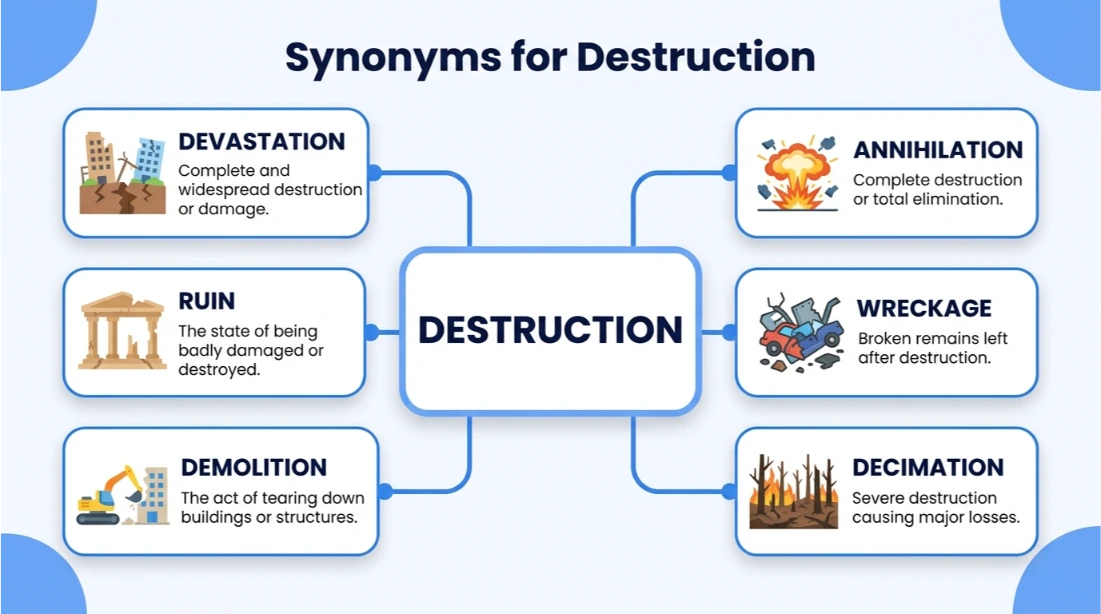
1. Annihilation
Meaning: Destroying something so completely that nothing remains.
Examples:
- The powerful blast resulted in the total annihilation of the target area.
- Our team suffered complete annihilation in the championship match.
2. Obliteration
Meaning: Wiping something out until no trace is left.
Examples:
- The heavy snowfall caused the total obliteration of all trail marks.
- The storm led to the complete obliteration of the small wooden shed.
3. Eradication
Meaning: Destroying or wiping out something entirely.
Examples:
- Doctors work tirelessly for the eradication of dangerous diseases worldwide.
- The farmer focused on the complete eradication of harmful garden pests.
4. Extinction
Meaning: Complete destruction or dying out of something.
Examples:
- An asteroid impact led to the extinction of dinosaurs millions of years ago.
- Many rare animal species face the threat of extinction today.
5. Elimination
Meaning: Removing or getting rid of something entirely.
Examples:
- Proper hand washing leads to the elimination of harmful germs.
- Our team celebrated the elimination of our strongest rival.
6. Extermination
Meaning: Destroying completely by killing, especially pests.
Examples:
- We hired professionals for the extermination of termites in our basement.
- Complete extermination of rats keeps the food warehouse safe.
7. Extirpation
Meaning: Pulling something out by the roots to destroy it.
Examples:
- Gardeners work on the extirpation of deep-rooted weeds every spring.
- The complete extirpation of the pest population saved the fruit trees.
8. Decimation
Meaning: Destroying a large part of something.
Examples:
- A terrible disease caused the decimation of local farm animals.
- Harsh winter weather led to the decimation of the apple crop.
9. Devastation
Meaning: Severe damage that causes great sadness or loss.
Examples:
- The powerful earthquake caused severe devastation across the entire city.
- We were shocked by the devastation left behind by the forest fire.
10. Havoc
Meaning: Widespread destruction and total confusion.
Examples:
- The sudden snowstorm wreaked havoc on morning traffic.
- Playful puppies can cause havoc in a clean living room.
11. Desolation
Meaning: A state of complete destruction and loneliness.
Examples:
- The abandoned town was left in complete desolation after the flood.
- A deep sense of desolation filled the quiet, empty streets.
12. Ravaging
Meaning: Causing severe and widespread damage to an area.
Examples:
- The ravaging of the coastline by powerful waves worried local residents.
- Insects caused the complete ravaging of the green corn field.
13. Carnage
Meaning: Widespread damage, killing, or messy destruction.
Examples:
- The hurricane left scenes of awful carnage along the beach.
- Emergency workers rushed to clean up the accident carnage.
14. Wreckage
Meaning: The broken remains of something that was destroyed.
Examples:
- Workers cleared the wreckage from the highway after the crash.
- Searchers found the plane wreckage deep inside the dense jungle.
15. Ruin
Meaning: The complete destruction or downfall of something.
Examples:
- The heavy rain brought total ruin to the old mud house.
- Spilling juice on my assignment was the ruin of my hard work.
16. Ruination
Meaning: The process of being destroyed or ruined.
Examples:
- Gambling brought complete financial ruination to his family.
- Years of neglect caused the gradual ruination of the historic castle.
17. Damage
Meaning: Physical harm that lowers the value or usefulness.
Examples:
- The hail storm caused severe damage to the car windows.
- Smoking causes permanent damage to your lungs over time.
18. Harm
Meaning: Physical or mental damage to someone or something.
Examples:
- Frost can do serious harm to young garden plants.
- Proper protective gear prevents physical harm on the job.
19. Impairment
Meaning: Damaging something so it works less effectively.
Examples:
- Loud music can lead to permanent impairment of your hearing.
- Lack of sleep causes temporary impairment of focus and concentration.
20. Demolition
Meaning: The intentional knocking down or tearing apart of a building.
Examples:
- The city ordered the demolition of the unsafe old factory building.
- We watched the wrecking ball begin the demolition project.
21. Collapse
Meaning: Falling down or falling apart suddenly.
Examples:
- Heavy snow caused the sudden collapse of the garage roof.
- The unexpected collapse of the bridge blocked all river traffic.
22. Breakdown
Meaning: A sudden failure or collapse of a system or machine.
Examples:
- Engine failure caused a sudden breakdown of the delivery truck.
- Lack of communication led to a complete breakdown in negotiations.
23. Crash
Meaning: A violent collision that breaks things.
Examples:
- The sudden car crash completely ruined both vehicles.
- The computer crash resulted in the loss of all my important files.
24. Smashup
Meaning: A violent crash that destroys objects.
Examples:
- The icy road caused a multi-car smashup yesterday.
- Fortunately, everyone walked away safe from the terrible smashup.
25. Shattering
Meaning: The act of breaking something into tiny pieces violently.
Examples:
- The loud noise caused the shattering of the glass window.
- We heard the sudden shattering of dishes in the kitchen.
26. Shatter
Meaning: The act or result of breaking violently into small pieces.
Examples:
- The drop caused the ceramic vase to shatter on the floor.
- Bad news can instantly shatter a person’s trust.
27. Tearing Down
Meaning: Pulling apart a structure piece by piece.
Examples:
- Workers started the tearing down of the old wooden fence.
- Tearing down old walls created space for a nice city park.
28. Breaking
Meaning: Causing something to separate into pieces by force.
Examples:
- Careful handling prevents the breaking of fragile toys.
- The storm caused the breaking of several large tree branches.
29. Crushing
Meaning: Pressing something so hard that it breaks or flattens.
Examples:
- The heavy weight caused the crushing of the cardboard box.
- The news brought a crushing blow to their future plans.
30. Smashing
Meaning: Breaking something noisily into pieces by hitting hard.
Examples:
- We heard the loud smashing of wooden crates outside.
- Smashing the old tiles was the first step in remodeling.
31. Splintering
Meaning: Breaking into thin, sharp wood or bone pieces.
Examples:
- The hard impact caused the splintering of the wooden bat.
- We witnessed the splintering of the door during the break-in.
32. Ripping
Meaning: Tearing something apart violently and quickly.
Examples:
- Strong winds caused the ripping of the ship’s large sail.
- The dog started ripping the paper box into small bits.
33. Blasting
Meaning: Destroying or blowing up something using explosives.
Examples:
- Construction crews used blasting to clear rocks for the new road.
- The loud blasting shook the windows of nearby houses.
34. Wrecking
Meaning: The action of destroying or damaging a structure.
Examples:
- The wrecking crew moved in to clear the old building.
- Poor decisions led to the wrecking of their long friendship.
35. Overthrow
Meaning: Bringing down a leader or system by force.
Examples:
- The rebels planned the overthrow of the cruel government.
- The sudden vote led to the overthrow of the current club president.
36. Subversion
Meaning: Destroying or weakening an established system secretly.
Examples:
- The group was arrested for attempting subversion of state rules.
- Spreading fake news can lead to the subversion of truth.
37. Downfall
Meaning: A sudden loss of power, health, or success.
Examples:
- Dishonesty was the main cause of the manager’s downfall.
- Poor planning led to the quick downfall of the company.
38. Dissolution
Meaning: The closing down, breaking up, or ending of an organization.
Examples:
- Disagreements led to the dissolution of the business partnership.
- The dissolution of the old club made room for a new group.
39. Disruption
Meaning: Breaking apart an orderly system or event.
Examples:
- The power outage caused major disruption to the train schedule.
- Loud talking creates a big disruption during school exams.
40. Defeat
Meaning: The destruction of hope, plans, or a team in a contest.
Examples:
- The heavy score led to a painful defeat for our team.
- Bad weather caused the complete defeat of our camping plans.
41. Injury
Meaning: Physical harm or damage done to a body or system.
Examples:
- The fall caused a minor injury to his right knee.
- Always wear a helmet to prevent head injury while riding.
42. Loss
Meaning: The destruction or disappearance of something valuable.
Examples:
- The house fire caused a painful loss of family pictures.
- Poor sales resulted in a huge financial loss for the shop.
43. Sabotage
Meaning: Deliberately destroying something to stop an enemy or competitor.
Examples:
- Cutting the wires was a clear act of sabotage.
- Secret agents planned the sabotage of the enemy equipment.
44. Vandalism
Meaning: The intentional destruction of public or private property.
Examples:
- Spraying paint on city walls is a form of vandalism.
- The park closed early due to repeated acts of vandalism.
45. Slaughter
Meaning: The violent killing or destruction of many living things.
Examples:
- The war resulted in the tragic slaughter of innocent cattle.
- The sudden disease led to the slaughter of farm chickens.
46. Massacre
Meaning: The complete and violent destruction of a group.
Examples:
- The ancient army suffered a terrible massacre in the valley.
- Unchecked forest fires cause a massacre of local wildlife.
47. Waste
Meaning: The act of destroying, spoiling, or using something foolishly.
Examples:
- Leaving taps running is a terrible waste of clean water.
- The abandoned field turned into an empty, lonely waste.
48. Ruinage
Meaning: An informal word for the state of being destroyed.
Examples:
- The leaking roof caused the ruin of my new books.
- Neglect led to the complete ruin of the beautiful garden.
49. Desolation
Meaning: A feeling of complete emptiness and despair.
Examples:
- She felt total desolation after losing her beloved pet.
- The news left him in a state of emotional desolation.
50. Shattering
Meaning: The destruction of hopes, dreams, or trust.
Examples:
- The betrayal caused the shattering of their perfect relationship.
- The news brought a shattering blow to all our future plans.
Quick Reference: Synonyms by Context
| Context | Best Synonyms |
| Natural Disasters | Devastation, Havoc, Desolation, Ravaging |
| Buildings | Demolition, Collapse, Wrecking, Smash-up |
| Wars & Violence | Annihilation, Carnage, Massacre, Slaughter |
| Business/Organizations | Dissolution, Downfall, Overthrow, Defeat |
| Emotional/Abstract | Shattering, Ruination, Loss, Desolation |
| Intentional Harm | Sabotage, Vandalism, Subversion |
| Environmental | Eradication, Extinction, Extirpation |
| Accidental | Crash, Breakdown, Damage, Harm |
Frequently Asked Questions
What is the most common synonym for destruction?
“Ruin” and “devastation” are the two most common synonyms used in daily conversation. “Ruin” works well for personal losses, while “devastation” is more appropriate for widespread disasters.
Can destruction be used for non-physical things?
Yes, you can use destruction for non-physical things like dreams, trust, business relationships, careers, and reputations. For example: “The scandal caused the destruction of his career.”
What is the difference between destruction and damage?
Destruction means breaking something completely so it cannot be fixed or restored. Damage means harming something partially, often with the possibility of repair. A scratched car has damage; a completely crushed car has been destroyed.
What is a formal synonym for destruction?
“Annihilation,” “obliteration,” and “dissolution” are formal words used in academic, legal, and official contexts. “Eradication” is commonly used in medical and scientific writing.
How do I choose the right synonym for destruction?
Choose based on:
- Scale: “Demolition” for buildings, “devastation” for natural disasters
- Intent: “Sabotage” for deliberate harm, “collapse” for accidental failure
- Severity: “Annihilation” for complete loss, “damage” for partial harm
- Context: “Extinction” for species, “dissolution” for organizations
Practice Exercise: Test Your Knowledge
Fill in the blanks with the most appropriate synonym:
- The earthquake caused widespread __________ across the city. (Hint: severe damage with loss)
- The old building faced __________ to make room for a new mall. (Hint: intentional knocking down)
- Scientists work to prevent the __________ of endangered species. (Hint: complete dying out)
- The spy was arrested for __________ of military equipment. (Hint: deliberate destruction)
- The team suffered complete __________ in the final match. (Hint: total defeat)
Answers: 1. Devastation, 2. Demolition, 3. Extinction, 4. Sabotage, 5. Annihilation
Conclusion
Building a strong vocabulary is one of the easiest ways to become a more confident writer and speaker. By learning these 50 synonyms for destruction, you can describe different situations with greater accuracy and avoid repeating the same word over and over. If you’re writing about natural disasters, damaged buildings, environmental issues, historical events, business failures, or even broken relationships, choosing the right synonym helps your message become clearer and more engaging.
Remember that not every synonym has the same meaning or level of intensity. For example, “devastation” is commonly used for large-scale disasters, “demolition” refers to the intentional tearing down of buildings, and “annihilation” suggests complete destruction, while “damage” describes harm that may still be repairable. Understanding these subtle differences allows you to select the most appropriate word for every context.
The best way to remember new vocabulary is to use it regularly. Try replacing the word “destruction” with different alternatives in your essays, emails, stories, blog posts, or everyday conversations. Over time, these words will become a natural part of your vocabulary and help your writing sound more polished, expressive, and professional.
If you found this guide helpful, explore more synonym lists to continue expanding your English vocabulary and improve your communication skills one word at a time.

I’m Elaris Vane, a vocabulary enthusiast and English language writer at LexiBoost, where I help readers discover smarter and more natural ways to use English words. I enjoy simplifying complex vocabulary, explaining synonyms and antonyms, and breaking down confusing word differences into easy explanations.