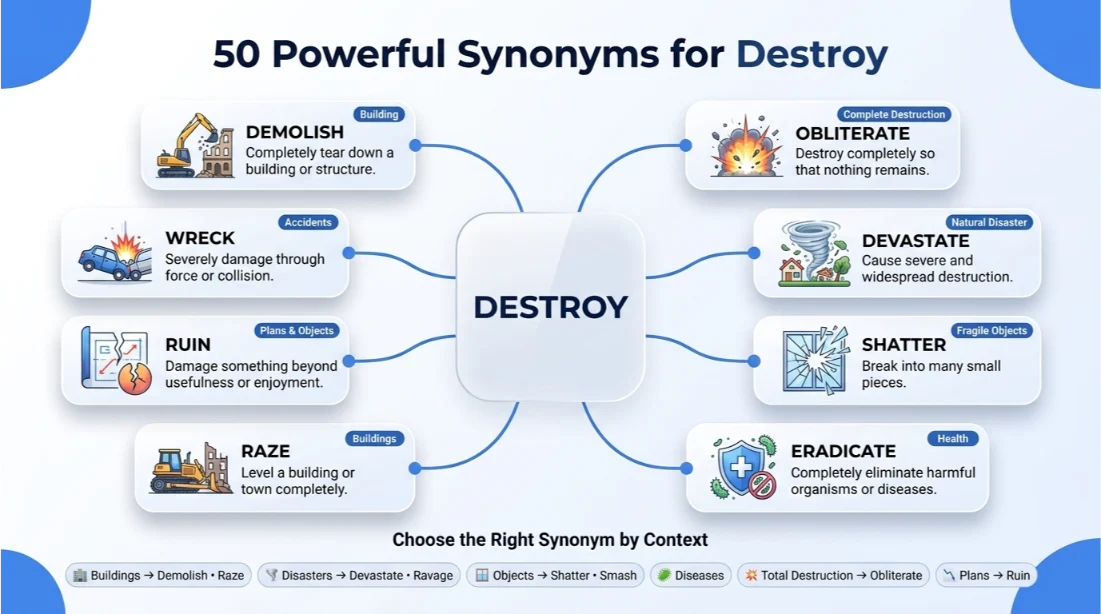
Have you ever found yourself using the word “destroy” again and again while writing an essay, story, email, or blog post? Although it’s a strong and useful word, repeating it too often can make your writing sound repetitive and less engaging. Expanding your vocabulary with the right alternatives helps you express ideas more clearly and choose words that perfectly match the situation.
In this guide, you’ll discover 50 powerful synonyms for destroy, each explained with a simple meaning, practical examples, and easy-to-understand usage. If you’re describing a building being torn down, a plan falling apart, or an object breaking beyond repair, there’s often a more accurate word than simply saying “destroy.”
Learning these synonyms isn’t just about sounding smarter; it also helps you become a more confident writer and speaker. Students can improve essays, professionals can write more polished emails, and content creators can produce more engaging articles. By the end of this guide, you’ll know when to use words like demolish, devastate, obliterate, shatter, and ruin, making your English richer, more precise, and far more effective in everyday communication.
What Does “Destroy” Mean?
The word “destroy” means to damage, ruin, or break something so completely that it can no longer be used, repaired, or restored. It can describe physical objects, buildings, nature, relationships, plans, or even abstract ideas. Depending on the context, “destroy” may refer to sudden damage, gradual ruin, or complete elimination.
Definition of Destroy
Destroy (verb): To completely damage, break, or end something so that it no longer exists or functions.
Pronunciation
Destroy: /dɪˈstrɔɪ/ (di-STROY)
Part of Speech
Verb
Common Uses of “Destroy”
The word “destroy” is commonly used in many everyday situations, including the following:
- Destroying a building during demolition.
- A fire destroying a forest.
- A storm destroying homes and roads.
- Bugs destroying crops in a field.
- A virus destroying important computer files.
- Negative habits destroying someone’s health.
- Strong evidence destroying an argument.
Simple Examples
- The earthquake destroyed several buildings in the city.
- A kitchen fire destroyed most of the family’s belongings.
- Too much moisture can destroy old books and photographs.
- Careless mistakes can destroy years of hard work.
- The powerful storm nearly destroyed the small fishing village.
Tip for Better Writing
While “destroy” is a strong and useful word, it isn’t always the most precise choice. For example, “demolish” is more suitable for buildings; “shatter” works better for glass; “eradicate” is commonly used for diseases or pests; and “ruin” often describes plans, reputations, or experiences. Choosing the most accurate synonym makes your writing clearer, more natural, and more engaging for readers.
When Should You Use the Word “Destroy”?
The word “destroy” is best used when you want to describe something being completely damaged, removed, or brought to an end. It suggests that the object, place, or idea can no longer exist, function, or be restored. However, choosing the right synonym based on the situation can make your writing more accurate and expressive.
Here are some of the most common situations where “destroy” is the right choice:
1. Physical Objects
Use destroy when an object is broken beyond repair or completely unusable.
Examples:
- The fire destroyed the old wooden barn.
- Dropping the laptop into water completely destroyed it.
2. Buildings and Structures
When buildings, bridges, or other structures are torn down or completely ruined, “destroy” is an appropriate general term. In some cases, a more specific synonym like “demolish” or “raze” may be even better.
Examples:
- The earthquake destroyed several apartment buildings.
- The city plans to destroy the unsafe bridge before rebuilding it.
3. Nature and Disasters
Natural disasters often destroy homes, forests, crops, and roads.
Examples:
- The hurricane destroyed hundreds of houses along the coast.
- Wildfires can destroy large areas of forest in just a few hours.
4. Technology and Data
The word “destroy” is also commonly used when files, devices, or digital information become permanently unusable.
Examples:
- The virus destroyed important company records.
- Heat can destroy the internal components of a computer.
5. Plans, Dreams, and Opportunities
You can also use destroy figuratively when something completely ends a goal, hope, or opportunity.
Examples:
- The unexpected cancellation destroyed our travel plans.
- One dishonest decision can destroy years of hard-earned trust.
6. Health and the Environment
“Destroy” is often used to describe serious harm to living things or ecosystems.
Examples:
- Pollution continues to destroy marine habitats.
- Smoking can gradually destroy lung tissue over time.
Writing Tip
Before using “destroy,” ask yourself if another word would be more precise. For example:
- Use “demolish” for buildings.
- Use shatter for glass or other fragile objects.
- Use “eradicate” for diseases, pests, or harmful organisms.
- Use “obliterate” when you want to emphasize complete destruction with no trace left.
- Use ruin when talking about plans, experiences, or reputations.
Choosing the most accurate word instead of relying on “destroy” every time makes your writing more vivid, professional, and enjoyable to read.
Top 50 Synonyms for Destroy
The English language offers many alternatives to the word “destroy,” but each has a slightly different meaning and is best suited to a particular context. Below are 50 carefully selected synonyms, along with their meanings, examples, and usage tips to help you choose the right word every time.
1. Ruin
Meaning:
To damage something so badly that it loses its value, usefulness, or enjoyment. It doesn’t always mean complete destruction.
Examples:
- Heavy rain can ruin an outdoor wedding.
- Spilling coffee on your laptop may ruin the keyboard.
Usage Tip: Use ruin for plans, experiences, reputations, clothing, or objects that become unusable or lose their value.
2. Wreck
Meaning:
To badly damage something through force, impact, or an accident.
Examples:
- The storm wrecked several fishing boats.
- Be careful not to wreck your new bicycle on rough trails.
Usage Tip: “Wreck” is commonly used for vehicles, buildings, and things damaged by accidents or natural disasters.
3. Demolish
Meaning:
To completely tear down or knock down a building or structure.
Examples:
- Workers will demolish the old stadium next month.
- The unsafe bridge was demolished to make way for a new one.
Usage Tip: Use “demolish” mainly for buildings, walls, bridges, and other structures.
4. Smash
Meaning:
To break something into pieces with great force.
Examples:
- He accidentally smashed the glass vase while moving furniture.
- The falling rock smashed the car’s windshield.
Usage Tip: Smash is ideal for glass, dishes, electronics, and other breakable objects.
5. Shatter
Meaning:
To break something hard and fragile into many small pieces.
Examples:
- The mirror shattered when it hit the floor.
- Extreme cold can cause glass to shatter unexpectedly.
Usage Tip: Use “shatter” for glass and ceramics and figuratively for dreams, confidence, or hopes.
6. Devastate
Meaning:
To cause severe destruction or overwhelming damage over a large area.
Examples:
- The wildfire devastated thousands of acres of forest.
- The earthquake devastated several nearby towns.
Usage Tip: Devastate is commonly used for natural disasters, wars, and emotionally overwhelming events.
7. Annihilate
Meaning:
To completely destroy or eliminate someone or something, leaving little or nothing behind.
Examples:
- The powerful explosion annihilated the abandoned warehouse.
- The championship team annihilated its opponents in the final match.
Usage Tip: Annihilate is often used in military, competitive, and figurative contexts.
8. Eradicate
Meaning:
To completely remove or destroy something harmful so that it no longer exists.
Examples:
- Scientists hope to eradicate the disease through vaccination.
- Farmers worked together to eradicate invasive weeds.
Usage Tip: Use “eradicate” for diseases, pests, viruses, or harmful practices, not physical objects.
9. Obliterate
Meaning:
To destroy something so completely that no trace remains.
Examples:
- The explosion obliterated the old bunker.
- Thick snow almost obliterated the hiking trail.
Usage Tip: “Obliterate” emphasizes total destruction or complete removal.
10. Raze
Meaning:
To completely destroy or level a building or area, usually by tearing it down or burning it.
Examples:
- The abandoned warehouse was razed to clear the land.
- Invading forces threatened to raze the village centuries ago.
Usage Tip: Raze is most often used for buildings, towns, and large structures that are completely leveled.
11. Crush
Meaning:
To press, squeeze, or compress something with great force until it breaks, loses its shape, or becomes unusable.
Examples:
- Be careful not to crush the eggs while carrying the grocery bag.
- The heavy machine crushed the empty cans for recycling.
Usage Tip: Use “crush” for soft or breakable objects that are damaged by pressure.
12. Wipe Out
Meaning:
To completely destroy, eliminate, or remove someone or something.
Examples:
- The powerful tsunami nearly wiped out the entire coastal village.
- The new treatment helped wipe out the infection.
Usage Tip: Wipeout is commonly used for populations, diseases, businesses, and large-scale destruction.
13. Trash
Meaning:
To severely damage or leave something in a very messy or unusable condition.
Examples:
- The guests trashed the rental house after the party.
- Strong winds trashed the campsite overnight.
Usage Tip: In informal English, trash often means to badly damage a place or object.
14. Vandalize
Meaning:
To deliberately damage or deface public or private property.
Examples:
- Someone tried to vandalize the park benches with spray paint.
- It is against the law to vandalize school property.
Usage Tip: Use “vandalize” when the damage is intentional, especially to public places or buildings.
15. Sabotage
Meaning:
To deliberately damage or interfere with something so that it fails or stops working properly.
Examples:
- The criminals attempted to sabotage the power station.
- False information can sabotage an important project.
Usage Tip: Sabotage often refers to intentionally causing failure rather than physically destroying something.
16. Dismantle
Meaning:
To take something apart piece by piece.
Examples:
- Workers will dismantle the old playground before installing new equipment.
- He carefully dismantled the computer to replace a damaged part.
Usage Tip: Dismantle suggests careful disassembly rather than violent destruction.
17. Despoil
Meaning:
To strip a place of its beauty, natural resources, or valuable possessions.
Examples:
- Illegal mining continues to despoil protected forests.
- Pollution can despoil rivers and lakes for generations.
Usage Tip: “Despoil” is most common in formal writing about nature, history, or cultural heritage.
18. Extinguish
Meaning:
To put out a fire or bring something to an end completely.
Examples:
- Firefighters worked quickly to extinguish the flames.
- The disappointing news extinguished their hopes of winning.
Usage Tip: Besides fires, “extinguish” is often used figuratively for hope, excitement, or enthusiasm.
19. Eliminate
Meaning:
To completely remove or get rid of something unwanted.
Examples:
- A good air purifier can eliminate dust from the room.
- The company introduced new rules to eliminate unnecessary expenses.
Usage Tip: “Eliminate” is commonly used in business, health, education, and everyday conversation.
20. Quell
Meaning:
To stop or bring something under control before it becomes worse.
Examples:
- Police were called to quell the disturbance.
- Deep breathing helped quell her anxiety before the presentation.
Usage Tip: Quell is usually used for emotions, protests, fears, or conflicts rather than physical objects.
21. Flatten
Meaning:
To knock something down until it becomes completely level with the ground.
Examples:
- The tornado flattened dozens of homes in just a few minutes.
- Workers used heavy machinery to flatten the old warehouse.
Usage Tip: “Flatten” is commonly used for buildings, trees, fields, and structures that are knocked down completely.
22. Break
Meaning:
To separate something into pieces or damage it so it no longer works properly.
Examples:
- Be careful not to break the glass while washing it.
- Dropping your phone can break the screen.
Usage Tip: “Break” usually means partial damage, but in some situations it can result in complete destruction.
23. Splinter
Meaning:
To break wood or another hard material into thin, sharp pieces.
Examples:
- The old fence began to splinter after years of exposure to rain.
- The impact caused the wooden door to splinter into pieces.
Usage Tip: Splinter is mainly used for wood and similar materials.
24. Damage
Meaning:
To cause physical harm that reduces the quality, appearance, or usefulness of something.
Examples:
- Heavy hail damaged several parked cars.
- Moisture can damage valuable books and documents.
Usage Tip: Use damage when something is harmed but may still be repaired or used.
25. Mutilate
Meaning:
To severely damage or disfigure a person, animal, or object.
Examples:
- The explosion mutilated several vehicles beyond recognition.
- Sharp machinery can mutilate materials if used carelessly.
Usage Tip: “Mutilate” is a very strong word and is most often used for severe physical damage.
26. Deface
Meaning:
To spoil the appearance of something by writing, painting, scratching, or marking it.
Examples:
- Vandals defaced the historic monument with graffiti.
- It is illegal to deface public property.
Usage Tip: “Deface” refers to damaging appearance rather than completely destroying an object.
27. Mar
Meaning:
To spoil or reduce the beauty, quality, or perfection of something.
Examples:
- Deep scratches marred the polished wooden table.
- A small error can mar an otherwise excellent presentation.
Usage Tip: Mar is often used in formal writing to describe minor but noticeable damage.
28. Decimate
Meaning:
To destroy a large part of something or greatly reduce its size, strength, or number.
Examples:
- The disease decimated the local bird population.
- The economic crisis decimated many small businesses.
Usage Tip: “Decimate” is commonly used for populations, armies, businesses, and natural disasters.
29. Ravage
Meaning:
To cause severe and widespread damage to a place, community, or environment.
Examples:
- The hurricane ravaged coastal towns overnight.
- Years of pollution have ravaged the river ecosystem.
Usage Tip: “Ravage” is frequently used when describing destruction caused by war, storms, fires, or disease.
30. Pulverize
Meaning:
To crush or grind something into very small pieces or powder.
Examples:
- The machine pulverized the rocks into fine gravel.
- The powerful blast pulverized the concrete wall.
Usage Tip: Pulverize emphasizes complete destruction through crushing or grinding and is often used in engineering, construction, and figurative writing.
31. Spoil
Meaning:
To reduce the quality, usefulness, or enjoyment of something.
Examples:
- Warm weather can spoil fresh food within a few hours.
- Revealing the ending will spoil the movie for everyone.
Usage Tip: Spoil is best used when something loses its quality or enjoyment rather than being physically destroyed.
32. Overthrow
Meaning:
To remove a government, ruler, or authority from power, usually by force.
Examples:
- The rebels attempted to overthrow the dictator.
- The revolution successfully overthrew the old government.
Usage Tip: Overthrow is used in political and historical contexts, not for physical objects.
33. Subvert
Meaning:
To secretly weaken, undermine, or destroy the authority of a system, organization, or belief.
Examples:
- False information can subvert public trust.
- Corruption may subvert a fair legal system.
Usage Tip: Use “subvert” when referring to ideas, governments, institutions, or authority.
34. Consume
Meaning:
To completely burn, use up, or destroy something.
Examples:
- The wildfire consumed thousands of acres of forest.
- Within minutes, the flames consumed the abandoned house.
Usage Tip: “Consume” is commonly used when fire, energy, or time completely uses up something.
35. Gut
Meaning:
To destroy the inside of a building while leaving the outer walls standing.
Examples:
- The fire gutted the historic theater overnight.
- Contractors gutted the old house before beginning renovations.
Usage Tip: Grout is mainly used for buildings damaged by fire or extensive remodeling.
36. Maul
Meaning:
To tear, crush, or severely damage through rough handling or an animal attack.
Examples:
- The bear mauled the campsite equipment.
- The powerful machine mauled the metal sheets during the accident.
Usage Tip: Maul often describes severe physical damage caused by force or animals.
37. Topple
Meaning:
To cause something tall to fall over.
Examples:
- Strong winds toppled several large trees.
- The earthquake toppled an old stone chimney.
Usage Tip: Topple is commonly used for trees, statues, towers, and other upright structures.
38. Level
Meaning:
To completely knock down or destroy a building or area until it is flat.
Examples:
- The explosion leveled several buildings.
- The bulldozers leveled the old factory to prepare the site for construction.
Usage Tip: “Level” is a powerful synonym often used in news reports about disasters and demolitions.
39. Corrode
Meaning:
To gradually destroy metal or other materials through chemical reactions.
Examples:
- Saltwater can corrode steel over time.
- Acid slowly corroded the metal pipe.
Usage Tip: “Corrode” refers to slow destruction caused by chemicals or rust.
40. Erode
Meaning:
To gradually wear away or destroy soil, rock, or other materials through natural forces such as wind or water.
Examples:
- Ocean waves continue to erode the coastline.
- Heavy rainfall can erode valuable farmland.
Usage Tip: “Erode” is commonly used for landscapes, soil, and rocks and figuratively for trust, confidence, or authority over time.
41. Dissolve
Meaning:
To cause a solid substance to break down and mix completely with a liquid until it is no longer visible in its original form.
Examples:
- Warm water will dissolve sugar in just a few seconds.
- The cleaning solution dissolved the stubborn residue.
Usage Tip: Dissolve is mainly used in scientific, cooking, and chemical contexts rather than for physical destruction.
42. Scorch
Meaning:
To burn the surface of something with intense heat without completely burning it.
Examples:
- Leaving the pan on the stove too long will scorch the food.
- The hot sun scorched the grass during the heatwave.
Usage Tip: “Scorch” refers to surface damage caused by heat and is less severe than “burn” or “destroy.”
43. Char
Meaning:
To burn something until its surface becomes black or partly turned into charcoal.
Examples:
- The campfire charred the wooden logs.
- The chef accidentally charred the edges of the steak.
Usage Tip: Char usually describes partial burning rather than complete destruction.
44. Blast
Meaning:
To destroy or break apart something with an explosion or a powerful burst of force.
Examples:
- Engineers used explosives to blast through the rocky hillside.
- The explosion blasted a hole in the concrete wall.
Usage Tip: Blast is commonly used in construction, mining, and military contexts.
45. Tear Down
Meaning:
To pull down or demolish a building or structure.
Examples:
- The city plans to tear down the abandoned shopping center.
- Workers began to tear down the old fence before installing a new one.
Usage Tip: “Tear down” is a common everyday alternative to “demolish.”
46. Break Apart
Meaning:
To separate into pieces because of force, pressure, or age.
Examples:
- The old wooden crate began to break apart after years of exposure to rain.
- The frozen ground caused the pavement to break apart.
Usage Tip: “Break apart” is often used for objects, structures, or materials that separate into pieces.
47. Cripple
Meaning:
To severely weaken or damage something so it can no longer function effectively.
Examples:
- The cyberattack cripple the company’s computer network.
- The severe storm cripple transportation across the region.
Usage Tip: “Cripple” is commonly used for systems, businesses, economies, and services. Because it can be sensitive when referring to people, use it thoughtfully.
48. Undo
Meaning:
To completely ruin or reverse the success or progress of something.
Examples:
- One careless mistake could undo months of hard work.
- Poor planning may undo all your previous efforts.
Usage Tip: Undo is often used for plans, achievements, progress, and relationships rather than physical objects.
49. Burn
Meaning:
To damage or destroy something through fire or intense heat.
Examples:
- The wildfire burned hundreds of acres of woodland.
- Be careful not to burn important documents.
Usage Tip: Burn is a broad term that can describe anything from minor scorching to complete destruction.
50. Decay
Meaning:
To gradually break down or be destroyed over time through age, moisture, or natural processes.
Examples:
- Without proper care, wooden fences will decay over the years.
- Fallen leaves naturally decay and enrich the soil.
Usage Tip: Decay describes slow, natural destruction rather than sudden damage caused by force.
Synonyms for “Destroy” by Context
Not every synonym for “destroy” fits every situation. Some words are better for buildings, while others are more suitable for emotions, technology, business, or nature. Choosing the right synonym makes your writing more accurate, natural, and engaging.
Best Synonyms for Destroying Buildings
When talking about buildings, bridges, walls, or other structures, these words are the most appropriate:
- Demolish – To intentionally tear down a building.
- Raze – To completely level a structure or area.
- Level – To knock something flat to the ground.
- Flatten – To make something completely flat after destruction.
- Tear Down – A common everyday phrase for removing a building.
Example:
The old shopping mall was demolished to make room for a new development.
Best Synonyms for Natural Disasters
These words describe widespread destruction caused by nature.
- Devastate
- Ravage
- Wreck
- Flatten
- Consume
Example:
The hurricane devastated several coastal communities in just a few hours.
Best Synonyms for Fire and Explosions
Use these words when describing destruction caused by heat, flames, or blasts.
- Burn
- Char
- Scorch
- Blast
- Consume
Example:
The explosion blasted a hole through the concrete wall.
Best Synonyms for Glass and Fragile Objects
These words work best for breakable items.
- Shatter
- Smash
- Break
- Crush
- Splinter (for wood)
Example:
The glass vase shattered when it slipped from the shelf.
Best Synonyms for Technology and Digital Data
These words describe damage to computers, systems, or digital information.
- Destroy
- Erase
- Eliminate
- Cripple
- Sabotage
Best Synonyms for Business and Projects
These words describe setbacks, failure, or serious disruption.
- Ruin
- Undo
- Sabotage
- Subvert
- Cripple
Example:
Poor financial planning can ruin even a successful business.
Best Synonyms for Health and Diseases
These words are often used in medical, scientific, and health-related writing.
- Eradicate
- Eliminate
- Wipe Out
- Destroy
Example:
Researchers hope to eradicate the disease through improved vaccines.
Best Synonyms for Nature and the Environment
These words describe gradual or widespread environmental destruction.
- Erode
- Corrode
- Ravage
- Despoil
- Consume
Example:
Years of pollution have despoiled the river and surrounding wildlife.
Best Formal Synonyms for Destroy
If you’re writing an essay, report, or professional document, these words sound more formal.
- Obliterate
- Annihilate
- Eradicate
- Decimate
- Devastate
- Demolish
- Subvert
- Nullify
- Despoil
- Pulverize
Best Everyday Alternatives to Destroy
For daily conversations and informal writing, these words are easier and more natural.
- Break
- Smash
- Ruin
- Wreck
- Tear Down
- Trash
- Burn
- Crush
- Spoil
- Damage
Common Mistakes When Using “Destroy”
The word “destroy” is powerful, but it’s not always the best choice. Many English learners use it in situations where a more precise word would sound more natural. Understanding these common mistakes will help you write with greater accuracy and confidence.
1. Using Destroy Instead of Damage
One of the most common mistakes is using “destroy” when something is only partly harmed.
❌ Incorrect: The storm destroyed my car, but it was repaired a week later.
✅ Correct: The storm damaged my car, but it was repaired a week later.
Why?
If something can still be repaired or used, damage is usually the better word.
2. Using Destroy Instead of Ruin
“Destroy” often refers to physical destruction, while “ruin” is commonly used for plans, experiences, reputations, or enjoyment.
❌ Incorrect: The rain destroyed our vacation.
✅ Better: The rain ruined our vacation.
More examples:
- The surprise ending ruined the movie.
- One mistake can ruin a good reputation.
3. Using “Destroy” Instead of “Demolish”
When talking about buildings or structures that are intentionally torn down, “demolish” is the more accurate choice.
❌ General: The workers will destroy the old building.
✅ More Precise: The workers will demolish the old building.
4. Using Destroy Instead of Shatter
For glass, mirrors, ceramics, and other fragile objects, shatter creates a clearer and more vivid image.
❌ General: She destroyed the glass vase.
✅ More Natural: She shattered the glass vase.
5. Using “Destroy” Instead of “Eradicate”
When talking about diseases, insects, weeds, viruses, or harmful bacteria, “eradicate” is usually the best word.
❌ General: Scientists hope to destroy the disease.
✅ More Accurate: Scientists hope to eradicate the disease.
6. Using Destroy Instead of Obliterate
If you want to emphasize that nothing remains after the destruction, “obliterate” is a stronger choice.
Example:
- The explosion obliterated the abandoned warehouse.
- The wildfire obliterated everything in its path.
Frequently Asked Questions
1. What is another word for destroy?
Some of the best synonyms for “destroy” include “ruin,” “demolish,” “wreck,” “smash,” “shatter,” “devastate,” “annihilate,” “obliterate,” “eradicate,” and “ravage.” The best choice depends on the context and the type of damage you want to describe.
2. What is a stronger word than destroy?
If you want to emphasize complete or extreme destruction, consider using obliterate, annihilate, pulverize, decimate, or devastate. These words often express a higher level of intensity than destroy.
3. What is the difference between “destroy” and “damage”?
“Destroy” means something is completely ruined or no longer usable, while “damage” means something has been harmed but may still be repaired or continue to function.
Example:
- The fire destroyed the house.
- The storm damaged the roof.
4. Which synonym for “destroy” is best for buildings?
For buildings and structures, demolish, raze, level, and tear down are the most accurate alternatives. These words specifically describe knocking down or completely removing structures.
5. What is the opposite of destroy?
Common antonyms of destroy include build, create, construct, repair, restore, preserve, protect, and save. These words describe creating, improving, or maintaining something instead of damaging or removing it.
6. Is “ruin” the same as “destroy”?
Not exactly. Destroy usually means complete physical destruction, while ruin often refers to damaging the quality, value, success, or enjoyment of something. For example, a storm may destroy a house, but it can ruin a vacation.
7. Is demolish a synonym for destroy?
Yes. “Demolish” is a synonym for “destroy,” but it is mainly used for buildings, walls, bridges, and other structures that are intentionally torn down.
8. What is the formal synonym for destroy?
Formal alternatives to destroy include obliterate, eradicate, annihilate, devastate, subvert, despoil, pulverize, and nullify. These words are commonly used in academic, legal, historical, and professional writing.
9. Which synonym for “destroy” is best for essays?
For essays and formal writing, consider using “devastate,” “eradicate,” “demolish,” “ravage,” “obliterate,” “decimate,” or “subvert.” Choosing the most precise synonym improves clarity and makes your writing more engaging.
10. How can learning synonyms for “destroy” improve my vocabulary?
Learning different synonyms helps you avoid repetition, write more naturally, and express ideas with greater precision. It also strengthens your speaking, reading, and writing skills, making your English more varied and effective.
Conclusion
Building a strong vocabulary starts with choosing the right words for the right situation. While “destroy” is a useful and powerful verb, relying on it too often can make your writing sound repetitive. Learning a variety of synonyms for destroy allows you to express ideas with greater accuracy and create more engaging sentences.
In this guide, you’ve explored 50 carefully selected synonyms for destroy, along with their meanings, examples, and practical usage tips. If you’re writing an essay, preparing a report, creating blog content, or simply improving your English, using words like demolish, devastate, obliterate, ravage, and shatter can make your writing clearer and more impactful.
Keep practicing these new words in everyday conversations and writing exercises. The more you use them in the right context, the more natural they will become. Over time, you’ll build a richer vocabulary and communicate with greater confidence and precision.

I’m Ethan Cole, a passionate vocabulary writer at LexiBoost, where I help readers understand English words in a simpler and smarter way. I enjoy exploring synonyms, antonyms, and word meanings while creating easy-to-follow content that improves everyday communication