INTRODUCTION
Have you ever stepped on something squishy in the dark? Or maybe you read a news story about a huge corporate mistake that made you shake your head? In both situations, you might naturally use the word gross.
For example, if you leave milk out in the hot sun for three days, it may become a gross, lumpy mess. However, using the same word repeatedly can make your writing sound plain and repetitive.
The word “gross” has a few main meanings in English. It can describe something dirty or unpleasant that causes disgust. It can also describe something rude, crude, or offensive. In financial contexts, it can refer to the total amount of money earned before taxes or other deductions. It can also describe a serious or obvious mistake.
Learning alternative synonyms for gross helps students write better essays, helps bloggers keep their readers engaged, allows content writers to avoid repetitive phrasing, and helps daily English users express themselves clearly.
MAIN CONTENT – 50 SYNONYMS FOR GROSS
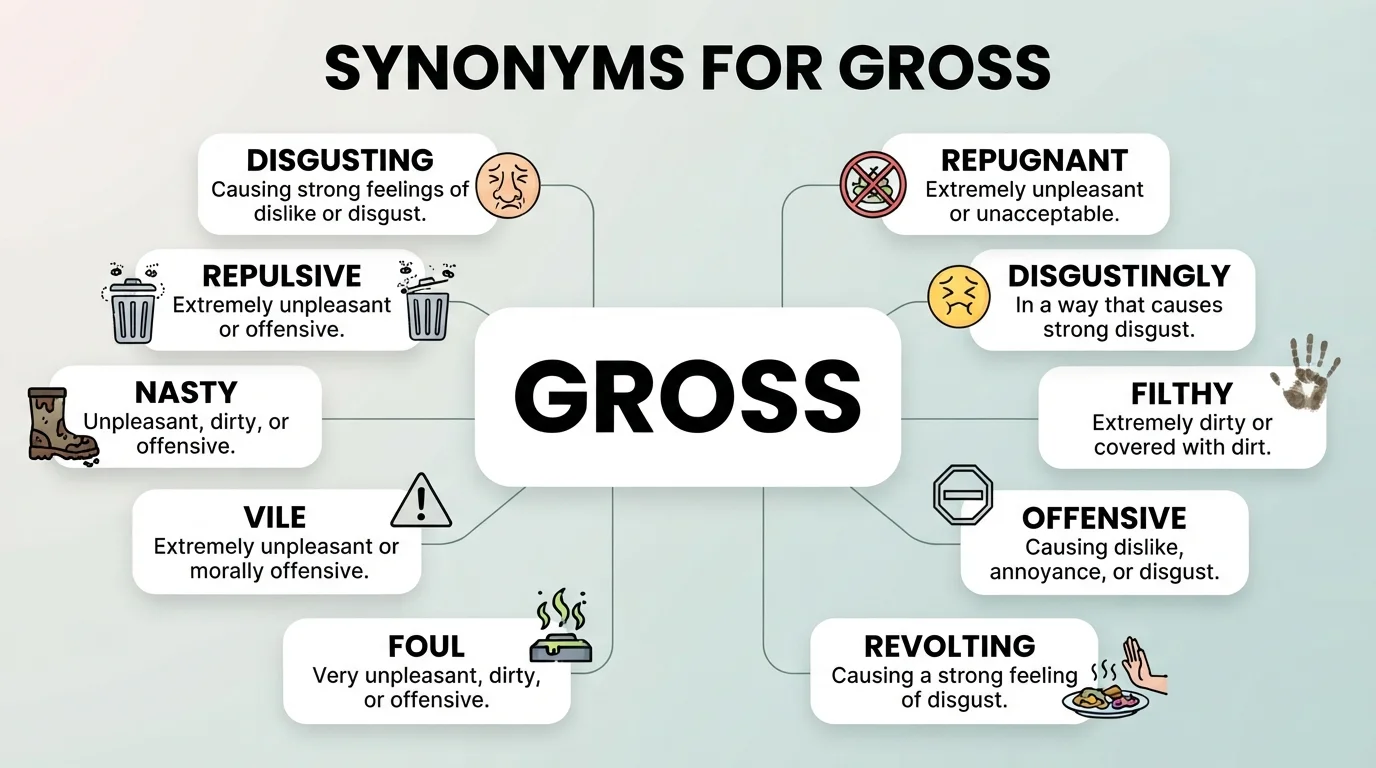
1. Disgusting
Meaning: This word describes something that makes you feel sick or deeply upset.
Examples:
- The old trash in the kitchen smelled absolutely disgusting.
- He refused to eat the burnt and slimy food because it looked disgusting.
2. Revolting
Meaning: This word means so unpleasant that it turns your stomach.
Examples:
- The sink was filled with a revolting pile of rotten food.
- She turned her face away from the revolting smell of the sewer.
3. Nauseating
Meaning: This word describes something that makes you feel like you want to throw up.
Examples:
- The strong smell of sour milk was completely nauseating.
- The boat rocked so wildly that the motion became nauseating.
4. Repulsive
Meaning: This word means driving others away because it is so unpleasant or ugly.
Examples:
- The movie featured a repulsive monster that lived underground.
- He found the cruel behavior of the bully deeply repulsive.
5. Sickening
Meaning: This word describes something so bad that it makes you feel physically ill.
Examples:
- We heard a sickening crash when the two cars hit each other.
- The smell of the decaying leaves in the basement was sickening.
6. Foul
Meaning: This word means very dirty, smelly, or bad to the senses.
Examples:
- The stagnant pond water had a foul odor.
- He used foul language when he accidentally bumped his toe.
7. Yucky
Meaning: This is a very simple word used to describe something that tastes or feels bad.
Examples:
- The mud felt cold and yucky on my bare feet.
- This medicine has a yucky taste, but it will help you heal.
8. Offending
Meaning: This word describes something that causes discomfort, displeasure, or annoyance.
Examples:
- The janitor quickly removed the offending trash bag from the hallway.
- She asked him to turn off the offending loud music.
9. Unpalatable
Meaning: This word means not pleasant to eat, drink, or accept.
Examples:
- The soup was far too salty and completely unpalatable.
- He had to deliver the unpalatable truth to his boss.
10. Unsavory
Meaning: This word describes something unpleasant to taste or a person of bad character.
Examples:
- The restaurant had an unsavory smell floating from the kitchen.
- She decided to avoid hanging out with those unsavory characters.
11. Vulgar
Meaning: This word describes speech or behavior that is rude and lacks good taste.
Examples:
- He made a vulgar joke that made everyone in the room quiet.
- She disliked the show because of its vulgar humor.
12. Crude
Meaning: This word means rough, simple, or lacking manners and polite polish.
Examples:
- He drew a crude sketch of the house on a paper napkin.
- His crude manners upset the guests at the dinner table.
13. Coarse
Meaning: This word describes a rough texture or rude, unrefined speech.
Examples:
- The towel was made from a coarse fabric that scratched my skin.
- He was criticized for his coarse jokes during the meeting.
14. Indecent
Meaning: This word describes behavior or clothing that is not acceptable in public.
Examples:
- The police stopped him for wearing an indecent outfit in public.
- It is indecent to shout at people who are trying to work.
15. Improper
Meaning: This word means not suitable, right, or matching accepted social standards.
Examples:
- It is improper to use your phone during a movie screening.
- The accountant was fired for handling company funds in an improper way.
16. Offensive
Meaning: This word describes something that hurts feelings or causes deep anger.
Examples:
- The speaker made an offensive comment about the local community.
- The room was filled with an offensive odor of wet paint.
17. Uncouth
Meaning: This word describes a person who behaves in a clumsy or rude manner.
Examples:
- His uncouth habit of talking with his mouth full annoyed everyone.
- She thought the noisy customer was very uncouth.
18. Tasteless
Meaning: This word means lacking good style, elegance, or good judgment.
Examples:
- He wore a tasteless outfit to the formal wedding ceremony.
- The comedian told a tasteless joke about the recent storm.
19. Crass
Meaning: This word describes behavior that shows no intelligence or care for feelings.
Examples:
- Making fun of his mistake was a very crass thing to do.
- She was hurt by his crass remarks about her artwork.
20. Ribald
Meaning: This word describes humor or speech that is wildly rude and suggestive.
Examples:
- The sailors sang a ribald song as they worked on the deck.
- The play was full of ribald comedy that made the crowd laugh.
21. Total
Meaning: This word means the complete amount when everything is added together.
Examples:
- The total cost of the new books came to fifty dollars.
- Her total earnings for the week were higher than usual.
22. Aggregate
Meaning: This word means a whole formed by combining several separate elements.
Examples:
- The aggregate sales for all store branches reached a new high.
- They calculated the aggregate score after three rounds of play.
23. Overall
Meaning: This word means including everything from start to finish.
Examples:
- The overall health of the garden improved after the rain.
- His overall performance on the test was very impressive.
24. Entire
Meaning: This word means whole or complete, with no parts left out.
Examples:
- He ate the entire pizza by himself in one sitting.
- The entire class went on a field trip to the museum.
25. Whole
Meaning: This word means full, complete, or not divided into pieces.
Examples:
- She spent the whole day reading her favorite storybook.
- The whole family gathered together for the holiday dinner.
26. Full
Meaning: This word means containing as much as possible or complete in amount.
Examples:
- Please give me your full attention while I read the rules.
- He received the full price for the car he sold.
27. Complete
Meaning: This word means having all necessary parts and being finished.
Examples:
- I need a complete list of your home addresses by noon.
- The construction team delivered a complete report on the project.
28. Comprehensive
Meaning: This word means covering or including all details and aspects of something.
Examples:
- The guide offers a comprehensive view of local historical sites.
- She took a comprehensive test at the end of the school year.
29. Flagrant
Meaning: This word describes a bad action that is very obvious and done openly.
Examples:
- Stealing the bike in broad daylight was a flagrant crime.
- The player made a flagrant foul and was sent off the field.
30. Egregious
Meaning: This word describes an error or act that is remarkably bad.
Examples:
- Leaving the front door wide open was an egregious mistake.
- The document contained an egregious spelling error on the main page.
31. Blatant
Meaning: This word describes bad behavior that is done openly and without shame.
Examples:
- Telling a blatant lie to the teacher will get you into trouble.
- He showed a blatant disregard for the posted speed limit signs.
32. Glaring
Meaning: This word means extremely obvious and easy to notice immediately.
Examples:
- There was a glaring error in the math equation on the board.
- She noticed a glaring hole in his logic during the debate.
33. Obvious
Meaning: This word means easy to see, clear to understand, or easily noticed.
Examples:
- It was obvious that she had practiced the piano piece well.
- The answer to the puzzle was obvious from the beginning.
34. Patent
Meaning: This word describes something clear, obvious, and plain to see.
Examples:
- His statement was a patent falsehood that no one believed.
- She looked at the problem with patent frustration.
35. Rank
Meaning: This word describes something that is complete, absolute, or offensively foul.
Examples:
- The old shed was filled with rank, decaying weeds.
- He accused his opponent of rank dishonesty during the campaign.
36. Manifest
Meaning: This word means clear and obvious to the eye or the mind.
Examples:
- His relief was manifest as soon as he heard the good news.
- The system failed due to manifest flaws in its basic design.
37. Barefaced
Meaning: This word describes shameless and open bad behavior.
Examples:
- He told a barefaced lie despite all the evidence against him.
- Her barefaced cheek surprised everyone sitting in the room.
38. Utter
Meaning: This word means complete, total, or absolute.
Examples:
- The room fell into utter darkness when the power went out.
- The news came as an utter surprise to the entire team.
39. Heavy
Meaning: This word can describe great weight, intensity, or seriousness.
Examples:
- He carried a heavy box up the long flight of stairs.
- The company faced a heavy loss after the slow season.
40. Massive
Meaning: This word describes something very large, heavy, and solid.
Examples:
- A massive boulder blocked the narrow mountain road.
- The project required a massive amount of hard work.
41. Immense
Meaning: This word means extremely large or great in size or scale.
Examples:
- The desert spread out before them in immense silence.
- He felt an immense sense of joy after passing the exam.
42. Bulky
Meaning: This word describes an object that is large and difficult to carry.
Examples:
- The winter coat was too bulky to fit into his backpack.
- They moved the bulky furniture out of the small bedroom.
43. Corpulent
Meaning: This word is a formal way to describe a person who is fat.
Examples:
- The corpulent king sat comfortably on his wooden throne.
- The doctor advised the corpulent man to walk every morning.
44. Heavier
Meaning: This word describes a person or animal whose body weight is significantly above a healthy range.
Examples:
- Providing pets with a balanced diet and regular exercise can help prevent obesity.
- The medical study explored ways to help people manage their weight, stay active, and support their overall health.
45. Unrefined
Meaning: This word describes raw materials or people lacking polite manners.
Examples:
- Sugar in its unrefined state looks dark and coarse.
- His unrefined speech showed that he lacked proper training.
46. Smutty
Meaning: This word describes something dirty or content containing improper jokes.
Examples:
- The old book had smutty marks on its front cover.
- He was asked to stop making smutty comments at work.
47. Sordid
Meaning: This word describes actions that are dirty, cheap, or dishonorable.
Examples:
- The newspaper revealed the sordid details of the scandal.
- They lived in a sordid basement apartment near the tracks.
48. Vile
Meaning: This word means extremely unpleasant, bad, or wicked.
Examples:
- The witch cooked a vile potion in her dark cave.
- He had a vile temper when things did not go his way.
49. Abhorrent
Meaning: This word describes something that causes deep hatred and disgust.
Examples:
- Cruelty to animals is completely abhorrent to most people.
- His dishonest behavior was abhorrent to his family.
50. Loathsome
Meaning: This word means causing hatred, disgust, or revulsion.
Examples:
- The villain in the story had a loathsome personality.
- He had to clean the loathsome mess left behind in the yard.
FAQS
1. What is the most common synonym for gross?
The most common synonym for gross when referring to disgust is “disgusting.”
2. Can gross mean total money earned?
Yes, “gross” means the total money earned before taking away taxes or costs.
3. What is a synonym for gross misconduct?
A great synonym for gross misconduct is “flagrant” or “egregious” misconduct.
4. Is the word “yucky” a formal synonym for “gross”?
No, “yucky” is an informal synonym mostly used in casual daily speech.
5. What is the opposite word for gross income?
The opposite word for gross income is “net” income, which is money after taxes.
6. How does learning synonyms help my writing score?
Learning synonyms stops word repetition and makes your essays clearer and more precise.
CONCLUSION
Learning different synonyms for gross is one of the easiest ways to upgrade your English vocabulary. Replacing basic words with specific synonyms makes your writing more interesting to read and helps you sound natural when speaking.

My name is Emily Johnson, and I am an English content writer with a strong passion for language and communication. I enjoy exploring the beauty of words and turning complex vocabulary into simple, easy-to-understand explanations. My work mainly focuses on synonyms, antonyms, word meanings, and practical writing tips that help people improve their English skills step by step.