Have you ever tried to describe your emotions or physical sensations but felt stuck repeating the exact same word? Picture writing a story where every sentence starts with “I feel happy,” “I feel cold,” or “I feel the soft blanket.” It quickly sounds repetitive and plain.
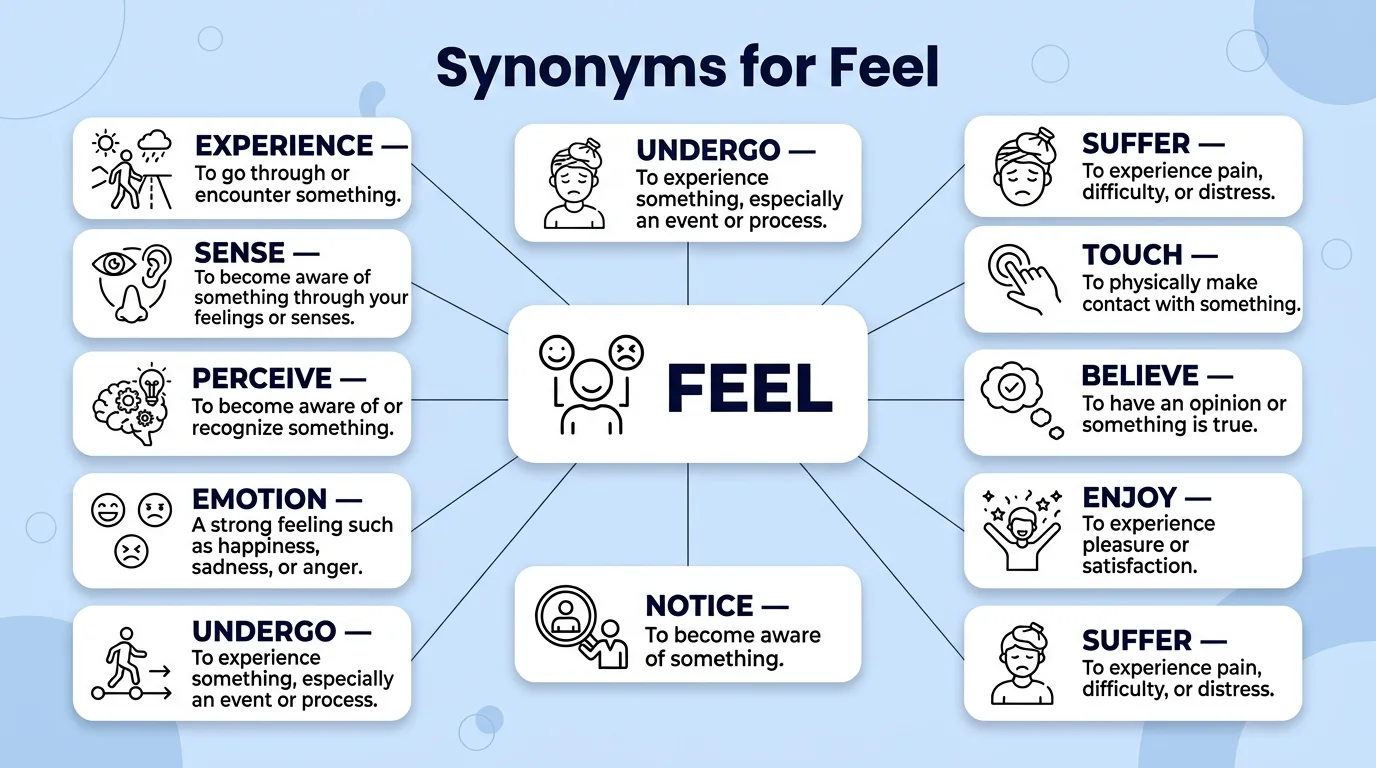
To feel means to experience an emotion, sense a physical touch, or hold a personal opinion. Finding accurate synonyms for feel helps you share exact thoughts and moods with greater power.
This vocabulary guide is useful for students writing school papers, bloggers sharing personal stories, content writers crafting vivid copy, and daily English users chatting with friends. Exploring strong synonyms for feel makes your everyday communication sharper, more descriptive, and far more engaging.
1. Sense
Meaning:
To notice something using your body or your mind.
Examples:
- I sense that someone is standing near the doorway.
- She could sense the growing excitement in the classroom.
2. Touch
Meaning:
To place your hand or fingers on an object.
Examples:
- Touch the warm sweater before you buy it.
- The toddler reached out to touch the soft velvet pillow.
3. Experience
Meaning:
To go through a specific event, emotion, or situation.
Examples:
- We experience pure happiness when visiting our favorite places.
- Travelers experience different customs in foreign cities.
4. Perceive
Meaning:
To notice and understand something through your natural senses.
Examples:
- Dogs perceive quiet sounds that people miss completely.
- I perceive a slight shift in his daily mood.
5. Notice
Meaning:
To become aware of a detail around you.
Examples:
- Did you notice the sudden change in temperature outside?
- She began to notice a small leak under the kitchen sink.
6. Detect
Meaning:
To discover or identify something faint or hidden.
Examples:
- The kitchen alarm can detect tiny traces of smoke.
- He could detect the fresh scent of pine in the air.
7. Believe
Meaning:
To think that an idea or statement is true.
Examples:
- I believe this walking path is the safest way home.
- Many people believe daily practice leads to great success.
8. Consider
Meaning:
To think carefully about a topic before deciding.
Examples:
- Please consider every choice before signing your name.
- We consider this quiet park a great place to read.
9. Suffer
Meaning:
To go through physical pain or emotional distress.
Examples:
- Houseplants suffer when they go without water for weeks.
- Runners suffer sore muscles after completing long road races.
10. Endure
Meaning:
To stay strong through a difficult or painful time.
Examples:
- Campers must endure freezing winds during winter hikes.
- The sturdy bridge can endure heavy river floods.
11. Handle
Meaning:
To hold, lift, or touch something using your hands.
Examples:
- Handle the fragile ceramic mug with extra care.
- Museum guides handle ancient artifacts with soft cotton gloves.
12. Caress
Meaning:
To touch a surface or person in a gentle, caring way.
Examples:
- The warm sea breeze seemed to caress her skin.
- He paused to caress his purring cat on the couch.
13. Stroke
Meaning:
To move your hand smoothly and gently over a surface.
Examples:
- She started to stroke the puppy’s silky back.
- Stroke the polished wood to check for rough spots.
14. Graze
Meaning:
To touch or brush against something lightly while passing.
Examples:
- The falling leaf managed to graze his bare arm.
- Tree branches graze the bus windows on narrow country roads.
15. Tap
Meaning:
To hit a surface gently with your fingertips or an object.
Examples:
- Tap the glass screen to turn on the tablet.
- He began to tap his foot to the steady drum beat.
16. Palpate
Meaning:
To examine a body part by pressing gently with fingers.
Examples:
- Doctors palpate the sore stomach to find tender spots.
- The veterinarian will palpate the kitten’s leg for sprains.
17. Fumble
Meaning:
To feel around awkwardly or clumsily with your hands.
Examples:
- I had to fumble through my deep backpack for my keys.
- He began to fumble with the small buttons on his coat.
18. Grope
Meaning:
To search blindly by reaching out with your hands in the dark.
Examples:
- We had to grope our way down the dark hallway during the power outage.
- She began to grope for the bedside lamp switch.
19. Finger
Meaning:
To touch, check, or explore an item using fingertips.
Examples:
- Shoppers often finger the wool cloth to test its thickness.
- The curious boy started to finger the smooth shell.
20. Regard
Meaning:
To view, judge, or think about something in a specific way.
Examples:
- Teachers regard consistent study as an essential learning habit.
- Neighbors regard the local community center as a safe gathering spot.
21. Deem
Meaning:
To judge or declare that something has a particular quality.
Examples:
- Inspectors deem the cracked wooden dock unsafe for swimmers.
- The coach will deem the training session complete after stretching.
22. Opine
Meaning:
To state your personal thought or open opinion on a subject.
Examples:
- Several critics opine that the film needs a shorter runtime.
- Gardeners opine that morning sunlight produces sweeter tomatoes.
23. Suspect
Meaning:
To think that an outcome or situation is probably true.
Examples:
- I suspect the rain shower will clear up by noon.
- Police suspect the back gate remained unlocked overnight.
24. Assume
Meaning:
To accept an idea as true without checking the facts first.
Examples:
- Do not assume the library stays open late on Sundays.
- Most guests assume dinner starts right at seven o’clock.
25. Deduce
Meaning:
To figure out an answer using logic, clues, and facts.
Examples:
- We can deduce the secret code by studying the puzzle clues.
- Scientists deduce ocean depths by analyzing sound waves.
26. Discern
Meaning:
To clearly see, hear, or recognize something difficult to notice.
Examples:
- Drivers struggled to discern lane markers through the dense fog.
- She could discern a tiny scratch on the antique mirror.
27. Distinguish
Meaning:
To see the clear difference between two similar things.
Examples:
- Young students learn to distinguish between fact and fiction.
- It is simple to distinguish genuine silk from synthetic nylon.
28. Recognize
Meaning:
To identify something familiar because you have encountered it before.
Examples:
- I recognize that friendly voice from the morning radio show.
- Hikers recognize trail markers by their bright yellow paint.
29. Apprehend
Meaning:
To grasp and understand an idea with your mind.
Examples:
- Students quickly apprehend the basics of simple addition.
- It took a few moments to apprehend the importance of the news.
30. Intuit
Meaning:
To know something instantly through natural instinct rather than logic.
Examples:
- Caring parents often intuit what their crying baby needs.
- Experienced drivers intuit when another vehicle wants to merge.
31. Divine
Meaning:
To discover or guess something through sharp intuition.
Examples:
- She managed to divine our surprise birthday plans early.
- The scout could divine the cleanest water source nearby.
32. Conject
Meaning:
To guess an outcome using limited information.
Examples:
- Historians conject that ancient travelers rested near this stream.
- Without test results, doctors can only conjecture the diagnosis.
33. Harbor
Meaning:
To hold an ongoing thought or deep emotion in your mind.
Examples:
- Try not to harbor resentment after minor disagreements.
- He continued to harbor hope for a positive outcome.
34. Cherish
Meaning:
To hold a feeling, memory, or object dear to your heart.
Examples:
- Families cherish warm memories from summer vacations.
- I cherish the handmade wooden gift from my grandfather.
35. Savor
Meaning:
To take time to fully enjoy a wonderful taste or feeling.
Examples:
- Take your time and savor every bite of the hot pie.
- The soccer team gathered to savor their championship win.
36. Relish
Meaning:
To get intense pleasure and satisfaction from an activity.
Examples:
- Avid readers relish spending quiet rainy afternoons with books.
- Young dogs relish running through wide-open grass fields.
37. Bear
Meaning:
To carry the weight of a heavy physical load or emotional burden.
Examples:
- Strong movers bear the heavy weight of the wooden wardrobe.
- Caring leaders bear full responsibility for team mistakes.
38. Taste
Meaning:
To sample or briefly experience a specific event or feeling.
Examples:
- The young startup company got to taste early market success.
- Ambitious athletes train hard to taste victory in the finals.
39. Know
Meaning:
To possess certain facts, understanding, or personal awareness.
Examples:
- I know that daily reading expands your personal vocabulary.
- Park rangers know every rocky path on the steep mountain.
40. Grasp
Meaning:
To hold tightly with your hand or to understand an idea fully.
Examples:
- Grasp the wooden stair railing securely when walking down.
- Learners easily grasp simple computer coding concepts.
41. Gather
Meaning:
To draw a conclusion based on visible evidence and clues.
Examples:
- From his broad smile, I gather that the interview went well.
- We gather that the express train will arrive slightly late today.
42. Guess
Meaning:
To form an opinion without having definite facts.
Examples:
- Try to guess how many colored beads fit inside the jar.
- I guess we should carry umbrellas just in case it rains.
43. Foresee
Meaning:
To realize or expect that an event will happen in advance.
Examples:
- Traffic planners try to foresee major delays before construction starts.
- Nobody could foresee the sudden storm rolling across the plains.
44. Anticipate
Meaning:
To look forward to an event and prepare for it early.
Examples:
- Eager fans anticipate the release of the author’s new mystery book.
- Store managers anticipate high shopper volume during holiday weekends.
45. Undergo
Meaning:
To pass through an intense experience, process, or medical change.
Examples:
- The historic clock tower will undergo essential stone repairs.
- Patients undergo simple health screenings before minor surgeries.
46. Weep
Meaning:
To express deep sadness or overwhelming emotion through tears.
Examples:
- Many theatergoers weep during emotional scenes in tragic plays.
- She felt ready to weep with profound relief after hearing the news.
47. Rejoice
Meaning:
To feel or show tremendous delight, joy, and celebration.
Examples:
- Neighbors rejoice whenever new trees get planted on their street.
- The cheering crowd will rejoice if their home team wins tonight.
48. Tremble
Meaning:
To shake involuntarily due to cold, intense fear, or excitement.
Examples:
- His cold fingers began to tremble in the icy winter air.
- Nervous public speakers often tremble slightly before stepping on stage.
49. Vibrate
Meaning:
To shake back and forth rapidly, creating a physical sensation.
Examples:
- Deep bass notes from the speakers cause the wooden floor to vibrate.
- Please set your mobile phone to vibrate during formal meetings.
50. Yearn
Meaning:
To feel an intense, heartfelt longing or deep desire for something.
Examples:
- Weary travelers yearn for the comfort of their own beds.
- Creative artists yearn for quiet spaces to craft their work.
FAQS
1. What are the best synonyms for “feel” when talking about emotions?
Words like experience, harbor, cherish, and relish best express emotional states.
2. Can “feel” be used to describe physical touch?
Yes, words such as touch, caress, stroke, and handle work perfectly for physical contact.
3. Which synonyms for feel work best for opinions and thoughts?
Terms like “believe,” “consider,” “regard,” and “opine” are ideal for expressing viewpoints.
4. What are strong formal synonyms for feel in academic writing?
Scholarly alternatives include perceive, discern, deduce, and apprehend.
5. Why should writers avoid repeating the word feel?
Overusing the same basic word makes your text repetitive and dulls reader interest.
6. How do I select the most suitable synonym for feel?
Match the context by picking sensory terms for physical touch, cognitive words for opinions, or expressive words for emotions.
Conclusion:
Learning and applying diverse synonyms for “feel” instantly improves your writing, blogging, speaking, and everyday communication. Replacing overused words with precise vocabulary helps you describe delicate emotions, tactile sensations, and thoughtful opinions with absolute clarity. Practice using these expressive alternatives in your daily emails, academic essays, and casual conversations to become a more confident and descriptive communicator today!

I’m Sophia Carter, and I love researching English words and turning them into simple, useful vocabulary guides for learners. I enjoy exploring synonyms, alternative word choices, and sentence improvement tips that help people write more naturally and professionally.