Imagine sitting in a literature class or a company strategy meeting, trying to describe a sharp contrast between two completely opposite ideas. You might want to explain how a character acts kind in public but cruel at home, or how a business wants to cut costs while simultaneously trying to boost product quality.
If you keep repeating phrases like “big difference” or “opposite sides,” your message can lose its punch. You might reach for the word “dichotomy,” which means a division or contrast between two things that are represented as being completely different or opposed to each other.
But using “dichotomy” over and over again in an essay, report, or presentation can make your writing feel repetitive.
If you are a student writing an analysis paper, a blogger crafting an insightful post, a professional drafting an executive summary, or an English learner expanding your word bank, mastering synonyms for dichotomy will make your writing far clearer, richer, and more engaging.
Quick Reference: Top 20 Synonyms for Dichotomy
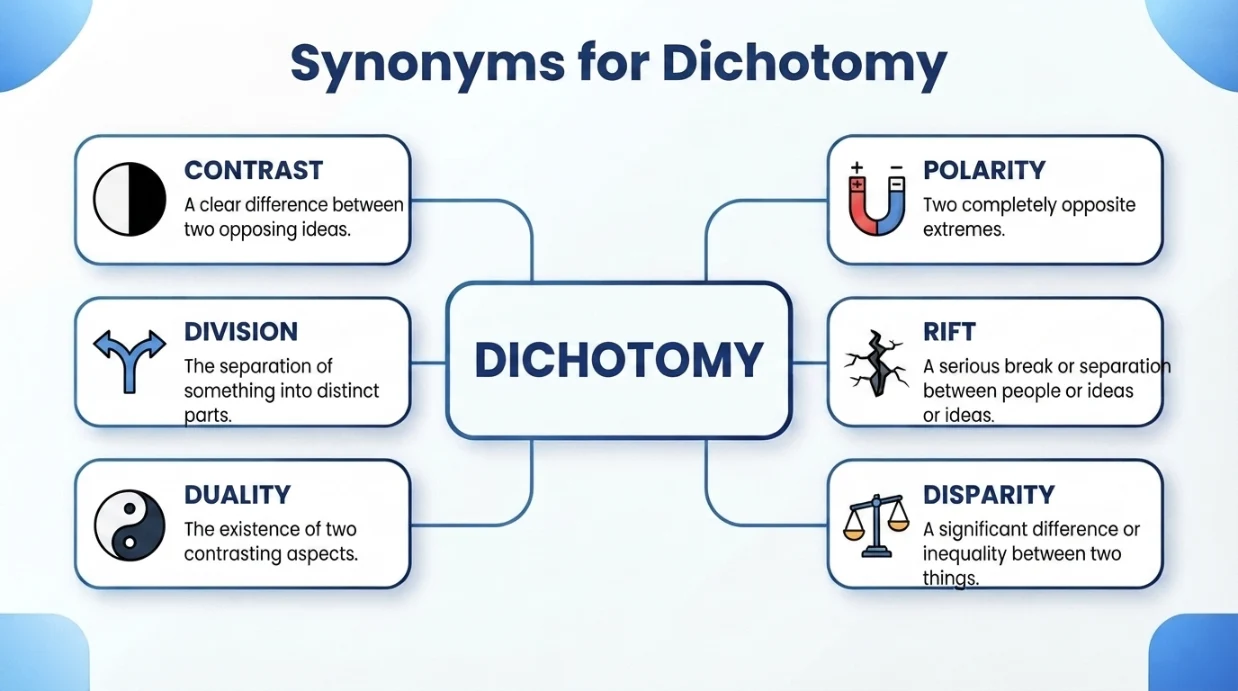
Here is a quick reference table featuring twenty of the most useful synonyms for “dichotomy,” complete with their core meanings and ideal usage contexts.
| Synonym | Meaning | Best Used For |
| Division | A separation into two or more parts or groups | General splits, organizations, or groups |
| Contrast | A clear difference between two things | Comparing visible features, ideas, or styles |
| Polarity | Complete opposition between two extreme points | Opinions, magnetic charges, or political views |
| Split | A division or rift separating two sides | Conflicts, opinions, or physical separations |
| Dualism | The state of having two opposite aspects or principles | Philosophy, religion, or human nature |
| Contradiction | A combination of statements or ideas that oppose each other | Arguments, logic, or conflicting behaviors |
| Gulf | A deep, wide gap or separation between two things | Social classes, understanding, or opinions |
| Rift | A serious break or separation in friendly relations | Friendships, political parties, or families |
| Disjunction | A sharp disconnection or lack of harmony between two things | Policies, theory vs. reality, or logic |
| Divergence | The process of moving or extending in different directions | Trends, paths, opinions, or growth |
| Disparity | A great difference or inequality between two things | Wealth, age, statistics, or opportunities |
| Antithesis | A person, idea, or thing that is the exact direct opposite | Literary analysis, debates, or core themes |
| Separation | The act or state of keeping things apart | Boundaries, physical spaces, or concepts |
| Paradox | A situation or statement that seems contradictory yet true | Complex situations, puzzles, or human behavior |
| Cleavage | A sharp line of division or split within a group | Politics, geology, or social movements |
| Schism | A formal split or division within an organization or church | Religious bodies, political parties, or groups |
| Opposition | A resistance, disagreement, or state of being placed opposite | Debates, games, or opposing forces |
| Duality | An instance of having two distinct parts or qualities | Character traits, art, or natural phenomena |
| Gap | A space, break, or noticeable difference between two things | Knowledge, income, or generations |
| Alienation | A feeling of isolation or separation from a group or idea | Psychology, society, or personal feelings |
50 Synonyms for Dichotomy (Categorized & Explained)
Category 1: Direct Splits and Structural Divisions
These words work best when you want to describe a clear physical, organizational, or conceptual separation into two parts.
1. Division
- Meaning: The act or process of separating something into two or more distinct parts or groups.
- Examples:
- The deep division between the two political factions made passing the new bill nearly impossible.
- Our manager explained the division of labor across the design and engineering teams.
2. Split
- Meaning: A sharp break, division, or separation within a group, concept, or object.
- Examples:
- A sudden split in opinion caused the board of directors to delay their final vote.
- The split between online sales and in-store purchases widened during the winter holiday season.
3. Separation
- Meaning: The state of keeping distinct things apart or dividing something into individual components.
- Examples:
- Strict laws require a clear separation between church and state matters.
- The physical separation of the two research teams helped them focus on their unique goals.
4. Disjunction
- Meaning: A sharp lack of connection or harmony between two things that should be linked.
- Examples:
- Critics noted a confusing disjunction between the company’s green promises and its factory emissions.
- There was a clear disjunction between what the candidate promised and how he actually voted.
5. Cleavage
- Meaning: A distinct line of division, split, or factional difference within a large group or society.
- Examples:
- The vote revealed a sharp cultural cleavage between urban voters and rural communities.
- Social researchers studied the growing economic cleavage across major metropolitan regions.
6. Schism
- Meaning: A formal or permanent split within a religious body, political party, or organization.
- Examples:
- The disagreement over church leadership eventually led to a historical schism.
- A deep schism within the party threatened to ruin their chances in the upcoming election.
7. Bifurcation
- Meaning: The splitting or branching of a single structure, path, or idea into two separate parts.
- Examples:
- The trail reached a bifurcation in the woods, forcing the hikers to choose between two paths.
- Analysts observed a bifurcation in the market, where high-end and budget brands thrived while middle-tier stores closed.
8. Partition
- Meaning: The division of a physical space, territory, or system into distinct, isolated sections.
- Examples:
- The historical partition of the territory created two distinct nation-states with their own borders.
- Workers installed a glass partition to separate the noisy reception area from the quiet office desks.
9. Segmentation
- Meaning: The process of dividing a whole concept, market, or object into smaller, distinct segments.
- Examples:
- Customer segmentation allows marketing teams to target specific age groups with tailored advertisements.
- The segmentation of the textbook into short modules helped students digest complex topics easily.
10. Detachment
- Meaning: The act of separating one thing from another, or a mental state of remaining distant.
- Examples:
- The physical detachment of the island from the mainland preserved its rare wildlife species.
- Her professional detachment allowed her to make tough business decisions without letting emotion interfere.
Category 2: Extreme Opposites and Polarity
Use these terms when describing two sides that sit at complete opposite ends of a spectrum.
11. Polarity
- Meaning: The presence of two completely opposite, contrasting, or competing qualities, principles, or tendencies.
- Examples:
- The extreme polarity of opinion on social media made respectful debate difficult to find.
- Astronomers studied the magnetic polarity of the distant planet to understand its core structure.
12. Antithesis
- Meaning: A person, concept, or thing that represents the direct, exact opposite of another.
- Examples:
- His chaotic and messy lifestyle was the exact antithesis of his sister’s tidy and organized routine.
- Cruelty is the absolute antithesis of everything this charitable foundation stands for.
13. Opposition
- Meaning: A state of being placed directly opposite or an active resistance and disagreement between forces.
- Examples:
- The proposed highway expansion faced strong opposition from local neighborhood leaders.
- The constant opposition between the two main characters drove the dramatic tension of the play.
14. Contradiction
- Meaning: A combination of statements, ideas, or features that are totally opposed to one another.
- Examples:
- Telling people to save money while constantly buying luxury items is a clear contradiction.
- The lawyer pointed out a major contradiction between the witness’s statement and the video evidence.
15. Contradictoriness
- Meaning: The quality or condition of containing elements that directly oppose or deny each other.
- Examples:
- The inherent contradictoriness of his public statements made voters question his honesty.
- Critics discussed the strange contradictoriness of a quiet horror movie setting.
16. Oppositeness
- Meaning: The property or state of being placed on the far opposite side in position, nature, or character.
- Examples:
- The stark oppositeness of their personalities made them an unusual yet surprisingly effective team.
- She noticed the complete oppositeness of the warm, sunny weather to her gloomy personal mood.
17. Polarization
- Meaning: A process in which opinions or groups divide sharply into two contrasting and hostile camps.
- Examples:
- The political polarization of the electorate made finding a bipartisan solution almost impossible.
- Media channels often contribute to polarization by focusing only on extreme viewpoints.
18. Antipodes
- Meaning: Two places, ideas, or things that are direct opposites of each other, positioned on opposite sides.
- Examples:
- Her calm, quiet demeanor and her brother’s loud, energetic outbursts were true behavioral antipodes.
- In philosophical debates, their views were treated as the intellectual antipodes of modern thought.
19. Reverse
- Meaning: The complete opposite or contrary of something previously stated or expected.
- Examples:
- Rather than panicking, she reacted in the exact reverse and calmly called emergency services.
- The new policy had the reverse effect of what the board intended, causing sales to drop.
20. Inverse
- Meaning: Something that is inverted or opposite in order, nature, direction, or effect.
- Examples:
- There is often an inverse relationship between the price of an item and consumer demand for it.
- The speed of the machine proved to be the exact inverse of its overall energy efficiency.
Category 3: Differences, Gaps, and Disparities
These words are ideal when highlighting a noticeable space, inequality, or contrast between two elements.
21. Contrast
- Meaning: A clear and striking difference between two things when they are compared side by side.
- Examples:
- The bright white snow provided a sharp contrast against the dark green pine trees.
- There was a striking contrast between the luxurious hotel lobby and the poor neighborhood surrounding it.
22. Disparity
- Meaning: A noticeable and usually unfair difference, inequality, or gap between two things.
- Examples:
- The study highlighted a growing disparity in funding between rich and poor school districts.
- Community leaders met to address the income disparity affecting families across the city.
23. Gulf
- Meaning: A deep, vast gap, separation, or difference in understanding, age, or circumstances.
- Examples:
- A wide generational gulf in technology habits separated the grandfathers from their teenage grandchildren.
- Language barriers created a deep communication gulf between the international partners.
24. Rift
- Meaning: A serious, noticeable break or separation in friendly relationships, opinions, or agreement.
- Examples:
- Money arguments created a permanent rift between the two business co-founders.
- The policy debate opened a wide rift among members of the local city council.
25. Gap
- Meaning: A clear space, break, or difference in knowledge, performance, time, or status.
- Examples:
- The bridge program helped close the achievement gap between transfer students and regulars.
- There was a noticeable gap between what the user manual described and how the software actually ran.
26. Divergence
- Meaning: The process of moving apart, developing differently, or taking different paths from a common point.
- Examples:
- Over time, a gradual divergence in their career interests led the twin brothers to live in different cities.
- Economic data showed a sharp divergence between rising stock prices and falling consumer confidence.
27. Distinction
- Meaning: A clear difference or contrast that sets two similar things apart into separate categories.
- Examples:
- The professor made a clear distinction between short-term memory storage and long-term learning.
- It is important to draw a distinction between a temporary setback and a permanent failure.
28. Discrepancy
- Meaning: An unexpected difference, inconsistency, or variance between two facts, numbers, or stories.
- Examples:
- The accountant discovered a major discrepancy between the cash register receipt and the bank deposit.
- Investigators worked around the clock to resolve the discrepancy between the two witness testimonies.
29. Variance
- Meaning: The fact or quality of being different, inconsistent, or divergent from a standard or another item.
- Examples:
- The actual construction budget showed a high variance from the original price estimate.
- Quality inspectors noted a small variance in size among the manufactured metal parts.
30. Margin
- Meaning: The degree of difference, space, or distance separating two competing scores, values, or sides.
- Examples:
- The candidate won the town election by a narrow margin of just forty votes.
- Engineers left a wide safety margin to account for unexpected weather conditions during building.
Category 4: Philosophical Dualities and Human Nature
Select these terms when discussing abstract concepts, human psychology, philosophical principles, or complex themes.
31. Duality
- Meaning: An instance of having two distinct, often contrasting parts, aspects, or fundamental qualities.
- Examples:
- The novel explores the inner duality of human nature through its hero’s moral struggles.
- Light exhibits a fascinating wave-particle duality that scientists continue to study in physics.
32. Dualism
- Meaning: A philosophical or conceptual system that divides everything into two core principles or aspects (such as mind and body).
- Examples:
- Traditional mind-body dualism suggests that mental thoughts exist separately from physical brain matter.
- The ancient religion explained world events as an eternal dualism between good and evil forces.
33. Paradox
- Meaning: A situation, person, or statement that seems completely contradictory on the surface yet holds a deeper truth.
- Examples:
- It is a curious paradox that standing still in a moving train can make you feel like you are traveling backward.
- The quiet city park presented a peaceful paradox right in the middle of a bustling downtown center.
34. Double Consciousness
- Meaning: A psychological state of having an identity or awareness divided into two distinct cultural or personal perspectives.
- Examples:
- Immigrants often experience a double consciousness as they balance their home culture with their new country’s customs.
- The essay brilliantly analyzed the author’s double consciousness while navigating academic and working-class circles.
35. Ambivalence
- Meaning: The state of holding two conflicting, opposite feelings or attitudes toward a person, idea, or situation at the same time.
- Examples:
- She felt a strong sense of ambivalence about moving to a new city for work, mixing excitement with fear.
- The public showed ambivalence toward the new law, praising its goals but doubting its effectiveness.
36. Incongruity
- Meaning: The quality or state of being out of place, unsuitable, or incompatible with surrounding elements.
- Examples:
- The comedy in the film relied heavily on the absurd incongruity of a penguin wandering through a desert town.
- She noticed the stark incongruity of an antique grandfather clock inside a sleek modern office.
37. Incompatibility
- Meaning: The state of two things, ideas, or personalities being so fundamentally different that they cannot exist together harmoniously.
- Examples:
- The couple decided to separate amicably due to deep schedule and lifestyle incompatibilities.
- Technical support confirmed the software error was caused by an incompatibility between the program and the operating system.
38. Bipolarity
- Meaning: The condition of having or being organized around two opposing poles, centers of power, or extreme states.
- Examples:
- Political analysts studied the global bipolarity that characterized world relations during the Cold War era.
- The emotional bipolarity of the main character made the dramatic story unpredictable and intense.
39. Double-mindedness
- Meaning: A state of wavering, indecision, or having a mind divided between two opposing thoughts or choices.
- Examples:
- His double-mindedness prevented him from committing fully to either career option.
- The speaker warned the audience that double-mindedness often leads to missed opportunities.
40. Coexistence
- Meaning: The state of two different, opposing, or distinct things existing together in the same space or time.
- Examples:
- The treaty aimed to establish a peaceful coexistence between the two neighboring nations.
- Environmentalists worked hard to promote the safe coexistence of local wildlife and expanding suburban towns.
Category 5: Conflict, Clashing, and Disagreement
Use these words when describing a dichotomy that generates active friction, argument, or clash.
41. Friction
- Meaning: Conflict, disagreement, or tension caused by a clash between differing views, personalities, or interests.
- Examples:
- Blending two different corporate cultures created temporary friction among office staff.
- The constant friction between the lead singer and the guitarist eventually broke up the band.
42. Clash
- Meaning: A sharp, forceful disagreement, conflict, or collision between opposing ideas, colors, or groups.
- Examples:
- A dramatic clash of opinions broke out during the town hall meeting regarding property taxes.
- Her bright neon jacket created an undeniable visual clash with the formal dark suits in the room.
43. Conflict
- Meaning: A serious disagreement, argument, or prolonged struggle between opposing forces or ideas.
- Examples:
- The movie deals with the internal conflict a young doctor faces between ambition and duty.
- A sharp conflict of interest prevented the council member from voting on the construction proposal.
44. Tension
- Meaning: A state of mental strain, emotional stress, or unspoken hostility between opposing sides.
- Examples:
- High budget cuts created a noticeable sense of tension across all company departments.
- The dramatic tension in the courtroom rose as the jury prepared to deliver its final verdict.
45. Disagreement
- Meaning: A failure to agree, or a difference of opinion between two or more people or parties.
- Examples:
- A minor disagreement over bedroom colors was quickly settled with a paint sample test.
- Despite their disagreement on economic policy, the two leaders remained close personal friends.
46. Discord
- Meaning: A lack of agreement, harmony, or peace between people, things, or musical notes.
- Examples:
- Unmet expectations introduced severe household discord during the family holiday gathering.
- The musician deliberately used dissonant chords to create a feeling of eerie discord in the movie score.
47. Collision
- Meaning: A strong, sudden clash or conflict between opposing interests, cultures, or ideas.
- Examples:
- The film portrays the dramatic collision of ancient traditions with fast-paced modern technology.
- A sudden collision of schedules forced the team to reschedule their project presentation.
48. Antagonism
- Meaning: Active hostility, opposition, or dislike between two individuals, groups, or opposing sides.
- Examples:
- Years of intense sports rivalry created a deep antagonism between the two cross-town high schools.
- The supervisor worked to eliminate personal antagonism and build a cooperative team atmosphere.
49. Inconsistency
- Meaning: A state of lacking agreement, logical connection, or uniformity across different parts or times.
- Examples:
- The editor flagged an inconsistency in the story where a character’s eye color changed midway through.
- Frequent attendance inconsistency hurt his overall grades at the end of the school semester.
50. Variance
- Meaning: A state of discord, disagreement, or being at odds with another person or standard statement.
- Examples:
- His official court testimony was at complete variance with his previous recorded statement to the police.
- The employee’s actions were at variance with the company’s code of conduct.
Context Reference Table
Choosing the best synonym for “dichotomy” depends heavily on your writing field and target audience. Refer to this handy table to select the most natural replacement:
| Context | Best Synonyms |
| Academic Writing | Disjunction, Divergence, Bifurcation, Disparity, Segmentation |
| Everyday Conversation | Difference, Split, Gap, Contrast, Separation |
| Business & Strategy | Discrepancy, Division, Segmentation, Polarization, Margin |
| Literature & Arts | Duality, Antithesis, Paradox, Juxtaposition, Discord |
| Emotional Situations | Ambivalence, Tension, Friction, Rift, Alienation |
| Formal & Legal Writing | Schism, Partition, Variance, Contradiction, Incompatibility |
| Informal & Casual Writing | Split, Clash, Opposite, Break, Gap |
Frequently Asked Questions
What is another word for dichotomy?
Depending on your exact context, common synonyms for dichotomy include division, contrast, split, duality, polarity, and disjunction. If you are talking about an organizational split, division or schism works best. If you mean a literary contrast, duality or antithesis is ideal.
What is the difference between a dichotomy and a paradox?
A dichotomy is a sharp division between two contrasting or opposing things (like nature vs. nurture). A paradox is a statement or situation that appears self-contradictory on the surface but reveals an underlying truth upon closer inspection (like “less is more”).
Which synonym for dichotomy is most formal?
Words like bifurcation, disjunction, schism, and antithesis carry a high level of formality. They are excellent choices for academic research papers, formal speeches, legal documents, and literary analysis essays.
What is the best synonym for dichotomy in business writing?
In business and corporate strategy, terms like division, disparity, segmentation, gap, and discrepancy are most effective. They clearly communicate operational splits, market differences, or performance gaps without sounding overly dramatic.
Can dichotomy refer to physical separations?
While dichotomy usually refers to abstract concepts, ideas, or categories, related synonyms like partition, split, bifurcation, and separation can easily describe physical boundaries, paths, or structures divided into two parts.
Practice Exercise: Check Your Understanding
Test your knowledge of these synonyms! Choose the correct word from the word bank to fill in the blanks in the sentences below.
Word Bank: (Disparity, Bifurcation, Ambivalence, Schism, Antithesis)
- The trail reached a clear ____________ in the forest, forcing us to choose between the river path and the mountain climb.
- A deep political ____________ divided the committee, resulting in two separate factions forming rival proposals.
- She felt a wave of personal ____________ when deciding whether to accept the job offer in a distant city.
- The charitable organization works to reduce the economic ____________ between high-income and low-income neighborhoods.
- His rude and selfish behavior was the exact ____________ of his brother’s polite and generous nature.
Answer Key
- Bifurcation (a split or branching of a single path into two separate routes)
- Schism (a formal or serious split within an organization or group)
- Ambivalence (holding conflicting or opposite feelings toward a decision or situation)
- Disparity (a noticeable gap or inequality between two conditions or groups)
- Antithesis (a person or thing that represents the direct, exact opposite of another)
Conclusion
Mastering synonyms for dichotomy is a fantastic way to sharpen your vocabulary, elevate your essay writing, and communicate complex ideas with precision. Instead of relying on the word “dichotomy” every time you want to describe an opposite pair or sharp contrast, you can now choose exact terms like bifurcation for branching paths, duality for literary themes, disparity for economic gaps, or ambivalence for conflicting emotions.
Using the right synonym at the right time keeps your readers engaged and shows a strong command of the English language. Try incorporating two or three of these new words into your next assignment, blog post, or work report to see the difference firsthand!

My name is Emily Johnson, and I am an English content writer with a strong passion for language and communication. I enjoy exploring the beauty of words and turning complex vocabulary into simple, easy-to-understand explanations. My work mainly focuses on synonyms, antonyms, word meanings, and practical writing tips that help people improve their English skills step by step.