Imagine standing in a room full of people who just hit a massive milestone maybe a company launch, a graduation, or a hard-fought personal victory. The energy is electric, the music is pumping, and everyone is grinning from ear to ear. But when it’s time to raise a glass and toast the achievement, the only word anyone can seem to muster is “Let’s celebrate!”
While there is absolutely nothing wrong with the word “celebrate,” relying on it as a linguistic crutch quickly dampens the vibrancy of your prose. When you use the exact same term for a wild 21st birthday bash, a solemn religious observation, and a corporate victory lap, the unique emotional flavor of each event gets flattened.
By expanding your English vocabulary, you unlock the ability to paint precise pictures with your words. Choosing a tailored alternative doesn’t just prevent repetition; it signals to your reader the exact volume, mood, and cultural weight of the occasion.
Let’s transform your vocabulary enhancement journey by moving past the basics and into a richer linguistic toolkit.
What is another word for “celebrate”? “Celebrate” is “commemorate.”
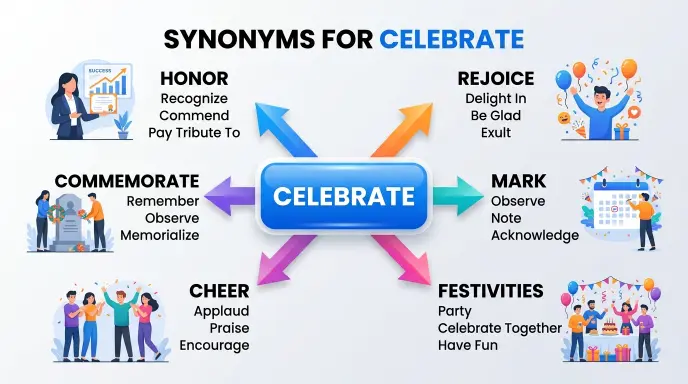
The most common and direct synonym for celebrate is commemorate. However, because “celebrate” spans everything from quiet reflection to high-energy partying, your choice depends entirely on the context.
Here are four strong, immediate alternatives to keep in your back pocket:
- Honor: Best used when you want to show deep respect for a person or an achievement (e.g., to honor a fallen hero).
- Rejoice: Perfect for expressing pure, heartfelt happiness or spiritual gladness (e.g., to rejoice at the good news).
- Mark: An excellent, understated choice for noting a specific date or milestone without necessarily throwing a party (e.g., to mark an anniversary).
- Carouse: Ideal for informal, lively, and often loud partying with plenty of food and drink (e.g., the team caroused late into the night).
Quick Reference: 30 Alternatives to Celebrate
| Synonym | One-Line Meaning |
| 1. Commemorate | To officially recall and respect a past event or person. |
| 2. Honor | To regard with great respect or public esteem. |
| 3. Rejoice | To feel or show great joy and delight. |
| 4. Observe | To fulfill or comply with a social or religious custom. |
| 5. Mark | To acknowledge a significant milestone or date. |
| 6. Exult | To show triumphant joy, especially over a victory. |
| 7. Glorify | To praise or honor something to the highest degree. |
| 8. Extol | To praise enthusiastically and highly in speech or writing. |
| 9. Lionize | To treat someone as a celebrity or public idol. |
| 10. Toast | To drink in honor of a person or an achievement. |
| 11. Revel | To enjoy oneself in a lively, boisterous way. |
| 12. Carouse | To engage in loud, lively drinking and partying. |
| 13. Jubilee | To take part in a special anniversary celebration. |
| 14. Magnify | To praise highly or extol the virtues of someone. |
| 15. Feast | To eat and drink sumptuously to mark an occasion. |
| 16. Inaugurate | To celebrate the official opening or beginning of something. |
| 17. Hallow | To honor something as holy or sacred. |
| 18. Laud | To praise highly, typically in a formal public context. |
| 19. Acclaim | To praise enthusiastically and publicly. |
| 20. Make merry | To laugh, drink, and enjoy oneself in a festive way. |
| 21. Party | To enjoy oneself at a social gathering. |
| 22. Keep | To observe or honor a holiday, feast, or tradition. |
| 23. Memorialize | To preserve the memory of someone through a monument or ceremony. |
| 24. Eulogize | To praise highly in a speech, typically after death. |
| 25. Triumph | To rejoice proudly over a major success or victory. |
| 26. Signalize | To make a moment or event notable or conspicuous. |
| 27. Revere | To feel deep respect or admiration for something. |
| 28. Paint the town | To go out and enjoy oneself flamboyantly. |
| 29. Fete | To honor or entertain someone with a lavish celebration. |
| 30. Solemnize | To perform a formal ceremony, typically a marriage. |
30 Detailed Synonyms for Celebrate
1. Commemorate
- Meaning: To officially recall and respect a past event or person.
- Explanation: “Commemorate” carries a respectful, solemn, or historical tone. Unlike “celebrate,” which implies clapping and cheering, commemorating is about memory and legacy. It is heavily utilized in formal writing, historical contexts, and public addresses to mark anniversaries of significant events like wars, discoveries, or the births of historical figures.
- Example 1: The city built a stunning marble monument to commemorate the bravery of the founding soldiers.
- Example 2: Every year on May 1st, workers gather to commemorate the historic labor movements.
2. Honor
- Meaning: To regard with great respect or public esteem.
- Explanation: Honor focuses heavily on the recipient rather than the party itself. It is a term of deep respect and high intensity, splitting the difference between formal ceremonies and personal gestures. You honor a retiring mentor, a lifetime achievement winner, or a cultural hero. It shifts the attention toward merit and recognition.
- Example 1: We are gathering tonight to honor Professor Vance for her forty years of scientific discovery.
- Example 2: The academy chose to honor the independent filmmaker with a surprise tribute.
3. Rejoice
- Meaning: To feel or show great joy and delight.
- Explanation: Rejoice is an emotionally charged word that leans toward literary, poetic, or spiritual contexts. It deals with internal ecstasy and shared profound happiness rather than the physical act of throwing a party. It is perfect for writing improvement when you want to highlight a deep sigh of relief or an overwhelming sense of communal gladness.
- Example 1: The entire village began to rejoice when the long-awaited rain finally broke the drought.
- Example 2: We rejoice in your magnificent success and wish you the absolute best on your journey.
4. Observe
- Meaning: To fulfill or comply with a social or religious custom.
- Explanation: “Observe” is a quiet, formal, and highly respectful synonym. It implies following rules, traditions, or religious protocols. You do not dance or drink when you observe a day of fasting; instead, you pay attention to its spiritual or cultural weight. It is widely used in journalistic and professional settings.
- Example 1: Our corporate offices will close on Monday to properly observe the national holiday.
- Example 2: Though living abroad, they continued to quietly observe their family’s traditional spring festival.
5. Mark
- Meaning: To acknowledge a significant milestone or date.
- Explanation: Mark is an incredibly versatile, neutral word. It acts as an understated alternative when a flashy word like “celebrate” feels a bit too loud or inappropriate. It is common in journalism and business communications to signify that a specific threshold has been crossed.
- Example 1: This evening’s quiet dinner was arranged to mark their twenty-fifth year of marriage.
- Example 2: The ringing of the opening bell will mark the official launch of our global expansion.
6. Exult
- Meaning: To show triumphant joy, especially over a victory.
- Explanation: Exult is a high-intensity, literary word. It describes the raw, competitive joy felt after conquering a massive obstacle, winning a sports championship, or defeating an adversary. It is a brilliant choice for expressive writing when characters are boasting, cheering, or feeling untouchable after a win.
- Example 1: The players began to exult in the locker room, raising the championship trophy high into the air.
- Example 2: It is unseemly to openly exult over the misfortune of your business competitors.
7. Glorify
- Meaning: To praise or honor something to the highest degree.
- Explanation: Glorify shifts the focus toward elevation and worship. It can be used in a religious context (glorifying a deity) or a secular one (glorifying a concept like hard work). Be careful, as it can occasionally carry a negative nuance in modern media, implying that something negative is being made to look dangerously attractive.
- Example 1: The epic poem was written entirely to glorify the legendary deeds of the ancient king.
- Example 2: Modern cinema should be careful not to glorify a lifestyle of crime and isolation.
8. Extol
- Meaning: To praise enthusiastically and highly in speech or writing.
- Explanation: “Extol” is a formal verb that lives in the realm of reviews, speeches, and high-level recommendations. When you extol something, you aren’t just saying it’s good—you are shouting its virtues from the rooftops. It differs from “celebrate” because it requires spoken or written arguments rather than a social gathering.
- Example 1: The tech reviewer continued to extol the virtues of the new smartphone’s battery life.
- Example 2: Health advocates constantly extol the incredible benefits of a balanced, whole-food diet.
9. Lionize
- Meaning: To treat someone as a celebrity or public idol.
- Explanation: Lionize is an advanced vocabulary word with a specific social nuance. When a community or media outlet lionizes someone, they turn them into an object of intense public fascination and celebration. It often carries a subtle warning that the praise might be slightly exaggerated or overwhelming for the person involved.
- Example 1: The local media began to lionize the young programmer after her app went viral overnight.
- Example 2: He was uncomfortable with how the public chose to lionize him just for doing his civic duty.
10. Toast
- Meaning: To drink in honor of a person or an achievement.
- Explanation: Toast is a highly specific, actionable synonym. It is warm, social, and fits beautifully into both formal gala dinners and casual bar hangouts. Toasting requires an action—raising a glass and saying a few words of praise. It grounds your writing in a concrete, physical scene.
- Example 1: Let us all raise a glass to toast the bride and groom on their beautiful journey ahead.
- Example 2: The team gathered at the local pub to toast the successful completion of their project.
11. Revel
- Meaning: To enjoy oneself in a lively, boisterous way.
- Explanation: Revel sits comfortably in the middle of the spectrum between formal and informal. It paints a picture of someone completely losing themselves in the joy of an environment or a moment. You can revel in a party or, metaphorically, revel in someone’s praise. It implies indulgence and deep satisfaction.
- Example 1: The carnival crowds continued to revel in the streets until the sun began to rise.
- Example 2: She allowed herself a few quiet minutes to revel in the glowing reviews of her debut novel.
12. Carouse
- Meaning: To engage in loud, lively drinking and partying.
- Explanation: “Carouse” is an informal, historical, and highly descriptive word. It implies a night of heavy drinking, lively storytelling, and boisterous behavior. If your characters are celebrating a victory by hitting multiple bars and making a scene, “carouse” is the exact word your language skills require.
- Example 1: The sailors would often carouse in the port taverns whenever their ship docked for supplies.
- Example 2: Our neighbors chose to carouse well past midnight, earning themselves a noise complaint.
13. Jubilee
- Meaning: To take part in a special anniversary celebration.
- Explanation: Jubilee is typically used as a noun, but it can denote a state of grand, historic celebration. It is tied to major milestones—like 25, 50, or 60 years of an institution, reign, or marriage. It evokes images of banners, parades, and massive national or community pride.
- Example 1: The kingdom erupted in a massive jubilee to celebrate the golden anniversary of the Queen’s coronation.
- Example 2: The university organized a week-long jubilee to mark a century of academic excellence.
14. Magnify
- Meaning: To praise highly or extol the virtues of someone.
- Explanation: While “magnify” usually means making something look physically bigger, its classical, formal synonym use means to lift up or enlarge someone’s reputation through intense praise. It is a high-register word found mostly in historical documents, literature, or religious texts, adding a dignified, archaic flavor to your prose.
- Example 1: The choir sang a beautiful hymn designed to magnify the names of their ancestors.
- Example 2: Her biographical piece sought to magnify the overlooked contributions of female wartime engineers.
15. Feast
- Meaning: To eat and drink sumptuously to mark an occasion.
- Explanation: Feast shifts the celebration directly to the dining table. It implies abundance, luxury, and communal sharing of food. When you use “feast” as a verb, it adds sensory texture to your writing, making the reader imagine overflowing platters, rich aromas, and hours spent talking over plates.
- Example 1: To celebrate the harvest, the entire town gathered in the square to feast on fresh crops.
- Example 2: The family would feast together every Sunday evening to catch up on the week’s events.
16. Inaugurate
- Meaning: To celebrate the official opening or beginning of something.
- Explanation: “Inaugurate” is a formal, procedural synonym used when a celebration marks a brand-new start. You inaugurate a president, a new corporate headquarters, a museum, or a systemic era. It carries a heavy tone of official importance and forward-looking optimism.
- Example 1: The city council will hold a gala to inaugurate the newly constructed public library system.
- Example 2: The technological breakthrough helped inaugurate a completely new era of clean energy production.
17. Hallow
- Meaning: To honor something as holy or sacred.
- Explanation: Hallow is a rare, deeply intense, and solemn word. It removes all elements of partying and replaces them with spiritual reverence. You hallow a burial ground, a historical battlefield, or a deeply held cultural tradition. It is perfect for serious, dramatic, or atmospheric creative writing.
- Example 1: Abraham Lincoln noted that the soldiers’ sacrifices did more to hallow the ground than any speech could.
- Example 2: The tribal elders gathered at dawn to hallow the ancient sanctuary before the annual festival.
18. Laud
- Meaning: To praise highly, typically in a formal public context.
- Explanation: Laud is a crisp, formal verb favored by journalists, critics, and academics. If an entity is being celebrated for its ethics, performance, or artistic value through official statements or awards, “laud” is the perfect fit. It is purely intellectual and professional.
- Example 1: Environmental groups continue to laud the company’s decision to eliminate single-use plastics.
- Example 2: The committee stepped forward to laud the young researcher for her groundbreaking genetic discovery.
19. Acclaim
- Meaning: To praise enthusiastically and publicly.
- Explanation: Acclaim involves shouting, applause, and widespread public agreement. It is often used in the arts and entertainment industries (e.g., “critically acclaimed”). It captures the moment an audience stands up to applaud a masterpiece or a hero.
- Example 1: Audiences around the world continue to acclaim the author’s final masterpiece novel.
- Example 2: The courageous pilot was loudly acclaimed by the massive crowd waiting at the airport terminal.
20. Make merry
- Meaning: To laugh, drink, and enjoy oneself in a festive way.
- Explanation: Make merry is an idiomatic phrase with a charming, old-world, or holiday feel. It evokes images of cozy firesides, warm winter drinks, and lighthearted singing. It is informal but classic, making it highly effective for festive or historical storytelling.
- Example 1: The villagers were invited to the castle hall to drink hot cider and make merry.
- Example 2: Let us put aside our daily worries for one night and simply make merry together.
21. Party
- Meaning: To enjoy oneself at a social gathering.
- Explanation: Party is the ultimate everyday, informal verb. It is conversational, highly relatable, and best kept out of formal academic or business writing. It implies casual fun, music, dancing, and a relaxed atmosphere among peers or friends.
- Example 1: After finishing their grueling final exams, the college students went out to party all weekend.
- Example 2: We plan to party at the beach house until our summer vacation officially ends.
22. Keep
- Meaning: To observe or honor a holiday, feast, or tradition.
- Explanation: When used in the context of celebration, keep means to maintain a continuous tradition or holiday. It is simple, slightly traditional, and implies faithfulness to a practice over a long period. It is less about loud noise and more about loyalty to a custom.
- Example 1: My grandmother always insisted that our family keep the traditional customs of the old country.
- Example 2: The community still chooses to keep the ancient autumn festival on the first night of the full moon.
23. Memorialize
- Meaning: To preserve the memory of someone through a monument or ceremony.
- Explanation: “Memorialize” is a somber, formal alternative. It is a specific type of celebration that looks backward to honor someone who has passed away or a tragic historic event. It focuses on ensuring that future generations do not forget the sacrifices made.
- Example 1: The foundation created a yearly student scholarship to memorialize the beloved professor’s life work.
- Example 2: Artists gathered to paint a vibrant downtown mural to memorialize the victims of the disaster.
24. Eulogize
- Meaning: To praise highly in a speech, typically after death.
- Explanation: “Eulogize” is a highly formal, speech-specific verb. While deeply tied to funerals, it can occasionally be used to describe an intense, formal speech of praise for someone who is retiring or leaving a position. It is structured, emotional, and profoundly respectful.
- Example 1: The prime minister stepped up to the podium to eulogize the late diplomat’s incredible peace efforts.
- Example 2: It is easy to eulogize a leader once they are gone, but we must support them while they are here.
25. Triumph
- Meaning: To rejoice proudly over a major success or victory.
- Explanation: Triumph mixes celebration with a sense of conquering an opponent or a massive challenge. It is energetic, powerful, and deeply emotional. Use it when your writing features a protagonist who has beaten the odds and stands victorious over adversity.
- Example 1: The small, independent research team managed to triumph over the multi-billion-dollar pharmaceutical giant.
- Example 2: She couldn’t help but triumph inwardly as her business model proved all the skeptics wrong.
26. Signalize
- Meaning: To make a moment or event notable or conspicuous.
- Explanation: Signalize is an uncommon, high-level vocabulary word. It means to do something special that highlights a specific day or event, lifting it above ordinary days. It is perfect for formal writing when an action or gift makes an occasion truly memorable.
- Example 1: The company president chose to signalize the anniversary by giving every employee a surprise bonus.
- Example 2: They decided to signal the opening of the new theater with a brilliant firework display over the harbor.
27. Revere
- Meaning: To feel deep respect or admiration for something.
- Explanation: Revere is a quiet, intense internal emotion. When you celebrate an icon by looking up to them with awe, you revere them. It is widely used in cultural, academic, and historical essays to show how a society treats its greatest figures or foundational values.
- Example 1: Many environmental advocates deeply revere the writings of early conservationists like John Muir.
- Example 2: The citizens continue to revere the old constitution as a flawless shield for their personal freedoms.
28. Paint the town
- Meaning: To go out and enjoy oneself flamboyantly.
- Explanation: Part of the idiom “paint the town red,” this phrase is highly informal, colorful, and casual. It describes an energetic night out filled with entertainment, dancing, and luxury. It is excellent for fiction, lifestyle blogs, and casual dialogue to inject fun and movement into a scene.
- Example 1: Once we sign this massive movie contract, we are going to go out and paint the town!
- Example 2: The sisters decided to paint the town to celebrate her promotion to senior vice president.
29. Fete
- Meaning: To honor or entertain someone with a lavish celebration.
- Explanation: “Fete” (often written as fête) carries a distinctly high-class, elegant tone. When you fete someone, you throw an upscale party, banquet, or festival specifically in their honor. It is frequently seen in high-society reporting, entertainment journalism, and sophisticated fiction.
- Example 1: The international fashion house arrived in Paris to fete their lead designer’s newest seasonal collection.
- Example 2: The legendary diplomat was feted at a gorgeous dinner party hosted by the prime minister.
30. Solemnize
- Meaning: To perform a formal ceremony, typically a marriage.
- Explanation: “Solemnize” is a highly technical, legal, and religious synonym. It refers specifically to the official act of conducting a ceremony with all legal and traditional rites. You do not solemnize a birthday; you solemnize a marriage, a treaty, or a profound religious covenant.
- Example 1: The ordained minister was legally authorized by the state court to solemnize marriages.
- Example 2: They gathered in the quiet chapel to solemnize their vows in front of a small group of close family.
Formal vs. Informal Synonyms
Using the right tone prevents your writing from sounding jarring to your reader. Grouping your options by formality ensures your word choice always matches your setting.
Formal & Professional Contexts
These words belong in academic essays, business press releases, historical non-fiction, and formal speeches. They prioritize respect, tradition, and intellectual recognition over loud partying:
- Commemorate (Best for historical events or anniversaries)
- Observe (Best for national or religious holidays)
- Inaugurate (Best for launches, openings, or political terms)
- Laud / Extol (Best for official praise of actions, performance, or ethics)
Informal & Conversational Contexts
These terms shine in creative fiction, casual emails, storytelling, lifestyle blogs, and everyday dialogue. They prioritize fun, high energy, social connection, and vibrant imagery:
- Party (The universal casual fallback)
- Paint the town (Perfect for a lively, celebratory night out)
- Carouse (Gives a gritty, high-energy, rowdy party feel)
- Make merry (Adds a warm, cozy, traditional festive tone)
How to Choose the Right Synonym
To pick the absolute best alternative from your growing English vocabulary, run your scenario through these three quick filters:
- What is the emotional volume? If the occasion is roaring, wild, and filled with laughter, lean toward reveling, carousing, or painting the town. If it is quiet, respectful, or bittersweet, select “observe,” “commemorate,” or “mark.”
- Is the focus on a person or an event? If you are highlighting an individual’s merits, use honor, laud, fete, or lionize. If you are focusing on a date on the calendar, choose mark, keep, or solemnize.
- What is the setting? A business proposal or corporate announcement should stick to inaugurating, marking, or acclaiming. A novel or personal essay can experiment with rich, descriptive terms like “exult,” “feast,” or “rejoice.”
Frequently Asked Questions
What is the difference between “celebrate” and “commemorate”?
“Celebrate” implies a joyful, upbeat public party or personal expression of happiness. “Commemorate” means to officially honor and remember a significant past event or individual, often carrying a serious, respectful, or historical tone rather than a festive one.
Can I use “carouse” in a formal business email?
No, “carouse” is highly informal and implies loud, rowdy drinking and partying. Using it in a corporate or professional setting can sound inappropriate or unprofessional; stick to words like “mark,” “honor,” or “acknowledge” instead.
What is a good literary alternative to celebrate?
“Exult” and “rejoice” are fantastic literary choices. “Exult” captures triumphant, proud joy over a specific victory, while “rejoice” conveys deep, pure, and often spiritual or communal delight that adds emotional texture to storytelling.
Which synonym is best for a company product launch?
“Inaugurate” or “mark” works beautifully for business milestones. You can write that you are “inaugurating a new era of software solution” or “gathering to mark the official product launch,” keeping the tone professional yet ambitious.
Is “fete” a common everyday word?
“Fete” is a sophisticated, higher-register word common in journalism, literature, and event planning. It specifically implies throwing a lavish, elegant party or festival to honor a prominent individual or specific milestone achievement.
Conclusion
Mastering vocabulary variety is one of the fastest, most effective paths to writing improvement. When you intentionally swap out a generic, exhausted verb like “celebrate” for a precise alternative like commemorate, exult, or fete, you immediately elevate your expressive writing.
You stop merely telling your reader that an event happened, and you start showing them its exact mood, weight, and social significance.
The next time you sit down to write about a milestone, a holiday, or a sweeping victory, challenge yourself.
Look past the obvious choices, tap into your expanded English vocabulary, and select a synonym that makes your sentences crackle with life. Your readers and your writing will thank you for it!

I’m Elaris Vane, a vocabulary enthusiast and English language writer at LexiBoost, where I help readers discover smarter and more natural ways to use English words. I enjoy simplifying complex vocabulary, explaining synonyms and antonyms, and breaking down confusing word differences into easy explanations.