Have you ever moved to a new city, started a new job, or learned a new skill? At first, everything feels unfamiliar. But after some time, you begin to feel comfortable. That process is called adapting.
Imagine a student who moves to a new school. In the beginning, making friends and understanding new rules can be difficult. However, after a few weeks, the student becomes comfortable and confident. They have successfully adapted to their new environment.
The word “adapt” means to change or adjust so you can fit a new situation. It is a common word in English, but using the same word repeatedly can make your writing sound boring.
Learning different synonyms helps students, bloggers, content writers, and everyday English users communicate more clearly and professionally.
What is Another Word for Adapt?
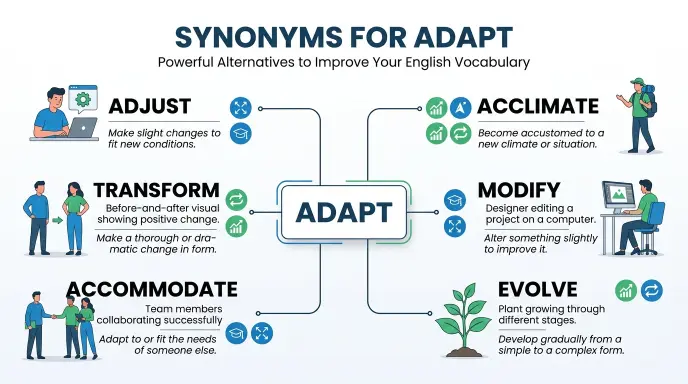
The most common and versatile synonym for adapt is adjust. When you need a direct, everyday alternative that fits almost any situation without changing your meaning, adjust is your best option.
However, because “adapt” can mean anything from modifying an object to surviving a major life transition, different scenarios call for more specific vocabulary choices:
- Modify: Use this when you are making physical, structural, or minor changes to an object, design, or plan (e.g., “modify the website layout”).
- Acclimate: Choose this when someone is getting used to a new climate, culture, or physical environment over time (e.g., “acclimate to the high altitude”).
- Pivot: Perfect for modern business, tech, or strategic shifts where a rapid, intentional change of direction is required (e.g., “the startup decided to pivot”).
- Tailor: Use this when you are customizing or reshaping something to fit an exact, specific need or audience perfectly (e.g., “tailor the resume for the job application”).
Quick Reference: 30 Alternatives to Adapt
| Synonym | One-Line Meaning |
| Adjust | To make minor changes to achieve a desired fit, state, or relationship. |
| Modify | To alter the structure, character, or appearance of something slightly. |
| Tailor | To customize or shape something to fulfill a specific requirement. |
| Acclimate | To get used to a new climate, environment, or set of conditions. |
| Pivot | To rapidly change direction or strategy in response to new data. |
| Evolve | To develop gradually over time into a more advanced or adapted state. |
| Conform | To change behavior or characteristics to match established rules or norms. |
| Accommodate | To modify plans or spaces to fit the needs of someone or something else. |
| Reconfigure | To rearrange the elements, settings, or structure of a system. |
| Align | To adjust components or ideas so they parallel or support each other. |
| Accustom | To familiarize oneself with a condition or practice through repetition. |
| Amend | To alter text, laws, or formal documents to improve accuracy or fairness. |
| Revamp | To patch up, revise, or reconstruct something to give it a fresh look. |
| Calibrate | To make precise, fine-tuned adjustments to tools, data, or expectations. |
| Assimilate | To absorb and integrate into a new culture, group, or information set. |
| Fine-tune | To make minute, highly precise adjustments for peak performance. |
| Transform | To undergo a complete, dramatic change in form, appearance, or nature. |
| Habituate | To become psychological or physically used to a stimulus over time. |
| Tweak | To make a sharp, very small adjustment to improve an overall system. |
| Reorient | To change the focus, direction, or primary targeting of an initiative. |
| Customise | To build or alter something to meet an individual’s unique specs. |
| Metamorphose | To change completely into a fundamentally different form or structure. |
| Bend | To flex or compromise rules temporarily without breaking them completely. |
| Reshape | To give a new form, direction, or conceptual framework to something. |
| Revise | Altering ongoing work or written text to reflect updated realities. |
| Convert | To change the function, state, or character of an object into another. |
| Vary | To introduce changes or diversity to prevent monotony or rigidity. |
| Harmonize | To bring different, conflicting elements into a pleasing, balanced agreement. |
| Naturalize | To introduce a plant, animal, or person into a non-native environment successfully. |
| Modernize | To update older systems or ideas to match current standards and trends. |
Formal vs. Informal Synonyms
When working on writing improvement, context dictates your word choice. Using a casual word in a scientific paper or a stuffy academic term in a friendly blog post creates a jarring mismatch for your reader.
Formal Synonyms
These terms carry academic, legal, or highly professional weight. They are best suited for research papers, business reports, legal documentation, and corporate strategy.
- Assimilate: Implies deep, structural integration, often used in sociology or cognitive psychology (e.g., “assimilating complex data systems”).
- Calibrate: Derived from engineering and science, this implies highly measurable, precise adjustments based on strict standards (e.g., “calibrating market expectations”).
- Reconfigure: Frequently used in IT, logistics, and organizational design to describe structural changes (e.g., “reconfiguring network protocols”).
Informal Synonyms
These words are conversational, punchy, and perfect for casual blogging, emails, speech, and creative narratives.
- Tweak: Implies a fast, low-stakes, minor adjustment that takes seconds but fixes a small annoyance (e.g., “let me tweak this headline real quick”).
- Roll with the punches: An idiom that beautifully captures the emotional side of adapting to unexpected challenges in everyday life (e.g., “plans changed, so we just had to roll with the punches”).
- Revamp: Great for creative industries, marketing, and style writing, implying a fun makeover rather than a boring administrative change (e.g., “we need to revamp our Instagram grid”).
30 Detailed Synonyms for Adapt
1. Adjust
- Meaning: To alter slightly to achieve a desired fit, appearance, or functional state.
- Explanation: Adjust is the closest direct sibling to adapt. It carries a highly neutral tone, making it safe for both formal boardrooms and informal conversations. While adapting often implies a deep, long-term survival mechanism, adjusting usually refers to a quick, practical correction. It implies that the core structure remains the same, but minor elements are shifted to optimize performance or comfort. It sounds natural when talking about physical objects, financial numbers, or psychological mindsets.
- Examples:
- Please adjust the thermostat if the room gets too cold during the meeting.
- It took the team a few weeks to adjust to the new remote working schedule.
2. Modify
- Meaning: To make partial changes to the form, characteristics, or properties of something.
- Explanation: Modify sits squarely in professional, technical, and academic writing. It carries an objective, analytical tone. Unlike adapt, which can happen naturally or unconsciously, modification is always intentional, planned, and executed. It suggests that someone deliberately edited a design, document, code, or physical structure to make it better suited for a specific purpose. It avoids emotional weight and focuses entirely on structural action.
- Examples:
- The developers had to modify the application’s source code to fix the security vulnerability.
- We modified our initial travel plans after hearing the weather forecast.
3. Tailor
- Meaning: To design, build, or alter something to meet specific, individual needs.
- Explanation: Derived from the clothing industry, tailor carries an elegant, premium, and highly intentional nuance. When you tailor something, you aren’t just making a random change; you are customizing it with precision for a specific target audience or situation. It is heavily utilized in marketing, education, and career development because it highlights care, attentiveness, and high value. It differs from adapt because it implies a top-down creative decision rather than a reactive survival response.
- Examples:
- The professor decided to tailor the curriculum to match the students’ career goals.
- An expert marketer knows how to tailor ad copy for different social platforms.
4. Acclimate
- Meaning: To accustom oneself to a new climate, physical environment, or atmosphere.
- Explanation: Acclimate has a clear biological and environmental undertone. It is highly specific compared to the broad nature of adapt. Use this synonym when the change involves physical survival, comfort, or getting used to tangible surroundings like weather, altitude, temperature, or even a stressful new office atmosphere. It implies a gradual, natural internal process of becoming comfortable with something that initially felt shocking or alien.
- Examples:
- Mountain climbers must camp at base stations for days to acclimate to the thinning air.
- It takes time for international students to acclimate to a completely new culture.
5. Pivot
- Meaning: To completely turn or shift a strategy, direction, or focus, usually while keeping one core element fixed.
- Explanation: Pivot is a dynamic, high-energy modern buzzword widely used in tech, startup culture, and business strategy. It carries an intense, decisive tone. While adapting can be a slow, quiet process, a pivot is a sharp, deliberate reaction to a sudden roadblock or market realization. It tells the reader that the subject evaluated new data and made an immediate, calculated change in direction to avoid failure.
- Examples:
- When the app’s video feature failed to gain traction, the startup pivoted to photo sharing.
- The public relations team had to pivot their messaging after the unexpected press leak.
6. Evolve
- Meaning: To develop gradually, naturally, and progressively over a long period.
- Explanation: Evolve carries massive scale, history, and natural weight. It shifts the focus from a quick patch to a grand, long-term transformation. Whether used biologically or metaphorically in business and art, it implies that adaptation happened organically over generations or major life cycles. It sounds highly sophisticated and professional, suggesting that the changes made resulted in a superior, more advanced version of the original subject.
- Examples:
- Languages evolve over centuries as different cultures interact and trade.
- Our business model must evolve if we want to remain competitive in the digital age.
7. Conform
- Meaning: To behave, change, or develop in accordance with socially established standards, rules, or laws.
- Explanation: Conform carries a distinct psychological and systemic weight, often bordering on restrictive or rigid. Unlike adapt, which usually sounds positive and resourceful, conforming can sometimes imply a loss of individuality. It means modifying your shape, behavior, or ideals purely because an external authority or majority group demands it. It is widely used in legal, societal, and corporate governance contexts.
- Examples:
- The new factory design must conform strictly to local environmental regulations.
- He chose to conform to the corporate dress code despite his personal preference for casual attire.
8. Accommodate
- Meaning: To adjust actions, spaces, or thoughts to fit the specific needs or desires of others.
- Explanation: Accommodate is deeply rooted in empathy, hospitality, and cooperation. It carries a warm, professional, or helpful tone. When you accommodate, you are voluntarily adapting your own schedule, rules, or physical space to make things easier, more comfortable, or accessible for someone else. It differs from adapt because it explicitly requires a relational element—you are changing for someone.
- Examples:
- The hotel went out of its way to accommodate our dietary restrictions.
- We can shift our meeting time to 3:00 PM to accommodate your busy morning schedule.
9. Reconfigure
- Meaning: To change the internal layout, settings, or structural arrangement of a system.
- Explanation: Reconfigure is a heavy, technical word deeply tied to computer science, machinery, and complex organizational structures. It carries an analytical, precise, and professional tone. It implies that all the original pieces or team members are still there, but they are being plugged together in a brand-new way to achieve better efficiency, security, or output.
- Examples:
- The network administrator had to reconfigure the router settings after the power outage.
- The factory floor was reconfigured to speed up the assembly of the new vehicle model.
10. Align
- Meaning: To adjust components, goals, or viewpoints so they are in perfect agreement or parallel positions.
- Explanation: Align is an incredibly popular corporate strategy term. It carries a tone of harmony, efficiency, and shared purpose. While adapting might just mean changing to survive, aligning means consciously adjusting your trajectory so that it matches up beautifully with another system, trend, or organizational objective. It removes friction and ensures everyone is pulling in the exact same direction.
- Examples:
- We need to align our marketing campaign with the upcoming seasonal product launch.
- The wheels must be properly aligned to prevent uneven tire wear on the vehicle.
11. Accustom
- Meaning: To make oneself or someone else familiar with something through regular practice or exposure.
- Explanation: Accustom is a gentle, psychological synonym that deals with habit formation and routine. It is moderately formal but works perfectly in everyday storytelling. It implies that a situation which once felt strange, difficult, or uncomfortable has now become normal simply due to the passage of time and repeated exposure. It emphasizes the mental conditioning side of adaptation.
- Examples:
- It took several months for the children to accustom themselves to the quiet routine of country life.
- She quickly grew accustomed to the fast-paced nature of the busy city newsroom.
12. Amend
- Meaning: To alter or formalize legal text, documents, or agreements to make them more accurate, just, or updated.
- Explanation: Amend has strict legal, political, and highly formal boundaries. You should almost never use it to describe physical actions or personal lifestyles. Instead, keep it reserved for contracts, constitutional laws, formal proposals, and written records. It carries an official, corrective, and serious tone, implying that the original document was incomplete or outdated and has now been adapted to fix errors or protect rights.
- Examples:
- The committee voted unanimously to amend the bylaws regarding member voting rights.
- The contract was amended to include a clause protecting the freelancer’s intellectual property.
13. Revamp
- Meaning: To thoroughly restructure, restyle, or renew something to give it a fresh look or improved functionality.
- Explanation: Revamp is an active, energetic, and highly visual word popular in marketing, design, and casual business talk. It carries a tone of exciting transformation. While adapting can sometimes sound like a chore forced upon you by bad luck, revamping sounds like a fun, deliberate choice to inject new life into an outdated product, website, or strategy. It focuses heavily on improving outward appearance and user experience.
- Examples:
- The studio decided to revamp the entire user interface before launching the game globally.
- We need to revamp our recruitment process to attract top-tier global talent.
14. Calibrate
- Meaning: To precisely adjust an instrument, system, or expectation against an exact standard or external reality.
- Explanation: Calibrate is a clinical, scientific word that oozes professional expertise and high precision. In engineering, it means adjusting a sensor or scale so its readings are perfectly true. Metaphorically, in business or communication, it means adjusting your tone, pricing, or expectations so they match the exact reality of the market or audience. It implies careful measurement, calculation, and absolute accuracy.
- Examples:
- Technicians must calibrate the lab equipment weekly to guarantee accurate test results.
- The leadership team spent hours calibrating their financial projections based on Q1 data.
15. Assimilate
- Meaning: To fully absorb, integrate, and become part of a larger community, culture, or body of knowledge.
- Explanation: Assimilate is a profound, high-intensity word used heavily in social sciences, immigration discussions, and advanced learning contexts. It is formal and serious. Unlike a simple adjustment, assimilation means adapting so deeply that you blend into the background of the new environment completely, taking on its characteristics, habits, and knowledge systems as your own.
- Examples:
- New immigrants often struggle to balance preserving their heritage with trying to assimilate.
- It takes time for a new employee to fully assimilate the vast corporate culture and history.
16. Fine-tune
- Meaning: To make tiny, highly specific adjustments to a system or process to achieve peak performance.
- Explanation: Fine-tune is a wonderful, practical alternative that carries a tone of mastery and attention to detail. It works beautifully across corporate settings, athletic training, and creative arts. It tells the reader that the heavy lifting is already done; the system is already adapted, but the author is now making microscopic tweaks to turn a good result into a flawless, elite performance.
- Examples:
- The chef spent weeks working to fine-tune the recipe before opening the restaurant.
- We need to fine-tune our ad targeting parameters to reduce our cost-per-click.
17. Transform
- Meaning: To undergo a complete, radical change in form, nature, appearance, or character.
- Explanation: Transform is a high-impact, inspiring word that vastly exceeds the quiet nature of adapt. Use this when the adaptation is so profound that the original state is barely recognizable. It carries a dramatic, highly positive, and empowering emotional tone. It is perfect for marketing case studies, motivational speeches, and evolutionary narratives where minor changes aren’t enough—a complete metamorphosis is required.
- Examples:
- The digital revolution completely transformed the way global businesses manage customer service.
- With consistent training and a proper diet, he transformed his physical health.
18. Habituate
- Meaning: To become so psychologically or physically familiar with a condition or stimulus that it no longer triggers a strong response.
- Explanation: Habituate is a technical, formal word used primarily in psychology, biology, and neurology. It carries an objective, cold, and clinical tone. It describes a passive, automatic type of adaptation where the mind or body stops noticing a background stressor, sound, or environment simply because it has become a constant part of life.
- Examples:
- Urban residents eventually habituate to the constant roar of traffic outside their windows.
- The laboratory animals became habituated to the presence of human researchers over time.
19. Tweak
- Meaning: To twist or adjust something slightly and sharply to optimize its operation or appearance.
- Explanation: Tweak is a friendly, casual, and highly action-oriented word used constantly by writers, developers, and designers. It carries an informal, fast-paced tone. It tells the reader that there is absolutely nothing broken or deeply wrong with the project; it just needs a tiny, quick fix to make it perfect. It implies low risk and high agility.
- Examples:
- If you tweak the font size slightly, the entire paragraph will fit on one page.
- We just need to tweak the email subject line to see if our open rates improve.
20. Reorient
- Meaning: To shift the focus, direction, mindset, or primary target of an individual or organization.
- Explanation: Reorient is a highly professional corporate and psychological term. It carries an intentional, strategic, and macro-level tone. When an organization reorients, it realizes its current path or philosophy is no longer working, prompting it to turn its entire focus toward a new North Star. It implies stepping back, reassessing values, and changing direction completely.
- Examples:
- The university had to reorient its funding toward STEM fields to secure state grants.
- After the crisis, he decided to reorient his life around family rather than career advancement.
21. Customize
- Meaning: To modify or build a product, service, or experience to fulfill a user’s unique, personal specifications.
- Explanation: Customize is a commercially charged, client-centric word widely used in web development, manufacturing, and design. It carries an empowering, high-value tone. While adapting can feel like a compromise, customizing feels premium because it places the power in the hands of the user, altering a basic template to perfectly fit their precise lifestyle or workflow.
- Examples:
- Our software allows users to customize their dashboard to show relevant metrics.
- The agency offers customized marketing packages based on the specific budget of the client.
22. Metamorphose
- Meaning: To undergo a complete, striking, and magical structural transformation into a completely new entity.
- Explanation: Metamorphose is a highly literary, descriptive, and dramatic word. It sits comfortably in creative writing, high-end journalism, and natural sciences. It carries an intense, awe-inspiring tone. It should be used when a standard word like adapt feels way too boring to describe a radical, beautiful, or shocking evolution from one state of being to another.
- Examples:
- Over the decades, the quiet fishing village metamorphosed into a crowded, glittering metropolis.
- The caterpillar will eventually metamorphose into a vibrant monarch butterfly inside its chrysalis.
23. Bend
- Meaning: To temporarily flex, relax, or compromise a strict rule or standard to accommodate a unique situation.
- Explanation: Bend is an informal, highly metaphorical alternative. It carries a conversational, human tone, often used when talking about bureaucracy, rules, or personal boundaries. When you bend to adapt, you aren’t permanently breaking the structure or changing your identity; you are simply showing temporary flexibility to survive a tricky situation or show kindness to someone.
- Examples:
- The manager agreed to bend the company policy just this once to help the stranded customer.
- Good leaders know when to stand firm and when to bend to keep team morale high.
24. Reshape
- Meaning: To change the fundamental form, narrative, character, or future outlook of an entity or concept.
- Explanation: Reshape is an impactful, highly professional term popular in economic journalism, political speeches, and visionary business copy. It carries a powerful, constructive tone. It tells the reader that the subject is not passively reacting to changes; they are actively taking control to mold the future, industry standards, or public opinion into a completely new shape.
- Examples:
- Artificial intelligence is currently working to reshape the global job market across multiple industries.
- The CEO’s bold new vision helped reshape the company’s public image after the scandal.
25. Revise
- Meaning: To re-examine, correct, and update written text, opinions, policies, or plans based on fresh evidence.
- Explanation: Revise is a foundational academic, professional, and editorial word. It carries an intellectual, objective, and careful tone. It implies that new data, feedback, or errors have come to light, making it necessary to adapt your previous work, stance, or business strategy to make it accurate and bulletproof.
- Examples:
- The author had to revise the third chapter extensively based on the editor’s notes.
- The central bank decided to revise its economic growth forecast downward due to inflation.
26. Convert
- Meaning: To change the physical form, character, function, or digital format of something into an entirely different one.
- Explanation: Convert has an analytical, practical, and highly functional nuance. It works perfectly in tech, real estate, and physical sciences. When you convert something, you take a resource that was adapted for one specific purpose and completely alter its utility so it can serve an entirely new role without wasting the original asset.
- Examples:
- They plan to convert the old brick warehouse into modern luxury loft apartments.
- You can use this free online tool to convert a PDF file into an editable Word document.
27. Vary
- Meaning: To intentionally introduce differences, alterations, or diverse elements into a routine or system.
- Explanation: Vary carries a tone of balance, health, and calculated diversity. It is used across educational, medical, and artistic content. Instead of adapting as a desperate response to a problem, varying is a proactive adaptation strategy used to prevent boredom, physical injury, or systemic stagnation by mixing things up regularly.
- Examples:
- Athletes should vary their training routines to prevent repetitive strain injuries and build core strength.
- To keep your writing engaging, you must vary sentence length and structure across paragraphs.
28. Harmonize
- Meaning: To bring separate, conflicting, or diverse elements into a beautiful, peaceful agreement or balance.
- Explanation: Harmonize is a highly positive, elegant word borrowed from music theory. It is incredibly effective in diplomacy, international trade, design, and human resource copy. It carries a deeply cooperative, soothing tone, implying that multiple distinct entities have adapted their individual settings so they can coexist without clash or friction.
- Examples:
- The multinational corporation worked tirelessly to harmonize safety standards across all its global branches.
- The interior designer selected natural colors to harmonize the modern furniture with the rustic room.
29. Naturalize
- Meaning: To introduce and successfully adapt a foreign plant, animal, or person into a brand-new environment.
- Explanation: Naturalize has deep legal and botanical roots, giving it a formal, specialized tone. In immigration contexts, it means giving a foreigner full citizenship rights. In biology, it means an introduced species has adapted so perfectly to the local ecosystem that it now reproduces naturally without human help. It implies deep, permanent belonging.
- Examples:
- After living in London for nearly a decade, she finally decided to apply to become a naturalized citizen.
- The cherry blossom trees have become completely naturalized in this region over the past century.
30. Modernize
- Meaning: To adapt, update, or overhaul old infrastructure, ideas, or systems to meet contemporary standards.
- Explanation: Modernize is a forward-looking, progressive word used constantly in political commentary, urban planning, and technological copy. It carries a highly positive, developmental tone. It tells your reader that old, dusty, or inefficient ways of doing things are being adapted to stay relevant, fast, and competitive in the modern world.
- Examples:
- The city council allocated millions of dollars to modernize the public transit system this year.
- Traditional businesses must modernize their digital infrastructure if they want to survive online.
Frequently Asked Questions
What is the difference between adapt and adopt?
To adapt means to change something to fit a new situation or environment. To adopt means to take something up completely as your own, such as an idea, a child, a country, or a new habit, without making changes to it.
Can I use “modify” instead of “adapt” in a business report?
Yes. Modify is a highly professional, objective alternative to adapt when discussing plans, software, layouts, or corporate strategies. It indicates that structural or procedural edits were made intentionally to meet a specific goal.
What is a good casual idiom for adapting to a bad situation?
The most popular everyday idiom is “roll with the punches.” It means to remain flexible, calm, and resilient when encountering unexpected challenges or rapid changes in your day-to-day life instead of giving up.
Is “acclimate” always related to the weather or climate?
While acclimate originated in biology to describe adjusting to temperature or altitude, it is now widely used metaphorically in professional contexts to describe a human getting comfortable with a brand-new corporate culture, school, or routine.
When should I use “pivot” instead of “adapt”?
Use pivot when a business, team, or individual makes a rapid, intentional, and sharp change in strategy because their current path is failing. Adapt implies slow, gradual survival, while pivot emphasizes quick, calculated agility.
Conclusion
Mastering the nuances of English vocabulary is the ultimate gateway to expressive writing and effective communication skills. As we have seen throughout this comprehensive guide, relying on the word “adapt” over and over again hides the specific color, intensity, and strategy of your narrative.
By replacing it with targeted alternatives like pivot, tailor, calibrate, or acclimate, you instantly provide your readers with deep, contextual clarity.
Writing improvement does not happen by accident; it is the direct result of deliberate, mindful word choice. When you select a synonym that carries the exact formal or informal tone required for your piece, your copy transforms from a predictable string of text into a sharp, highly engaging, and persuasive experience.
This level of precision is exactly what separates generic, robotic content from high-impact, human-driven prose that easily satisfies Google’s helpful content guidelines.
Don’t let your vocabulary sit idle on the page. The next time you sit down to draft an article, review a corporate presentation, or polish a creative essay, challenge yourself to audit your verbs. Actively replace lazy repetitions with the rich, precise alternatives you discovered here today.
Your audience will thank you for the clarity, your text will flow with newfound energy, and your writing skills will reach heights you never thought possible. Start diversifying your word choices right now!

I’m Ethan Cole, a passionate vocabulary writer at LexiBoost, where I help readers understand English words in a simpler and smarter way. I enjoy exploring synonyms, antonyms, and word meanings while creating easy-to-follow content that improves everyday communication