Imagine sitting in a high-stakes board meeting or staring at a blank document, trying to explain your strategy for a new project. You type out, “Our approach to this problem…” Then, a few sentences later, you write, “As we approach the launch date…” Before you know it, the word is everywhere, cluttering your sentences and flattening your delivery.
It’s a common trap. We rely on this versatile word because it operates as both a noun and a verb, stepping in for everything from physical movement to intellectual strategy.
When you repeat the same word, your readers tune out. In professional writing, overusing a single term makes the text feel mechanical, obscuring your actual expertise. On the flip side, diversifying your language acts as an immediate form of vocabulary enhancement.
By selecting precise alternatives, you show a commanding grasp of English vocabulary and sharp communication skills. Instead of forcing your reader to guess your meaning based purely on context, choosing the exact right synonym instantly sharpens your expressive writing. It turns a vague statement into a punchy, memorable piece of prose.
Moving past a default vocabulary is the ultimate tool for genuine writing improvement, transforming passive reading into active engagement.
What is Another Word for Synonyms for Approach?
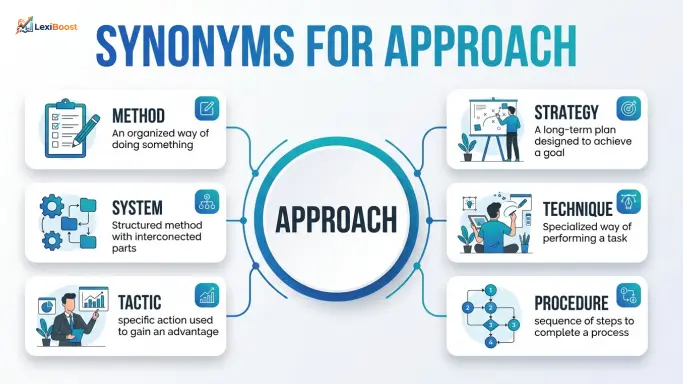
The most common and direct synonym for a conceptual “approach” is method. When you are looking to replace the word in terms of an intellectual framework or strategy, method provides immediate clarity without sounding overly formal.
Depending on your specific context, here are four other strong alternatives to swap in for better word choice:
- Strategy: Best used in business or high-level planning where long-term goals and calculated moves are involved.
- Perspective: Ideal when “approach” refers to a mindset, viewpoint, or how someone interprets a situation.
- Advance: The perfect choice when dealing with the physical act of moving closer to a target or objective.
- Methodology: A more formal, academic alternative used when discussing a systematic, structured framework of practices.
How to Choose the Right Synonym
Selecting the perfect alternative requires evaluating both the part of speech and the underlying tone of your sentence.
First, determine if your use of “approach” is a noun (a framework or path) or a verb (the act of drawing near or addressing someone).
Second, consider your audience. A creative essay benefits from evocative words like angle or converge, while technical documentation demands objective terms like procedure or system.
Pay close attention to intensity confront carries a confrontational energy, whereas address is neutral and professional. Matching the synonym’s inherent nuance to your intentional meaning prevents awkward phrasing and keeps your writing natural.
Quick Reference: 30 Alternatives to Synonyms for Approach
| Synonym | One-Line Meaning |
| 1. Method | A systematic or established way of doing something. |
| 2. Strategy | A long-term, calculated plan designed to achieve a specific goal. |
| 3. Technique | A specialized skill or execution style used to complete a task. |
| 4. Angle | A specific perspective or unique way of looking at a problem. |
| 5. Tactic | A concrete action or short-term maneuver used to gain an advantage. |
| 6. Procedure | An official, step-by-step series of actions conducted in a set order. |
| 7. Attitude | A settled way of thinking that reflects a specific mental posture. |
| 8. Perspective | A particular attitude toward or way of regarding something; a viewpoint. |
| 9. Methodology | A system of broad principles and rules applied to a field of study. |
| 10. Access | A means of approaching, entering, or gaining entry to a place. |
| 11. Advance | To physically move forward or draw closer to a specific point. |
| 12. Near | To come closer in space, time, or relative condition. |
| 13. Address | To direct attention, speech, or effort toward solving a problem. |
| 14. Confront | To face a challenge, problem, or person directly and defiantly. |
| 15. Consult | To seek information, advice, or guidance from an expert source. |
| 16. Proposal | An offer or plan put forward for consideration or discussion. |
| 17. Approximations | An estimate or calculation that comes close to a correct value. |
| 18. Path | A track, route, or course of action designed to reach an outcome. |
| 19. System | A set of connected things or parts forming a complex whole. |
| 20. Policy | A course of principle adopted by an organization or individual. |
| 21. Converge | To move from different directions toward a single common point. |
| 22. Accost | To approach and speak to someone aggressively or boldly. |
| 23. Appraise | To assess the value, quality, or nature of an upcoming situation. |
| 24. Modus Operandi | A distinct, characteristic way of working or handling a situation. |
| 25. Formulation | The action of creating or preparing a plan in a precise form. |
| 26. Outlook | A person’s general point of view or general attitude toward life. |
| 27. Blueprint | A detailed, structured photographic print or plan of action. |
| 28. Standard | An authorized, baseline model used for gauging an execution. |
| 29. Incline | To lean toward a specific opinion, action, or physical direction. |
| 30. Breakthrough | A significant step or sudden advance that bridges a difficult gap. |
30 Detailed Synonyms for Approach
1. Method
- Meaning: A systematic, logical, or established way of doing something.
- Explanation: Method strips away the ambiguity often found in the word “approach.” It implies a structured, orderly sequence that has been tested and proven effective. Use this word in professional, academic, or scientific settings where reproducibility matters.
- Examples:
- The research team adopted a rigorous statistical method to analyze the quarterly market trends.
- Her method of teaching complex calculus concepts keeps students engaged throughout the semester.
2. Strategy
- Meaning: A high-level, long-term plan designed to achieve a major goal under conditions of uncertainty.
- Explanation: Strategy elevates the concept of an approach by implying deliberate planning, resource allocation, and a focus on the big picture. It carries a professional, authoritative tone and is heavily favored in business, military, and competitive environments.
- Examples:
- The board approved a aggressive marketing strategy to capture a younger demographic.
- We need a clear strategy to navigate these shifting regulatory compliance frameworks over the next decade.
3. Technique
- Meaning: A specialized skill or efficient way of executing a practical task.
- Explanation: Technique focuses directly on mechanical or artistic skill. It differs from a general approach because it highlights the craftsmanship, dexterity, or technical prowess required to do the work.
4. Angle
- Meaning: A specific perspective, motive, or unique way of looking at a problem.
- Explanation: Angle is an informal or journalistic alternative to a conceptual approach. It implies looking at a situation from a unique direction to uncover hidden insights or advantages.
- Examples:
- Let’s look at this marketing problem from a fresh angle to see what our competitors missed.
- The investigative reporter found a fascinating political angle that completely changed the front-page narrative.
5. Tactic
- Meaning: A concrete, short-term action or maneuver used to achieve a specific immediate objective.
- Explanation: Tactic is much more granular and immediate than a general approach. While a strategy is the overarching master plan, tactics are the boots-on-the-ground actions that execute it. The tone is deliberate, sharp, and highly focused on immediate victory or resolution. It is ideal for business negotiations, athletic plays, or digital marketing campaigns.
- Examples:
- Offering a limited-time discount code is a classic sales tactic to boost end-of-month revenue.
- The defense attorney employed a brilliant cross-examination tactic that caught the witness off guard.
6. Procedure
- Meaning: An official, mandatory sequence of actions executed in a set order.
- Explanation: Procedure is rigid and formal, emphasizing compliance, safety, and institutional standards. Unlike a flexible personal approach, a procedure must be followed exactly as written to avoid errors or penalties. It is perfect for medical environments, corporate compliance manuals, legal frameworks, and technical troubleshooting protocols.
- Examples:
- Please follow the standard emergency evacuation procedure posted near the main stairwell exit.
- The lab technician meticulously executed the testing procedure to prevent cross-contamination of the blood samples.
7. Attitude
- Meaning: A settled way of thinking or feeling, reflected in a person’s posture or behavior.
- Explanation: When an “approach” refers to the psychological stance a person takes toward a challenge, attitude is a strong psychological substitute. It captures the emotional tone if positive, defensive, cynical, or collaborative that shapes how someone tackles their daily responsibilities. It is casual to semi-formal and shifts focus to emotional intelligence and mindset.
- Examples:
- Maintaining a collaborative attitude during group projects helps prevent unnecessary personal friction.
- His defensive attitude toward constructive criticism made it incredibly difficult for the creative team to collaborate.
8. Perspective
- Meaning: A particular viewpoint, mindset, or way of interpreting a situation.
- Explanation: Perspective deals with how a situation is perceived based on a person’s unique background, experience, or values. It is a soft, intellectual alternative to a conceptual approach. It highlights that there is no single correct answer, encouraging empathy and open-mindedness in professional discussions and creative projects.
- Examples:
- Traveling extensively provides a global perspective that enriches your understanding of local economics.
- We need to look at this user interface from the customer’s perspective to fix the confusing checkout flow.
9. Methodology
- Meaning: The underlying system of methods, principles, and rules used in a field of study.
- Explanation: Often misused as a fancy word for “method,” methodology is actually the philosophical and scientific justification behind the methods chosen. It is a highly academic, formal term reserved for research papers, scientific trials, and deep industry analyses. It carries significant intellectual authority and implies structural rigor.
- Examples:
- The dissertation included a thorough breakdown of the qualitative research methodology used to gather data.
- Our development team strictly adheres to the Agile methodology to deliver software updates iteratively.
10. Access
- Meaning: The physical means, opportunity, or right to enter or approach a place or object.
- Explanation: Access serves as an excellent replacement for “approach” when dealing with physical geography, architecture, or digital security clearance. It describes the physical pathway or permission required to get close to a location, database, or high-profile individual, leaning toward a functional and logistical tone.
- Examples:
- The construction crew built a temporary gravel ramp to allow heavy vehicle access to the deep excavation site.
- Only authorized system administrators have direct access to the encrypted customer database.
11. Advance
- Meaning: To physically move forward or draw closer to a specific target or point in time.
- Explanation: Advance is an action-oriented verb or noun that replaces the physical movement aspect of “approach.” It carries a sense of purpose, momentum, and sometimes military precision. It can also describe abstract progress, such as an industry advancing technologically. It feels far more dynamic and energetic than a simple approach.
- Examples:
- The infantry columns began to advance steadily toward the heavily fortified ridge under the cover of dense fog.
- As the deadline continues to advance, our project team must increase their daily output to stay on track.
12. Near
- Meaning: To come closer in space, time, or relative condition.
- Explanation: Near is a direct, minimalist verb that elegantly replaces “approach” when tracking distance or time. It is highly versatile, fitting seamlessly into both casual speech and formal literature. It feels less clinical than “approach,” focusing cleanly on the narrowing gap between two objects or dates.
- Examples:
- The cruise ship began to near the tropical harbor just as the morning sun broke through the clouds.
- As we near the end of the fiscal calendar, budget discussions are becoming increasingly urgent.
13. Address
- Meaning: To direct attention, conversational focus, or problem-solving effort toward a specific issue.
- Explanation: Address is the consummate professional verb to swap for “approach a problem.” It implies stepping up to take responsibility for an issue, defining it, and beginning the process of fixing it. The tone is proactive, mature, and efficient, making it a favorite in corporate communications, political speeches, and customer service updates.
- Examples:
- Management promises to address the recent scheduling conflicts during tomorrow morning’s team meeting.
- We must immediately address the security vulnerabilities identified in our mobile application code.
14. Confront
- Meaning: To face a challenge, problem, or adversarial person directly, boldly, and often defiantly.
- Explanation: Confront is a high-intensity alternative that replaces a passive approach with assertive action. It implies friction, bravery, or tension. You don’t just gently handle a problem when you confront it; you look it in the eye and resolve to conquer it. Use it when dealing with crises, difficult personal conversations, or deeply rooted systemic challenges.
- Examples:
- The HR manager had to confront the employee regarding their repeated violations of the office attendance policy.
- To succeed long-term, the startup had to confront its scaling limitations before expanding overseas.
15. Consult
- Meaning: To seek information, specialized advice, or guidance from an expert source before acting.
- Explanation: Consult replaces the idea of “approaching someone for help” with a much more professional, deferential tone. It implies that the person you are approaching possesses specialized knowledge or authority. It is standard in legal, medical, corporate, and academic fields.
- Examples:
- You should consult an experienced tax attorney before finalizing your corporate restructuring plan.
- The engineering team will consult the original architectural blueprints to verify the load-bearing capacity.
16. Proposal
- Meaning: A formal plan, offer, or scheme put forward for consideration, critique, or adoption by others.
- Explanation: When an approach takes the form of a written pitch or structured suggestion, proposal is the ideal noun replacement. It implies that the idea is fully formed but open to negotiation. The tone is professional, organized, and collaborative, inviting feedback from stakeholders or clients.
- Examples:
- The city council reviewed a comprehensive proposal to build a green community park downtown.
- We submitted a detailed budget proposal to the executives to secure funding for the new creative department.
17. Approximation
- Meaning: An estimate, calculation, or conceptual value that comes very close to a correct target.
- Explanation: This acts as an excellent substitute when “approach” is used in mathematical or analytical contexts to mean getting close to an accurate number or standard. It carries a highly technical, precise tone, signaling to readers that while the data isn’t perfectly exact, it is statistically reliable.
- Examples:
- The financial analyst provided a close approximation of the projected acquisition costs for the next fiscal year.
- For a rough approximation of your daily caloric needs, you can use a basic online basal metabolic rate calculator.
18. Path
- Meaning: A concrete route, track, or metaphorical course of action designed to reach a specific outcome.
- Explanation: Path is an evocative, visual word that makes abstract concepts feel tangible. When replacing a strategic approach, path suggests a journey, complete with milestones, progression, and a final destination. It can range from casual storytelling to inspirational corporate leadership presentations.
- Examples:
- Earning an advanced data science certification opened up a clear career path to senior management.
- The development team map out a specific development path to ensure the software launch stays on schedule.
19. System
- Meaning: A set of connected things, rules, or procedures forming an integrated, complex whole.
- Explanation: System implies a thoroughly engineered, interconnected network of operations. While an approach can be a single idea, a system is an entire ecosystem of moving parts working together. The tone is highly professional, technical, and organized, emphasizing efficiency, scale, and long-term sustainability.
- Examples:
- Our warehouse implemented an automated inventory tracking system to reduce fulfillment errors.
- She designed a personal filing system that keeps all tax documents organized by quarter and category.
20. Policy
- Meaning: A set course of principles or mandatory rules adopted and enforced by an organization.
- Explanation: Policy transforms a flexible organizational approach into an official law or guideline. It carries institutional authority and leaves no room for personal interpretation. It is the perfect choice for legal, educational, and corporate environments where standardized behavior and compliance are strictly required.
- Examples:
- The university maintains a strict zero-tolerance policy against plagiarism and academic dishonesty.
- Our corporate policy requires all remote employees to use a secure corporate virtual private network connection.
21. Converge
- Meaning: To move forward from completely different directions and eventually meet at a single common point.
- Explanation: Converge is a elegant, geometric verb that replaces “approach” when multiple entities, ideas, or physical objects are drawing closer to the same spot. It creates a vivid mental picture of unification and focus, making it excellent for scientific contexts, narrative descriptions, or analytical trend forecasting.
- Examples:
- Thousands of enthusiastic tech innovators converge on Silicon Valley every year for the annual developers summit.
- Economic indicators suggest that global market trends will converge over the next two fiscal quarters.
22. Accost
- Meaning: To approach and speak to someone in an aggressive, confrontational, or uncomfortably bold manner.
- Explanation: Accost is a specialized, high-intensity verb that should only be used when an approach is distinctly unwelcome, sudden, or hostile. It carries a heavy dramatic or negative emotional weight, making it standard in narrative fiction, legal testimonies, and journalistic reports of public altercations.
- Examples:
- Angry protestors began to accost the politicians as they attempted to exit the city hall building.
- A persistent salesman stepped forward to accost shoppers the moment they crossed the department store threshold.
23. Appraise
- Meaning: To thoroughly assess the value, quality, performance, or nature of a situation or object.
- Explanation: When you “approach a situation to see what it’s like,” appraise is the professional analytical upgrade. It implies that you are stepping back, taking an objective look, and making an expert judgment. It is standard in real estate, corporate evaluations, and strategic risk assessment.
- Examples:
- The insurance adjuster arrived early to appraise the storm damage done to the commercial warehouse roof.
- Before entering a high-stakes negotiation, you must carefully appraise your opponent’s structural strengths and hidden weaknesses.
24. Modus Operandi
- Meaning: A distinct, characteristic method of working or handling a specific recurring situation.
- Explanation: Often abbreviated as “M.O.,” this Latin phrase is an elegant, formal, or highly stylized substitute for a signature approach. It implies a deeply ingrained habit, pattern, or operating style unique to a specific individual or organization. It is frequently used in legal, investigative, and high-level business writing.
- Examples:
- Launching unannounced, highly disruptive product updates has become the eccentric tech company’s standard modus operandi.
- The detective immediately recognized the burglar’s unique modus operandi from three previous cold cases in the district.
25. Formulation
- Meaning: The precise action of planning, structuring, or preparing an idea in a specific, articulate form.
- Explanation: Formulation shifts the focus from the execution of an approach to the actual intellectual creation of it. It implies careful thought, deep analysis, and a structured assembly of ideas. It carries an intellectual, formal, and scientific tone, making it excellent for strategic briefs and academic outlines.
- Examples:
- The diplomatic delegation spent weeks working on the formulation of a comprehensive international peace treaty.
- Effective problem-solving requires the clear formulation of your core thesis before gathering field data.
26. Outlook
- Meaning: A person’s general point of view, overarching philosophy, or future mental posture toward life.
- Explanation: When “approach” describes someone’s general life philosophy (e.g., “her approach to life”), outlook is a warmer, more holistic substitute. It captures the psychological expectations and mood of a person or group, if optimistic, cautious, or bleak. It fits naturally into biographical writing, self-improvement content, and macroeconomic forecasting.
- Examples:
- Despite facing numerous career setbacks, she managed to maintain a remarkably optimistic outlook on her future.
- The central bank’s current economic outlook predicts a steady reduction in national inflation rates over the summer.
27. Blueprint
- Meaning: A detailed, highly structured, and authoritative technical plan of action.
- Explanation: Blueprint takes a conceptual approach and turns it into a concrete visual metaphor. It implies that every single detail has been meticulously mapped out ahead of time, leaving zero room for guesswork. It is a powerful, inspiring word often used by leaders to rally teams around a major operational overhaul.
- Examples:
- The executive team presented a clear blueprint for transitioning the company to a fully remote workforce model.
- The architect spent months finalizing the digital blueprint for the new solar-powered medical facility.
28. Standard
- Meaning: An authorized, baseline model or rule used for gauging quality, execution, or compliance.
- Explanation: When an approach becomes the universally accepted right way to do things, it becomes a standard. This word carries immense regulatory and professional weight, implying quality control, safety, and industry consensus. Use it to replace “approach” when referring to benchmark performance metrics.
- Examples:
- Our manufacturing plant adheres to the highest environmental standard for reducing chemical wastewater runoff.
- The newly appointed creative director set a pristine professional standard for all client-facing presentations.
29. Incline
- Meaning: To lean toward a specific opinion, behavior, action, or physical direction.
- Explanation: As a verb, incline replaces the subtle, tentative movement toward an idea or physical position. It is a gentle, nuanced word that suggests a natural preference or a soft pull rather than a forced or aggressive march. It is perfect for literary prose, psychological analyses, and nuanced diplomatic writing.
- Examples:
- After reviewing the initial research data, I incline toward supporting the second advertising hypothesis.
- The structural engineers noted that the historic brick tower had begun to incline slightly toward the north wall.
30. Breakthrough
- Meaning: A significant, sudden advance or discovery that successfully bridges a difficult gap.
- Explanation: Breakthrough is an enthusiastic, high-impact word used when a new approach completely shatters an old problem. It implies overcoming a major roadblock that had previously stalled progress for a long time. It carries an inspiring, celebratory tone, making it perfect for science, technology, and personal growth contexts.
- Examples:
- Developing this new vaccine formulation represents a monumental scientific breakthrough in global infectious disease control.
- After hours of frustrating troubleshooting, the software engineer finally made a breakthrough and resolved the server crash.
Frequently Asked Questions
What is the best synonym for approach in business writing?
Strategy or method are the best options. They substitute a vague concept with an authoritative, intentional plan of action, projecting professional competence and strategic clarity to executives, stakeholders, and clients alike.
Can I use “angle” instead of “approach” in formal documents?
No, angle is slightly casual and conversational. For formal, academic, or legal documents, you should opt for more objective alternatives such as methodology, perspective, or procedure to maintain institutional authority.
How do “tactic” and “strategy” differ as synonyms for approach?
A strategy is your long-term master plan or ultimate destination. A tactic is a concrete, immediate, short-term action used to execute a small piece of that strategy on the ground.
Is “modus operandi” too formal to use in daily communication?
It is a Latin legal term, making it best suited for formal, investigative, or stylistic business writing. In casual daily speech, stick to simpler equivalents like method, habit, or working style.
What word should I use when physically nearing an object?
Use verbs like advance, near, or converge. These physical action words provide clear geometric movement, making them far more vivid and descriptive than the generalized term “approach.”
Conclusion
Mastering vocabulary enhancement is a journey that yields immediate rewards for your communication skills. By taking the time to phase out repetitive fallback words like “approach” and stepping up to targeted alternatives, you breathe new life into your text. Choosing between nuanced words like strategy, tactic, method, or angle allows you to communicate with razor-sharp precision, ensuring your true meaning is never lost in translation.
As you continue developing your language skills, challenge yourself to look past the first word that pops into your head. Pay close attention to the emotional weight, context, and structural design of your sentences. Every subtle shift in your word choice acts as a building block for long-term writing improvement, converting basic, flat sentences into compelling, expressive writing that leaves a lasting impression. Step out of your vocabulary comfort zone, experiment with these diverse alternatives, and watch your professional impact soar today!

I’m Ethan Cole, a passionate vocabulary writer at LexiBoost, where I help readers understand English words in a simpler and smarter way. I enjoy exploring synonyms, antonyms, and word meanings while creating easy-to-follow content that improves everyday communication