Have you ever walked past a dark hallway at night and thought you saw a pale figure floating in the air? That spooky figure is what people call a ghost. A ghost is the spirit of a person who is no longer living. Many people love telling stories about a friendly ghost or a scary ghost around a campfire.
Learning fresh synonyms for “ghost” makes your creative writing much more exciting. This list is great for students writing school essays, bloggers sharing spooky tales, content writers drafting holiday posts, and daily English speakers. Using different words helps you paint vivid pictures in your reader’s mind. Let us explore 50 great synonyms for “ghost” today.
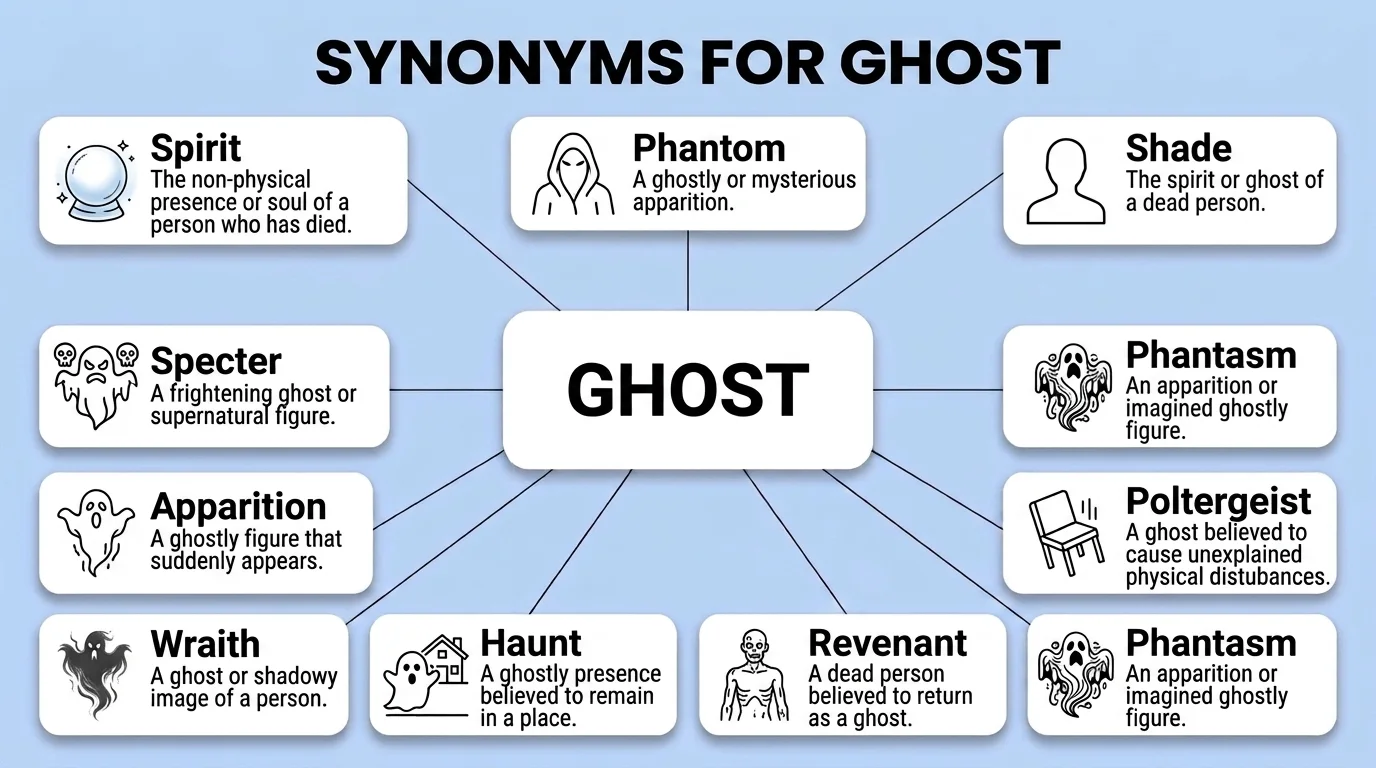
1. Spirit
Meaning:
The invisible part of a person that lives on after they die.
Examples:
- The old castle is home to a friendly spirit.
- She felt a calm spirit watching over her room.
2. Phantom
Meaning:
A pale figure that looks like a ghost and vanishes quickly.
Examples:
- A mysterious phantom appeared near the foggy lake.
- The phantom slipped right through the wooden door.
3. Specter
Meaning:
A visible ghost that looks creepy and brings bad feelings.
Examples:
- The dark specter stood quietly at the top of the stairs.
- Villagers told stories about a tall specter in the woods.
4. Apparition
Meaning:
A sudden appearance of a ghost that shocks people.
Examples:
- A glowing apparition surprised the night guard.
- We saw an icy apparition fade into thin air.
5. Wraith
Meaning:
A thin, floating ghost that looks like smoke.
Examples:
- A silent wraith drifted across the graveyard.
- The dark wraith vanished when the morning sun rose.
6. Spook
Meaning:
A fun, informal name for a ghost that scares you.
Examples:
- The kids dressed up as a little spook for Halloween.
- Did you see that spook flying past the window?
7. Poltergeist
Meaning:
A noisy ghost that likes to throw things around.
Examples:
- The poltergeist knocked all the cups off the shelf.
- Loud banging in the attic was caused by a poltergeist.
8. Shadow
Meaning:
A dark figure that moves around without a physical body.
Examples:
- A creepy shadow moved across the empty wall.
- He saw a tall shadow standing by the gate.
9. Shade
Meaning:
An old-fashioned word for a sad or quiet ghost.
Examples:
- The shade wandered through the cold forest path.
- Ancient tales speak of a weeping shade in the ruins.
10. Soul
Meaning:
The spiritual and eternal part of a human being.
Examples:
- The lost soul searched for peace in the old church.
- Stories say the wandering soul still visits the bridge.
11. Banshee
Meaning:
A female ghost from Irish legends who screams very loudly.
Examples:
- The wailing banshee warned the family of bad luck.
- We heard the cry of a banshee during the storm.
12. Vision
Meaning:
A glowing figure you see that seems magical or unreal.
Examples:
- She woke up and saw a glowing vision beside her bed.
- The traveler followed a strange vision into the woods.
13. Phantasm
Meaning:
A ghost-like figure created by fear or imagination.
Examples:
- He blinked his eyes to make the scary phantasm go away.
- The dark room seemed filled with every kind of phantasm.
14. Presence
Meaning:
An unseen feeling that a ghost is standing near you.
Examples:
- She felt a cold presence enter the quiet room.
- The strange presence made all the hairs on his neck stand up.
15. Revenant
Meaning:
A spirit that comes back from the grave to finish a task.
Examples:
- The old story told of a revenant seeking his lost gold.
- The lonely revenant walked the halls at midnight.
16. Ghoul
Meaning:
A scary, evil spirit that lurks around old graves.
Examples:
- The hungry ghoul hid behind the stone tomb.
- Legends say a wicked ghoul lives beneath the hill.
17. Haunt
Meaning:
A ghost that stays in one specific building.
Examples:
- The friendly haunt kept the library safe at night.
- That spooky house is home to a mischievous haunt.
18. Eidolon
Meaning:
An ideal image or glowing ghost of a person.
Examples:
- The shining eidolon of the queen stood in the hall.
- He painted an eidolon floating above the misty hills.
19. Manifestation
Meaning:
A ghost that makes itself visible in physical form.
Examples:
- The icy room was a sign of a ghostly manifestation.
- We watched the smoky manifestation take the shape of a man.
20. Doppelgänger
Meaning:
A ghostly double of a living person.
Examples:
- He was shocked to meet his own ghostly doppelgänger.
- Seeing a doppelgänger is often treated as an omen.
21. Manes
Meaning:
The peaceful spirits of dead ancestors from Roman tales.
Examples:
- The family made sweet offerings to the ancient manes.
- The protectivemanes watched over the family home.
22. Bogeyman
Meaning:
A scary ghost or monster used to frighten children into behaving.
Examples:
- He checked under his bed to make sure no bogeyman was there.
- The tale of the bogeyman kept the children indoors at night.
23. Boggart
Meaning:
A mischievous spirit that causes chaos in old houses.
Examples:
- The noisy boggart hid all the spoons in the kitchen.
- A clever boggart turned off the lamps in the hallway.
24. Hobgoblin
Meaning:
A playful but tricky little household spirit.
Examples:
- The tiny hobgoblin played tricks on the sleeping cat.
- Grandma left a bowl of milk for the helpful hobgoblin.
25. Sprite
Meaning:
A small, nimble spirit linked to nature or water.
Examples:
- A glowing sprite danced on top of the pond.
- The wood sprite protected the giant oak tree.
26. Astral Body
Meaning:
The glowing spirit form of a person that travels outside the physical body.
Examples:
- She felt her astral body lift softly into the air.
- The floating astral body drifted through the closed window.
27. Visitant
Meaning:
A polite word for a ghost that comes to visit.
Examples:
- The midnight visitant sat quietly in the rocking chair.
- Our old house has a harmless nightly visitant.
28. Demon
Meaning:
A wicked and harmful spirit with bad intentions.
Examples:
- The brave hero chased the scary demon away from town.
- An angry demon tried to blow out all the torches.
29. Genie
Meaning:
A magical spirit often trapped inside an old lamp or bottle.
Examples:
- The powerful genie granted three wishes to the boy.
- Smoke poured out of the bottle as the genie appeared.
30. Jinn
Meaning:
An unseen spirit from Middle Eastern stories made of fire.
Examples:
- The clever jinn granted safe travel across the desert.
- Legends tell of a mighty jinn living in the mountain cave.
31. Entity
Meaning:
A general word for any living or non-living spirit.
Examples:
- The strange entity flickered on the video screen.
- Scientists could not explain the floating entity.
32. Lemures
Meaning:
Angry and restless spirits from ancient Roman folklore.
Examples:
- The village held a ritual to calm the noisy lemures.
- Cold winds blew as the ancient lemures passed by.
33. Larva
Meaning:
An ancient term for a frightening, tormenting ghost.
Examples:
- The scary larva haunted the ruined theater.
- Old books warned travelers about the masked larva.
34. Dybbuk
Meaning:
A wandering, troubled spirit from Jewish folklore.
Examples:
- The rabbi helped free the family from the noisy dybbuk.
- The restless dybbuk hid inside the wooden box.
35. Yurei
Meaning:
A pale Japanese ghost that wears white robes and has long dark hair.
Examples:
- The sad yurei floated near the dark well.
- A famous painting showed the graceful yurei in the garden.
36. Will-o’-the-wisp
Meaning:
A floating, ghostly ball of light seen over swampy ground.
Examples:
- The lost traveler followed a glowing will-o’-the-wisp.
- A tiny will-o’-the-wisp led them safely out of the swamp.
37. Familiar
Meaning:
A spirit that takes the shape of an animal to assist someone.
Examples:
- The black cat acted as a protective familiar.
- Her owl familiar flew ahead to scout the dark path.
38. Imp
Meaning:
A tiny, mischievous spirit that loves pulling pranks.
Examples:
- The tiny imp tied his shoelaces together.
- A laughing imp hid behind the curtain.
39. Kobold
Meaning:
A mine or house spirit from German folklore.
Examples:
- The underground kobold guided the miners to safe tunnels.
- A helpful kobold swept the hearth while the family slept.
40. Púca
Meaning:
A shape-shifting Irish spirit that can bring good or bad luck.
Examples:
- The wild púca appeared as a giant black horse.
- Farmers left a small crop offering to please the púca.
41. Incubus
Meaning:
A dark spirit from medieval myths that visits people in their sleep.
Examples:
- Bad dreams were once blamed on a creeping incubus.
- The old story warned of an incubus lurking in the shadows.
42. Succubus
Meaning:
A mythical female spirit that appears in dreams.
Examples:
- The folklore tale described a mysterious succubus.
- He woke up startled by a dream of a succubus.
43. Oni
Meaning:
A giant spirit or ogre found in Japanese folklore.
Examples:
- The red-faced oni guarded the dark mountain bridge.
- People threw roasted beans to scare away the hungry oni.
44. Wendigo
Meaning:
A terrifying winter spirit from Native American stories.
Examples:
- The freezing storm brought whispers of the tall wendigo.
- Hunters stayed together to avoid the icy wendigo.
45. Kelpie
Meaning:
A shape-shifting water spirit that lives in Scottish lochs.
Examples:
- The spooky kelpie stood near the edge of the deep lake.
- Children were told never to ride the strange kelpie.
46. Changeling
Meaning:
A fairy spirit left secretly in place of a human baby.
Examples:
- The magical tale told of a curious changeling raised by humans.
- The young changeling had bright green glowing eyes.
47. Brownie
Meaning:
A good-natured house spirit that cleans the home at night.
Examples:
- The kind brownie polished all the silver while everyone slept.
- We left a cup of cream on the table for the brownie.
48. Pixie
Meaning:
A tiny magical spirit with wings that lives in woods and gardens.
Examples:
- A glowing pixie darted between the blooming roses.
- The playful pixie left sparkling dust on the leaves.
49. Shadow Person
Meaning:
A humanoid dark shadow seen moving quickly in the corner of your eye.
Examples:
- He saw a tall shadow person step into the closet.
- The mysterious shadow person disappeared when the light clicked on.
50. Ghast
Meaning:
A pale, terrifying spirit that strikes fear into observers.
Examples:
- A hideous ghast floated above the ruined churchyard.
- The sight of the pale ghast made the travelers run away.
FAQs
1. What is the most common synonym for ghost?
“Spirit” and “phantom” are the most common everyday words used in place of ghost.
2. What is a good synonym for a noisy ghost?
“Poltergeist” is the best word to describe a ghost that knocks over items and makes loud noises.
3. Which synonym for ghost is best for formal or literary writing?
Words like “apparition,” “specter,” and “wraith” add an elevated and poetic feel to formal writing.
4. Is a “wraith” different from a regular ghost?
Yes, a wraith is usually described as a thin, smoke-like, floating spirit often linked to bad omens.
5. Can “shade” mean a ghost?
Yes, in classical literature and mythology, “shade” refers to the quiet, lingering spirit of a deceased person.
6. What is the difference between a ghost and a ghoul?
A ghost is an immaterial spirit, while a ghoul is typically depicted as an evil, flesh-eating monster or creature.
Conclusion: Mastering Synonyms for Ghost
Expanding your vocabulary with rich synonyms for “ghost” will instantly enhance your creative writing, blogging, public speaking, and everyday communication. Using specific words like “phantom,” “specter,” or “poltergeist” helps you build suspense and express ideas with greater clarity. Try incorporating these words into your next creative essay, Halloween-themed blog, or casual story with friends to make your descriptions truly come alive.

I’m Sophia Carter, and I love researching English words and turning them into simple, useful vocabulary guides for learners. I enjoy exploring synonyms, alternative word choices, and sentence improvement tips that help people write more naturally and professionally.